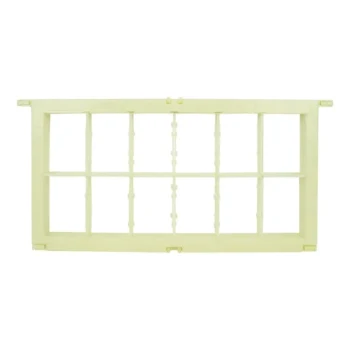
Standard-sized beehive frames serve as a critical control variable when analyzing the complex relationship between honeybees and parasitic mites. They provide a uniform brooding environment that is essential for isolating and studying specific biological traits, such as Suppressed Mite Reproduction (SMR). By ensuring consistent physical dimensions—typically 20x43cm—these frames allow researchers to maintain constant sampling volumes, enabling the precise calculation of mite infertility percentages without the noise of structural variance.
Standardization transforms a biological observation into a measurable data point. By fixing the physical dimensions of the brood area, you eliminate variables in the hive structure, ensuring that any fluctuations in mite populations are attributed to biological factors rather than environmental inconsistencies.
Establishing a Scientific Baseline
To accurately monitor Varroa mite reproductive dynamics, you must first control the environment in which they breed. Standard frames act as the constant in your equation.
Enabling Precise SMR Studies
The primary value of standard frames lies in their ability to facilitate the study of Suppressed Mite Reproduction (SMR) traits.
Because the frame structure is fixed, technicians can reliably locate and select worker bee larvae at specific developmental stages. This is most critical between 8 and 11 days after the cells are capped.
Consistent Sampling Volumes
Accurate data requires consistent sample sizes. Standardized dimensions ensure that a specific area of comb represents a reliable volume of brood cells.
This physical consistency allows for the accurate calculation of the percentage of infertile mites. Without this standardization, variations in comb thickness or cell density could skew infestation estimates.
Reducing Experimental Error
In comparative studies, the hardware must not influence the outcome. Standard frames serve as a benchmark to minimize error.
The Foundation as a Guide
Standard frames equipped with foundation guide worker bees to build neat, uniform honeycomb cells.
This structural uniformity is essential for the precise measurement of the capped brood area, which represents the colony's reproductive potential. It allows for the accurate counting of parasitic Varroa mites within individual cells, unhindered by irregular comb construction.
Comparability Across Colonies
To evaluate the effectiveness of a treatment or a breeding line, you must compare "apples to apples."
Standard frames ensure that data regarding capped brood area is comparable across different colonies and experimental groups. whether you are testing chemical treatments or breeding for resistance, the geometric baseline remains the same.
Facilitating Ongoing Monitoring
Beyond the mathematics of sampling, standardization supports the practical workflow of long-term monitoring.
Non-Destructive Inspection
Modular, standard frames allow beekeepers to extract, inspect, and replace individual combs without destroying the colony's nest structure.
This capability is vital for tracking mite dynamics over time. It allows for repeated sampling and direct observation of infestation levels, enabling timely interventions without causing significant stress to the hive.
Understanding the Trade-offs
While standardization provides a necessary framework for measurement, it is not without limitations that can affect data interpretation.
The "Old Comb" Variable
Standard frames allow for the reuse of combs to shorten honey production cycles, but this introduces a variable in mite monitoring.
Older combs can accumulate chemical residues or pathogen spores over time. When comparing mite dynamics between colonies, you must ensure that the age of the comb on the standard frames is roughly equivalent to avoid skewed results.
Maintenance of "Bee Space"
Standard frames rely on the precise control of "bee space" to function correctly.
If frames are not maintained or spaced correctly, bees will build "burr comb" or irregular bridges. This negates the benefits of standardization, making inspections difficult and altering the sampling volume, which can compromise the accuracy of mite counts.
Applying Standardization to Your Apiary Strategy
Standard frames are tools; their value depends on how you utilize them to meet your specific monitoring goals.
- If your primary focus is Breeding (SMR): Utilize standard frames to isolate larvae strictly 8-11 days post-capping to calculate mite infertility rates with high precision.
- If your primary focus is Treatment Evaluation: Use the standard frame dimensions to measure the total capped brood area before and after treatment to quantify the recovery of colony productivity.
- If your primary focus is General Management: Leverage the modularity of the frames to conduct regular, random sampling of brood cells to gauge colony strength and infestation levels.
Standardization is the prerequisite for objectivity; it clears the structural noise so you can hear the biological signal.
Summary Table:
| Feature | Impact on Varroa Monitoring | Key Benefit |
|---|---|---|
| Uniform Dimensions | Eliminates volume variance in brood area | Ensures consistent, repeatable sampling data |
| Standard Cell Size | Facilitates identification of larvae stages | Precise SMR (Suppressed Mite Reproduction) analysis |
| Modular Design | Allows non-destructive hive inspections | Enables long-term tracking without colony stress |
| Geometric Baseline | Provides 'apples to apples' comparison | Accurate evaluation of treatments across different colonies |
Elevate Your Apiary Management with HONESTBEE
Precision in beekeeping starts with high-quality, standardized equipment. At HONESTBEE, we specialize in supporting commercial apiaries and distributors with the robust tools needed to monitor hive health and maximize productivity.
Our value to your business includes:
- Comprehensive Wholesale Supply: From standardized frames and foundation to advanced honey-filling machinery.
- Precision Engineering: Hardware designed to maintain perfect 'bee space' and structural uniformity for scientific monitoring.
- Industry Expertise: We cater to the full spectrum of beekeeping needs, including specialized machinery and cultural merchandise.
Ready to scale your operations with equipment you can trust? Contact HONESTBEE today to explore our wholesale solutions!
References
- John R. Harbo, Jeffrey W. Harris. Resistance to <I>Varroa destructor</I> (Mesostigmata: Varroidae) When Mite-Resistant Queen Honey Bees (Hymenoptera: Apidae) Were Free-Mated with Unselected Drones. DOI: 10.1603/0022-0493-94.6.1319
This article is also based on technical information from HonestBee Knowledge Base .
Related Products
- Wooden Bee Hive Frames for Beekeeping and Wholesale
- HONESTBEE Wired and Assembled Wooden Bee Frames Foundation for a Thriving Hive
- Assembled Wooden Bee Frames with Plastic Foundation for Durability and Convenience by HONESTBEE
- Professional Galvanized Steel Frame Rest for Beehives
- Plastic Bee Frame Beekeeping Hive Frames for Wholesale
People Also Ask
- How do wooden and plastic hive frames compare in terms of durability? Wood vs. Plastic Longevity & Repairability
- How does balancing the number of frames impact hive productivity? Optimize Your Apiary's Biological Output
- What are the main considerations when choosing between wooden and plastic bee hive frames? Optimize Your Apiary's Efficiency
- How should beehive frames be maintained to prolong their lifespan? 5 Pro Tips for Durable Beekeeping Equipment
- What is the primary function of frames within a beehive system? Structural Foundation and Hive Management