
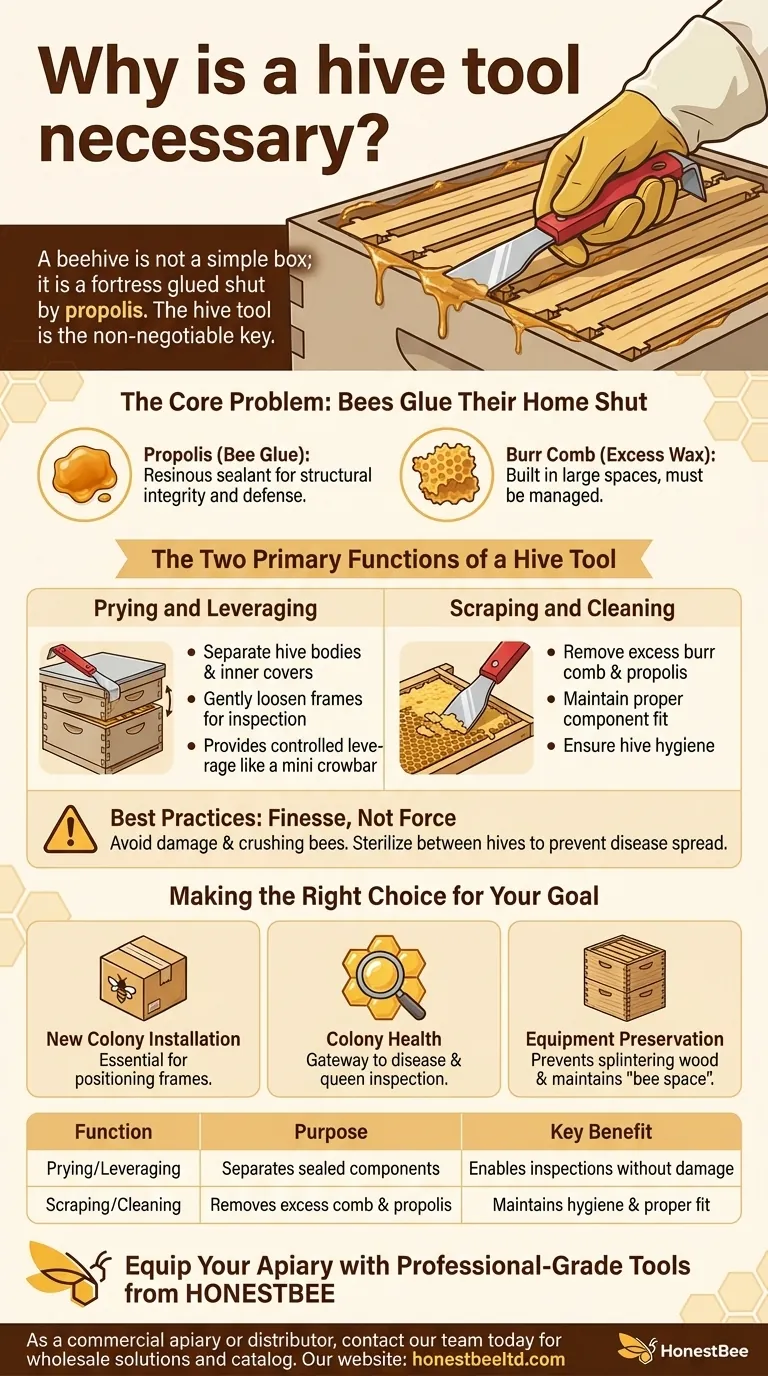
A hive tool is essential because honey bees seal every component of their hive together with a sticky, powerful resin called propolis. This natural "bee glue" makes it impossible to open the hive, separate boxes, or lift frames for inspection without a specialized tool designed for prying and scraping. It is arguably the single most indispensable piece of equipment for any beekeeper.
A beehive is not a simple box with loose parts; it is a fortress glued shut by its inhabitants. The hive tool is the non-negotiable key that grants the beekeeper access, allowing for essential inspection and maintenance without destroying the hive or harming the bees.

The Core Problem: Why Bees Glue Their Home Shut
To understand the hive tool, you must first understand the substances that make it necessary: propolis and burr comb.
What is Propolis?
Propolis is a resinous mixture that honey bees produce by combining tree resins with their own saliva and beeswax. They use this substance as a sealant for unwanted open spaces.
Functionally, propolis acts as the bees' superglue. It provides structural integrity, serves as a defense against predators, and even has antimicrobial properties that help maintain the colony's health.
The Beekeeper's Challenge
The bees' diligent sealing means that every part of a modern hive—from the main lid to the inner cover, the hive bodies (supers), and each individual frame—becomes glued together.
Without a tool, you cannot lift the cover, separate the boxes to check on honey stores or brood, or remove a single frame to inspect the queen's health.
The Two Primary Functions of a Hive Tool
While a hive tool has dozens of uses, they all fall into two primary categories: prying and scraping.
Prying and Leveraging
The main job of a hive tool is to carefully pry apart sealed components. Its design, like a miniature crowbar, provides the necessary leverage to do this with controlled force.
This is essential for separating stacked hive bodies, popping the inner cover free, and crucially, gently loosening the first frame in a box to begin a hive inspection.
Scraping and Cleaning
Bees also build excess wax, known as burr comb or brace comb, in any space they deem too large. This, along with propolis, must be managed.
The sharp, beveled edge of a hive tool is used to scrape away this excess comb and propolis from frames and hive boxes. This cleaning is critical for ensuring hive components fit together properly and for general hive hygiene.
Understanding the Trade-offs and Best Practices
While indispensable, a hive tool is a lever that must be used with care and skill. Improper use can cause more harm than good.
The Risk of Damage
The goal is finesse, not brute force. Aggressive prying can easily crack or damage the wooden hive boxes and frames.
More importantly, sudden movements can roll or crush bees between frames, including the queen. A calm, steady hand is essential to minimize disturbance and harm to the colony.
Maintaining Hive Hygiene
A hive tool comes into direct contact with the internal structures of the hive, including brood and honey.
If you are working with multiple colonies, it is critical to clean and sterilize your tool between hives. A dirty tool is a primary vector for spreading diseases like American Foulbrood from a sick colony to a healthy one.
Making the Right Choice for Your Goal
You cannot effectively manage a beehive by improvising with a screwdriver or putty knife. The hive tool is purpose-built for the unique challenges of the apiary.
- If your primary focus is installing a new colony: The hive tool is non-negotiable from day one for opening the bee package or nuc and positioning the frames.
- If your primary focus is colony health: The tool is your gateway to inspection, allowing you to lift frames to check for disease, pests like Varroa mites, and the queen's egg-laying pattern.
- If your primary focus is preserving your equipment: Using the correct tool for prying and scraping prevents you from splintering wood and damaging the precise "bee space" your hive components are designed to maintain.
Ultimately, the hive tool is the essential interface between the beekeeper and the complex, sealed world of the honey bee colony.
Summary Table:
| Function | Purpose | Key Benefit |
|---|---|---|
| Prying/Leveraging | Separates hive bodies, inner covers, and frames sealed with propolis. | Enables essential hive inspections without damage. |
| Scraping/Cleaning | Removes excess burr comb and propolis from frames and hive boxes. | Maintains hive hygiene and proper component fit. |
Equip Your Apiary with Professional-Grade Tools from HONESTBEE
As a commercial apiary or beekeeping equipment distributor, your efficiency and the health of your colonies depend on reliable, durable tools. HONESTBEE supplies the essential beekeeping supplies and equipment you need to operate at scale.
Let us help you streamline your operations with our wholesale-focused solutions. Contact our team today to discuss your equipment needs and request a wholesale catalog.
Visual Guide
Related Products
- HONESTBEE Professional Long Handled Hive Tool with Precision Cutting Blade
- Professional Multi-Function Stainless Steel Hive Tool
- HONESTBEE Premium Italian Style Hive Tool with Hardwood Handle
- Ergonomic Plastic Frame Spacer Tool for Rapid Hive Management Beekeeping
- Professional Grade Foldable Beehive Handles
People Also Ask
- Why are professional hive tools considered indispensable? Master Beekeeping Maintenance with Precision Leverage
- What is the role of professional hive tools in routine apiary maintenance? Expert Tips for Hive Health and Longevity
- What is a bee hive tool? Discover Why It’s the Most Essential Hand Tool for Every Beekeeper
- How do hive tools and queen rearing equipment facilitate the bee colony splitting process? Restore Your Apiary Faster
- Why are professional hive tools & observation equipment necessary for queen rearing evaluation? Master Your Quality


















