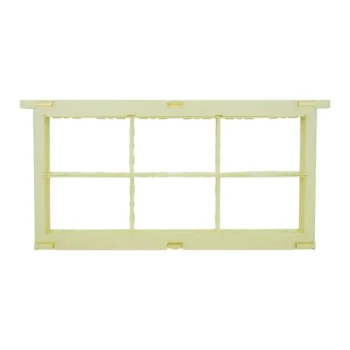
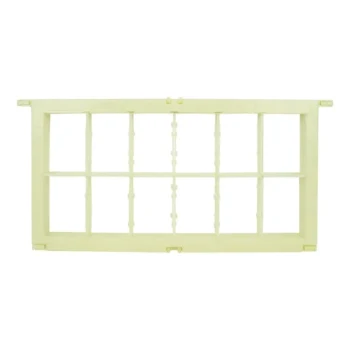
The use of a measuring frame with 5x5 cm grid lines is strictly driven by the need for a standardized, quantitative method to calculate colony population. By segmenting the brood area into 25 cm² sections, this tool leverages a known biological constant to convert surface area into specific cell counts without the need for manual counting.
The core utility of this frame rests on a fixed ratio: a single 5x5 cm grid square (25 cm²) contains approximately 100 sealed worker cells. This allows for a rapid, reproducible assessment of queen performance and hive strength.
The Mechanics of the Measurement
The Mathematics of Estimation
The primary function of the 5x5 cm grid is to simplify the complex geometry of a honeycomb into a manageable mathematical formula.
Because worker bee cells have a consistent size, a 25 cm² area serves as a reliable proxy for population density. Rather than counting thousands of individual cells, the observer counts the grid squares and multiplies by 100.
Quantifying Queen Vigor
This tool provides a direct metric for "egg-laying vigor," which is the rate and consistency at which a queen produces offspring.
By calculating the total area of sealed brood, beekeepers can objectively score the queen's output. This creates a tangible performance index that goes beyond subjective visual inspections.
The Value of Standardization
Ensuring Reproducibility
For data to be useful, it must be gathered consistently. The measuring frame ensures that measurements taken by different observers or at different times remain comparable.
This reproducibility is essential when tracking a colony's trajectory over a season. It removes the variability of human estimation, ensuring that a "strong" hive is defined by data, not opinion.
Comparing Hive Systems
The reference highlights the tool's critical role in evaluating different hive systems.
When testing new equipment or management techniques, the grid frame provides the high-precision quantitative data needed to determine which system yields better brood development.
Understanding the Limitations
Precision vs. Biological Variation
While described as a high-precision tool, it relies on an average.
The ratio of 100 cells per 25 cm² is a strong standard for sealed worker brood, but may slightly vary based on comb age or construction irregularities. It serves as a powerful statistical approximation rather than an absolute census.
Scope of Application
This specific grid size is calibrated for worker brood.
It is generally not applicable to drone brood, as drone cells are larger and would result in a lower cell count per square. The tool is specialized for assessing the workforce, not the reproductive drone population.
Making the Right Choice for Your Goal
To effectively use a measuring frame in your apiary management, consider your specific objectives:
- If your primary focus is genetic selection: Use the frame to calculate exact brood totals, allowing you to identify and breed from only the queens with the highest quantifiable egg-laying vigor.
- If your primary focus is hive management: Use the grid to spot-check colonies for sudden drops in sealed brood area, which acts as an early warning system for failing queens or disease.
By translating biological area into numerical data, the measuring frame turns the complex chaos of the hive into clear, actionable intelligence.
Summary Table:
| Metric | Value / Description |
|---|---|
| Grid Dimensions | 5 cm x 5 cm |
| Total Surface Area | 25 cm² per square |
| Cell Capacity | ~100 sealed worker cells per square |
| Primary Purpose | Quantifying queen egg-laying vigor & hive strength |
| Key Advantage | High-precision, reproducible data for population analysis |
Scaling Your Apiary with Data-Driven Insights
To manage a commercial apiary effectively, precision is paramount. At HONESTBEE, we understand that high-performance beekeeping requires both reliable data and robust equipment. Whether you are a large-scale distributor or a commercial beekeeper, we provide a comprehensive range of professional-grade tools—from specialized hive-making machinery to honey-filling equipment and essential consumables.
Our products are designed to enhance your operational efficiency and help you maintain the high standards required for modern honey production. Contact us today to explore our wholesale catalog and see how we can support your business growth!
References
- Tsvetan Tsvetanov, Ralitsa Balkanska. Queen bee egg-laying dynamics: evaluation of Roger-Delon and Warre hives. DOI: 10.61308/ayan9013
This article is also based on technical information from HonestBee Knowledge Base .
Related Products
- JZBZ Langstroth Queen Rearing Frame for Beekeeping
- Professional 500g Sectional Comb Honey Frame System for Beekeeping
- Ergonomic Plastic Frame Spacer Tool for Rapid Hive Management Beekeeping
- Professional Sectional Comb Honey Frame with 250g Cassette System for Beekeeping
- Professional Bee Frame Machine for Side Bar Shaping
People Also Ask
- Why use finishing colonies for queen cell capping? Secrets to Superior Queen Quality and Performance
- How do queen rearing frames and grafting needles function together? Master the Doolittle Method for High-Quality Queens
- What is the purpose of queen rearing frames? Master Controlled Queen Production for Your Apiary
- What are the functions of queen rearing frames and artificial queen cells? Master Bee Genetic Improvement
- What roles do professional queen rearing frames and artificial queen cells play? Scaling Your Queen Bee Production