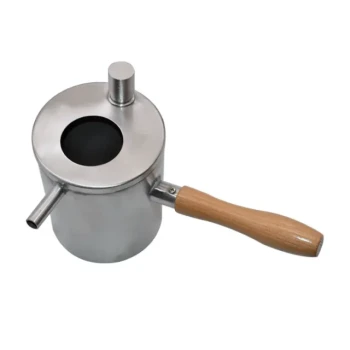
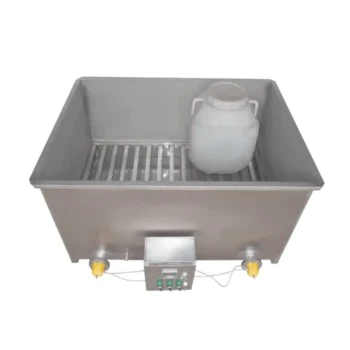
The primary function of a precision water bath set to 50°C is to fully dissolve sugar crystals in honey without compromising its chemical structure. By maintaining this temperature within a tight margin (±0.2°C), the equipment liquefies the sample to ensure it is perfectly homogeneous. This process prepares the honey for accurate refractive index measurement while preventing the thermal degradation that occurs at higher temperatures.
The Core Takeaway Honey is a heat-sensitive matrix that requires a delicate balance during processing. The 50°C setpoint is the specific "safe zone" that provides enough thermal energy to melt crystals and lower viscosity, yet remains low enough to preserve the sample's enzymatic and chemical integrity.
The Science of Sample Preparation
Achieving Complete Homogenization
Honey frequently exists in a crystallized state, which makes accurate analysis impossible. To obtain a representative sample, these sugar crystals must be completely dissolved back into a liquid phase. A constant temperature of 50°C is sufficient to break down these crystal structures efficiently.
Facilitating Refractive Index Measurement
The primary analytical reason for this specific temperature is to prepare for refractive index measurement. This test, which determines moisture content, requires a clear, liquid sample for light to pass through without scattering. If crystals remain, the reading will be erratic and incorrect.
Reducing Viscosity for Processing
Beyond analysis, heating to 50°C significantly lowers the viscosity of bulk honey. This increased fluidity is essential for mechanical processes, such as straining the honey through cloth filters. It allows for the removal of foreign matter and the destruction of yeast that could cause fermentation, all without scorching the product.
Why Precision is Non-Negotiable
Preventing Chemical Degradation
Honey is biologically active, containing enzymes and volatile compounds that are easily destroyed by heat. While 50°C is safe for short periods to dissolve crystals, temperatures exceeding this threshold can permanently damage these components. Precision equipment prevents accidental spikes in temperature that could ruin the sample's validity.
Avoiding Localized Overheating
Direct heating methods (like a hot plate) create "hot spots" that burn the honey unevenly. A water bath provides indirect, uniform heat transfer. This ensures the entire sample reaches 50°C simultaneously, preventing the darkening of color or the loss of enzyme activity associated with uneven heating.
Understanding the Trade-offs
The Risk of Thermal Damage
While 50°C is standard for dissolving crystals, it is near the upper limit for preserving "freshness" markers. Prolonged exposure at this temperature can eventually degrade heat-sensitive enzymes like diastase. Therefore, the processing time must be kept to the minimum necessary to achieve liquefaction.
Context-Specific Temperature Settings
It is critical to note that 50°C is not the universal temperature for all honey tests. For example, measuring diastase activity specifically requires a lower, stable environment of 40°C to simulate biological conditions. Using 50°C for such enzyme kinetics assays would yield inaccurate results regarding the honey's natural biological activity.
Making the Right Choice for Your Goal
To apply this correctly, align the temperature setting with your specific analytical objective:
- If your primary focus is Refractive Index or Moisture Analysis: Use 50°C to ensure all sugar crystals are fully dissolved for a clear optical reading.
- If your primary focus is Enzyme Analysis (e.g., Diastase): Lower the setting to 40°C, as 50°C will distort the reaction rate and degrade the enzymes you are trying to measure.
- If your primary focus is Straining and Sterilization: Use 45-50°C to lower viscosity for filtration and inhibit yeast without causing caramelization.
Precision at 50°C is the key to unlocking accurate physical measurements without sacrificing the chemical quality of the honey.
Summary Table:
| Process Requirement | Target Temp | Primary Objective | Key Benefit |
|---|---|---|---|
| Sample Preparation | 50°C | Dissolve sugar crystals | Ensures homogeneity for accurate testing |
| Moisture Analysis | 50°C | Refractive index clarity | Prevents light scattering for precise readings |
| Filtration/Straining | 45-50°C | Lower viscosity | Increases fluidity for efficient debris removal |
| Enzyme Analysis | 40°C | Preserve diastase activity | Maintains biological integrity of the sample |
| Precision Control | ±0.2°C | Prevent thermal spikes | Avoids darkening and chemical degradation |
Elevate Your Honey Quality with HONESTBEE Professional Solutions
Maintaining the delicate chemical balance of honey requires precision engineering. At HONESTBEE, we specialize in supporting commercial apiaries and distributors with high-performance beekeeping tools and industrial machinery. Whether you need precise water baths for lab analysis, honey-filling machines for production, or specialized hive-making equipment, our comprehensive wholesale offering ensures your operations remain efficient and your products remain premium.
Ready to scale your honey processing with industry-leading equipment?
References
- Md. Mostafa Kamal, Chuleui Jung. Physicochemical and microbiological characteristics of honey obtained through sugar feeding of bees. DOI: 10.1007/s13197-019-03714-9
This article is also based on technical information from HonestBee Knowledge Base .
Related Products
- Solar Beeswax Melter Easy Solar Wax Melter for Beeswax
- HONESTBEE AC Powered Wire Embedder with Alligator Clips
- Stainless Steel Heated Honey Tank Warming Heating Tank
- Honey Tank Heater Drum Heating Blanket for Honey Barrel
- Precision Honey Refractometer Instrument for Quality Assessment
People Also Ask
- How does a solar melter work to process beeswax? The Eco-Friendly Way to Pure Wax
- What is a solar wax melter and how does it work? Harness the Sun for Pure Beeswax
- What are the benefits of using a solar wax melter? Harness the Sun for Pure, Cost-Effective Beeswax
- What is the purpose of a solar wax melter in beekeeping? Sustainable Wax Processing for Modern Apiaries
- How does a solar-powered frame wax melter work? Harness the Sun for Sustainable Beekeeping