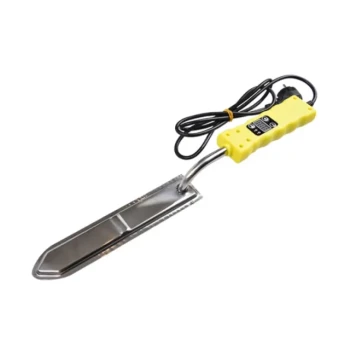
Precision temperature control is not optional; it is the single most critical variable in honey viscosity testing. Because honey is extremely sensitive to heat, an integrated temperature controller is required to regulate the measurement environment, typically within a range of 30°C to 95°C. This device ensures the sample reaches total thermal equilibrium, preventing the massive data skewing that results from even minor temperature fluctuations.
The viscosity of honey changes dramatically with slight temperature shifts. An integrated controller eliminates this variable, providing the stable environment necessary to build accurate Arrhenius models and ensure scientifically valid, repeatable comparisons across different batches.
The Science of Thermal Sensitivity
The Impact of Intermolecular Forces
Honey is a complex fluid where intermolecular forces define flow resistance. Even a fractional degree change in temperature can significantly alter these forces.
Without strict control, these fluctuations cause the viscosity to drift during the test. This results in measurement errors that render the data unusable for scientific analysis.
Achieving Thermal Equilibrium
Before a test can begin, the entire honey sample must be at a uniform temperature. An integrated controller manages the heating process to ensure the sample reaches thermal equilibrium.
If the sample is hotter on the edges than in the center, the viscometer will measure a gradient rather than the true viscosity. The controller stabilizes the sample to prevent this discrepancy.
Establishing Scientific Validity
Building Accurate Models
For advanced analysis, researchers rely on Arrhenius models and viscosity-temperature functional relationships. These mathematical models describe how a fluid behaves under different thermal conditions.
You cannot establish these relationships without high-precision thermal management. The integrated controller provides the stable data points required to calculate the activation energy of flow and other rheological properties.
Repeatability and Comparison
To compare the purity of honey from different geographic locations or batches, conditions must be identical. A liquid thermostat or integrated controller ensures the environment is consistent and repeatable.
This standardization allows you to confidently attribute differences in viscosity to the honey's composition, rather than environmental noise.
Understanding the Trade-offs
Equipment Complexity vs. Data Integrity
Using an integrated controller adds a layer of complexity and setup time compared to simple ambient testing. You must allow sufficient time for the equipment and sample to stabilize at the target temperature.
However, skipping this step for the sake of speed introduces uncontrolled variables. The "saved" time results in data that lacks the precision necessary for quality control or compliance.
The Limits of Regulation
While a controller regulates the environment (e.g., 30°C to 95°C), it cannot compensate for improper sample loading or air bubbles.
Operators must remember that temperature control is a prerequisite for accuracy, not a cure-all for poor operational technique.
Ensuring Data Integrity in Your Lab
To ensure your viscosity measurements are reliable, match your approach to your specific analytical goals:
- If your primary focus is Research and Modeling: Ensure your controller can hold steady at multiple set points to build accurate Arrhenius plots and viscosity-temperature curves.
- If your primary focus is Quality Control: Prioritize a system that reaches and maintains thermal equilibrium quickly to allow for efficient, valid comparisons between batches.
Ultimately, an integrated temperature controller transforms viscosity testing from a rough estimation into a precise, scientifically defensible metric.
Summary Table:
| Feature | Importance in Viscosity Testing | Impact on Honey Quality Control |
|---|---|---|
| Thermal Equilibrium | Ensures uniform temperature throughout the sample. | Eliminates measurement gradients for true viscosity readings. |
| Arrhenius Modeling | Provides stable data points for mathematical flow models. | Enables precise calculation of activation energy and rheology. |
| Consistency | Standardizes the testing environment (30°C to 95°C). | Allows for accurate batch-to-batch and geographic comparisons. |
| Data Integrity | Removes temperature as an uncontrolled variable. | Transforms rough estimations into scientifically defensible metrics. |
Elevate Your Honey Processing Precision with HONESTBEE
At HONESTBEE, we understand that maintaining data integrity is vital for commercial apiaries and distributors. Whether you are scaling production with our honey-filling machines or seeking high-quality beekeeping tools and machinery, we provide the professional-grade equipment needed to ensure your products meet the highest industry standards.
From specialized hardware to essential consumables, our comprehensive wholesale offerings are designed to help you build a more efficient and scientifically rigorous operation.
Ready to optimize your honey production and quality control?
Contact our expert team today to discuss your equipment needs!
References
- Afonso Maria João, Elsa Ramalhosa. Temperature Effect on Rheological Behavior of Portuguese Honeys. DOI: 10.1515/pjfns-2017-0030
This article is also based on technical information from HonestBee Knowledge Base .
Related Products
- Precision Honey Refractometer Instrument for Quality Assessment
- Professional Electric Honey Uncapping Knife with Heated Digital Temperature Control for Beekeeping
- Digital Honey Refractometer for Precision Measurement of Optimal Honey Quality
- Electric Hot Honey Uncapping Knife with Thermostat
People Also Ask
- How do professional scientific instruments contribute to honey quality testing? Ensure Purity and Market Compliance
- What are the key steps to using a honey refractometer? Ensure Honey Quality & Prevent Fermentation
- What are the two main types of honey refractometers? Comparing Manual vs. Digital for Quality Control
- What should be considered when choosing a refractometer for honey? 5 Key Factors for Precision Quality Control
- What criteria should be considered when choosing a honey refractometer? Expert Tips for Precise Moisture Control