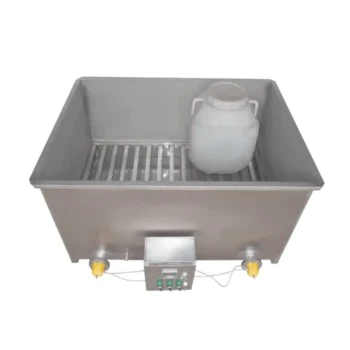
Precise temperature control is the technical foundation of accurate honey analysis. Constant temperature heating equipment, such as a water bath, is necessary because it reduces honey viscosity to release pollen grains from the sugar matrix while ensuring the thermal stability required to protect the pollen’s physical structure and the honey's chemical integrity.
Core Takeaway: Constant temperature heating equipment facilitates the rapid, uniform dissolution of honey samples, allowing for efficient pollen extraction and centrifugal separation without compromising the morphological markers or enzymatic quality required for international regulatory compliance.
Optimizing Sample Dissolution and Pollen Release
Lowering Viscosity for Efficient Processing
Honey is naturally a highly viscous substance that resists rapid mixing at room temperature. Heating equipment provides a stable environment, typically around 40°C, to reduce this viscosity and accelerate the dissolution of the sample into a mixture of distilled water and alcohol.
Releasing Pollen from the Sugar Matrix
Pollen grains are often trapped within a complex matrix of sugars and crystals. Gentle, uniform heat breaks down these structures, facilitating the complete release of pollen grains for subsequent centrifugal separation and microscopic identification.
Improving Centrifugal Efficiency
Once the viscosity is reduced, the separation of solid particles from the liquid phase becomes significantly more efficient. This ensures that the resulting sediment is concentrated and representative of the entire batch, which is critical for geographic and botanical authentication.
Preserving Morphological and Chemical Integrity
Protecting Delicate Pollen Morphology
The identification of honey origin relies on the visual characteristics of pollen grains. Precise temperature control prevents morphological distortion that can occur with localized overheating, ensuring the grains remain identifiable under a microscope.
Preventing Heat-Induced Chemical Changes
Honey is extremely sensitive to heat, and excessive temperatures can lead to the formation of Hydroxymethylfurfural (HMF). Using a precision water bath ensures the sample stays below the critical thresholds that would otherwise indicate "aging" or poor handling, preserving the sample's authenticity.
Maintaining Enzymatic Activity
Enzymes like diastase and invertase are heat-labile and begin to degrade significantly if temperatures fluctuate between 50°C and 75°C. High-precision heating equipment provides a uniform thermal field that protects these bioactive components during the preparation process.
Understanding the Trade-offs and Pitfalls
The Risk of Localized Overheating
Using non-specialized heating elements often creates "hot spots" where the honey in contact with the container wall exceeds safe limits. This can cause irreversible thermal damage to a portion of the sample, leading to inaccurate biochemical indicator measurements.
Balancing Dissolution Speed and Sample Safety
While higher temperatures (up to 60°C) can dissolve sugar crystals faster, they increase the risk of degrading heat-sensitive antioxidants. Professional labs must balance the need for rapid throughput with the necessity of maintaining the honey’s biological value.
Accuracy of Sensor Calibration
Low-quality heating equipment may have significant deviations between the displayed and actual temperature. In a B2B context, even a 5-degree variance can be the difference between a sample passing or failing international codex standards for HMF levels.
How to Apply This to Your Quality Assurance Strategy
The selection of heating equipment is a direct reflection of a laboratory's commitment to precision and professional expertise. For distributors and wholesalers, ensuring that testing facilities utilize high-precision equipment is vital for maintaining supply chain reliability.
- If your primary focus is regulatory compliance: Prioritize water baths with digital PID control to ensure HMF levels remain well below the 40 mg/kg international limit.
- If your primary focus is botanical authentication: Use equipment that maintains a strict 40°C threshold to preserve the fragile morphology of pollen grains for accurate microscopy.
- If your primary focus is operational efficiency: Invest in high-capacity, multi-well constant temperature baths to allow for the simultaneous processing of multiple batches with uniform heat distribution.
Utilizing professional-grade constant temperature equipment is the only way to guarantee the integrity of honey analysis and protect the commercial value of your product portfolio.
Summary Table:
| Key Factor | Technical Purpose | Impact on Analysis |
|---|---|---|
| Viscosity Reduction | Accelerates dissolution at ~40°C | Faster, uniform pollen release and mixing |
| Thermal Stability | Prevents localized "hot spots" | Protects delicate pollen morphology for identification |
| Chemical Preservation | Keeps temp below HMF formation limits | Ensures sample authenticity and enzyme activity |
| Centrifugal Efficiency | Optimizes solid-liquid separation | Produces a representative sediment for microscopy |
Optimize Your Honey Quality Control with HONESTBEE
Partner with HONESTBEE to elevate your honey processing and testing standards. We cater specifically to commercial apiaries and distributors, providing a comprehensive, one-stop sourcing experience for the entire beekeeping industry. From high-precision laboratory tools and honey-filling machinery to specialized hive-making equipment and essential consumables, our full-spectrum portfolio is designed to maximize your profit margins and supply reliability.
Why choose HONESTBEE?
- Deep Industry Expertise: Professional-grade equipment that meets international regulatory standards.
- Efficient Order Fulfillment: Rapid response times and ultra-fast delivery to keep your operations running.
- Premium Trading Services: Dedicated B2B support, including OEM/ODM capabilities for global wholesalers.
Ensure the integrity of your honey portfolio with the right technical foundation. Contact our expert team today to explore our wholesale offerings!
References
- Alinne Costa Cavalcante Rezende, Otilene dos Anjos Santos. Pollen of honey from <i>Melipona seminigra merrillae</i> Cockerell, 1919, <i>Scaptotrigona nigrohirta</i> Moure, 1968 and <i>Scaptotrigona</i> sp. Moure, 1942 (Apidae: Meliponini) reared in Sataré Mawé indigenous communities, Amazon, Brazil. DOI: 10.1080/01916122.2018.1458664
This article is also based on technical information from HonestBee Knowledge Base .
Related Products
- Stainless Steel Heated Honey Tank Warming Heating Tank
- Professional Thermostatic Conical Honey Melter
- Honey Tank Heater Drum Heating Blanket for Honey Barrel
- Honey Concentrating Vacuum Heating Thickening Machine Dehumidifier for Honey
- 0.5T Capacity Honey Dehumidifier Dryer with Vacuum Heating and Thickening Filtering Machine
People Also Ask
- What are the benefits of precise temperature control in honey heating tanks? Preserve Quality and Efficiency
- How do honey heating tanks offer scalability for growing beekeeping operations? Strategic Equipment Growth Solutions
- What features of a honey heating tank contribute to hygiene? Ensure Purity with Stainless Steel & Sanitary Design
- What is the primary role of a honey heating tank? Enhance Your Honey Processing Flow and Quality
- What is the purpose of using heating tanks or constant temperature water baths in honey dehydration? Optimize Purity & Flow