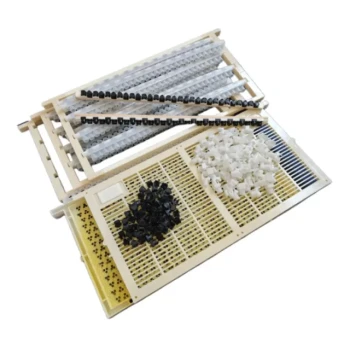
In vitro queen rearing equipment acts as a biological accelerator, fundamentally altering the scalability of stingless bee apiaries. While natural colonies suffer from extremely slow reproductive rates—typically dividing only once every one to two years—this technology simulates the natural nest environment to facilitate mass artificial cultivation, effectively removing the primary bottleneck to commercial expansion.
The natural reproductive cycle of stingless bees is too slow for industrial scaling. In vitro queen rearing shifts the paradigm from passive observation to active production, enabling rapid colony multiplication and targeted genetic improvement.
Overcoming the Biological Bottleneck
The Limitation of Natural Cycles
The primary barrier to scaling an apiary is the biology of the bee itself. Under natural conditions, a stingless bee colony divides rarely, often taking one to two years to generate a single new split.
Reliability on this natural pace makes rapid expansion impossible. An apiary relying solely on natural division creates a linear, slow-growth curve that cannot support commercial demands.
Simulating the Nest Environment
In vitro equipment solves this by artificially replicating the conditions found inside a healthy hive. By simulating the natural nest environment, the technology tricks the biological inputs required for queen development.
This allows the apiarist to cultivate queens on demand rather than waiting for the colony to decide it is time to reproduce.
Strategic Advantages of Artificial Rearing
Mass Artificial Cultivation
The core value of this technology is volume. It enables mass artificial cultivation, allowing a single operation to produce exponentially more queens than natural splitting would permit.
This breaks the dependency on existing colony maturity. You no longer need a fully mature colony to naturally swarm or split to gain a new queen; you can produce the queen independently.
Genetic Improvement
Scaling is not just about quantity; it is about quality. In vitro rearing allows for genetic improvement of the stock.
By controlling the rearing process, apiarists can select for specific traits. This ensures that the scaled apiary is not only larger but also genetically superior to the founder colonies.
Essential Context: The Role of Infrastructure
The Necessity of Supporting Tools
While in vitro equipment produces the queens, it does not create the colony structure. To successfully scale, you must pair queen rearing with professional colony splitting tools.
As noted in supplementary operational standards, precise segmentation of the hive is required to house these new queens.
Ensuring Colony Establishment
Producing a queen is futile if the new colony collapses. Standardized artificial hives and entrance designs are critical to encourage the colony to establish a defense system quickly.
Proper tooling reduces worker bee loss and prevents injury to the new queen during introduction. The technology of queen rearing must be supported by the hardware of hive management to ensure steady expansion.
Making the Right Choice for Your Goal
To effectively scale your stingless bee operation, consider your immediate objectives:
- If your primary focus is rapid expansion: Invest heavily in in vitro equipment to bypass the 1-2 year natural reproductive delay and maximize colony multiplication.
- If your primary focus is colony stability: Ensure your queen rearing output is matched by standardized hives and splitting tools to minimize worker loss during the transition.
Success in scaling stingless bees requires decoupling queen production from natural colony cycles.
Summary Table:
| Feature | Natural Reproductive Cycle | In Vitro Queen Rearing |
|---|---|---|
| Reproduction Rate | Slow (once every 1-2 years) | High (on-demand production) |
| Scalability | Linear and passive growth | Exponential and active growth |
| Environmental Control | Dependent on hive conditions | Precise simulation of nest environment |
| Genetic Management | Random/Natural selection | Targeted genetic improvement |
| Success Drivers | Colony maturity | Professional equipment and methodology |
Scale Your Commercial Apiary with HONESTBEE
Transition from passive observation to high-volume production with HONESTBEE. As a premier partner for commercial apiaries and distributors, we provide the full spectrum of professional beekeeping tools and machinery required to industrialize your operations.
By choosing HONESTBEE, you gain access to:
- Advanced In Vitro Equipment: Overcome biological bottlenecks and accelerate colony multiplication.
- Precision Machinery: From hive-making to honey-filling machines, we automate your workflow.
- Wholesale Consumables: A comprehensive array of essential hardware and cultural merchandise to support your brand.
Ready to transform your stingless bee operation into a genetically superior, high-output enterprise? Contact us today to explore our wholesale solutions!
References
- Hanilyn A. Hidalgo, Presbel B. Presto. The Development of Indicators for Social Enterprise Business Model in Melitourism. DOI: 10.56527/jabm.9.1.6
This article is also based on technical information from HonestBee Knowledge Base .
Related Products
- Retractable Chinese Queen Rearing Grafting Tools Equipment
- No Grafting Queen Rearing Kit: System for Royal Jelly Production and Queen Rearing
- Nicot Queen Rearing Kit for Beekeeping and Grafting in Nicot System
- Stainless Steel Queen Grafting Tool for Beekeeping and Bee Queen Grafting
- Premium Nicot Style Queen Rearing Kit with Hair Roller Bee Cages
People Also Ask
- Which specialized tools are necessary for implementing standardized queen rearing? Scale Your High-Yield Apiary
- Why are specialized queen rearing tools necessary to mitigate winter hive losses? Boost Apiary Survival and Recovery
- How do queen-rearing tools facilitate the sustainability and expansion of a commercial apiary? Drive Scalable Growth
- In what ways do modern queen rearing equipment and grafting tools improve competitiveness? Boost Breeding Success Rate
- What role do specialized queen rearing tools and consumables play in modern large-scale apiculture? Drive Production & Scale