The fundamental difficulty lies in a severe mismatch of scale.
Removing pollen from honey using standard straining equipment is physically impossible because the average pollen grain is approximately 25 microns wide, whereas the finest standard honey filters have openings of 200 microns or larger. Because the microscopic pollen is roughly eight times smaller than the mesh openings, it passes effortlessly through the filter along with the liquid honey, leaving the pollen content virtually unchanged.
Core Insight: Standard filtration relies on mechanical screening, but pollen acts as a microscopic suspended solid rather than visible debris. Because pollen grains are significantly smaller than the mesh of hobbyist equipment, true removal requires centrifugal phase separation, not simple straining.
The Physics of Filtration Failure
To understand why your equipment is failing to remove pollen, you must look at the microscopic geometry of the particles involved.
The Micron Gap
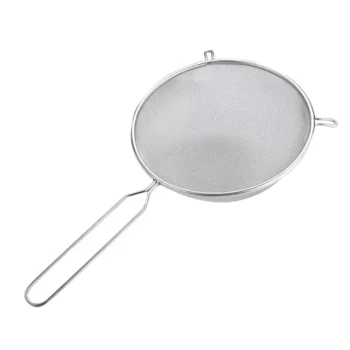
Standard honey straining equipment is designed to remove macroscopic debris like wax cappings and bee parts. These filters typically have a mesh size of 200 microns or larger. In contrast, the target you are trying to remove—the pollen grain—averages only 25 microns in width.
The "Open Door" Effect
This size discrepancy creates a "path of least resistance." Just as a pebble falls through a chain-link fence, pollen grains flow freely through the filter mesh. The honey carries the pollen in suspension, and the filter offers no physical barrier to stop it.
Why Gravity Straining Is Insufficient
Standard equipment typically relies on gravity to pull honey through a mesh. This method is fundamentally unsuited for pollen extraction.
Suspension in Liquid Matrix
Pollen grains are suspended within the viscous "liquid matrix" of the honey. Because their specific gravity allows them to remain suspended, gravity alone cannot pull them out of the solution or force them to settle against the flow of the honey.
The Need for Extreme Force
Separating these microscopic particles requires force far exceeding gravity. To effectively separate pollen from the sugar matrix, you generally need a high-speed centrifuge. This equipment must spin the honey at speeds between 2500 and 3500 rpm for upwards of 45 minutes to successfully settle the pollen into a pellet.
Understanding the Trade-offs
While it may seem desirable to filter honey to a crystal-clear state, attempting to remove pollen comes with significant technical and quality trade-offs.
Equipment Complexity vs. Accessibility
Standard straining allows for simple, low-tech processing suitable for hobbyists and small-scale operations. Achieving pollen-free honey requires industrial-grade centrifugation equipment capable of phase separation. This level of processing is generally inaccessible and impractical for standard production.
"Raw" Definition vs. Ultra-Filtration
Pollen is often considered a hallmark of "raw" honey. By employing the high-speed centrifugation necessary to remove it, you are technically stripping the honey of one of its natural components. While this is necessary for specific scientific applications like microscopic examination or palynology, it is often viewed as a negative in culinary contexts where pollen is a value-add.
Making the Right Choice for Your Goal
Whether you should attempt to remove pollen depends entirely on your end goal for the honey.
- If your primary focus is producing "Raw" honey: Stick to standard straining (200+ microns); retaining the pollen validates the honey's natural state and is expected by consumers.
- If your primary focus is scientific analysis: You must abandon straining and utilize a high-speed centrifuge (approx. 3500 rpm) to concentrate the pollen for microscopic observation.
- If your primary focus is aesthetic clarity: Accept that standard equipment cannot achieve this without stripping the honey of its character; you are limited by the physical mesh size of your tools.
True clarity in honey processing comes from matching your equipment to the microscopic reality of your product.
Summary Table:
| Parameter | Standard Straining | High-Speed Centrifugation |
|---|---|---|
| Mesh/Opening Size | 200 - 600 Microns | N/A (Phase Separation) |
| Pollen Removal | Virtually None | High Efficiency |
| Typical Use Case | Commercial Raw Honey | Scientific Analysis / Ultra-Pure |
| Equipment Scale | Manual / Gravity Fed | Industrial Machinery (2500-3500 RPM) |
| Impact on Quality | Retains Natural Components | Strips Pollen & Suspended Solids |
Elevate Your Honey Processing Efficiency with HONESTBEE
At HONESTBEE, we understand the technical challenges faced by commercial apiaries and distributors. Whether you are aiming for the perfect raw honey consistency or need high-precision equipment for large-scale production, we provide the tools to get you there.
Our comprehensive wholesale range includes everything from industrial-grade honey-filling machines and specialized hive-making hardware to a full spectrum of beekeeping tools and essential consumables. We help you scale your operations without compromising the quality your customers expect.
Ready to optimize your honey production line? Contact our expert team today to explore our wholesale solutions
Related Products
- electric honey extractor honey centrifuge 3 frame honey extractor stainless steel honey frame extractor
- Manual Hand Crank 4 Frame Honey Extractor Centrifuge for Beekeeping
- Honey Concentrating and Filtering Dehumidifier Machine 2T Capacity for Honey
- Electric Double Wall Honey Filtering Machine Purifier Equipment for Honey Processing Plant
- Professional Stainless Steel Honey Filter with Support Handle
People Also Ask
- What are the characteristics of electric honey extractors? Boost Your Apiary Efficiency with Automated Technology
- What are the disadvantages of using an electric honey extractor? Weighing Cost, Power, and Comb Safety
- What are the advantages of an electric honey extractor? Boost Efficiency and Scale Your Honey Production
- What are the technical advantages of electric honey extractors? Maximize Yield and Protect Your Bee Colony
- How does an electric honey extractor affect the quality of honey? Preserve Flavor & Purity with Precision Extraction