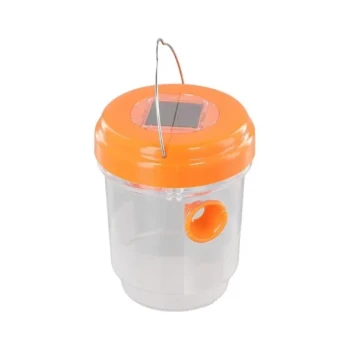
Effective hornet trapping relies on chemical signaling. Fermented sugar solutions or honey are necessary because they release volatile odors that mimic natural food sources. Without these specific attractants, there is no mechanism to draw hornet queens and workers from the wider environment into the capture point.
The success of a trap is defined by its lure. Fermented solutions provide the essential olfactory cues that trick hornets into entering a confined space, allowing for efficient pest control around the apiary.
The Science of the Lure
To understand why these solutions are non-negotiable, you must understand how hornets locate resources.
Creating Volatile Odors
A trap is physically static; it cannot chase the pest. Therefore, it must project its presence outwards.
Fermented sugar and honey solutions release volatile odors. These are chemical compounds that evaporate easily at normal temperatures, traveling through the air to create a scent plume.
Mimicking Natural Food Sources
Hornets are biologically driven to seek out specific carbohydrate-rich foods.
By using honey or fermented sugar, you are effectively mimicking natural food sources. This exploits the hornet's foraging instinct, compelling them to investigate the trap rather than ignoring it as an inanimate object.
Operational Efficiency
The use of these attractants is not just about catching a single insect; it is about managing the pest population at scale.
Concentrating the Predator
The primary goal of the attractant is to draw predators from the surrounding environment into a localized capture point.
Instead of hunting hornets individually across a wide area, the scent concentrates them in one spot. This significantly increases the efficiency of your pest control measures.
Targeting the Colony Hierarchy
Effective traps do not just catch foraging workers; they must also entice the leaders.
The reference highlights that these volatile odors effectively attract hornet queens as well as workers. Capturing queens is essential for disrupting the reproductive cycle and preventing the establishment of new colonies.
Critical Considerations
While these attractants are necessary, understanding their limitations is key to using them correctly.
The Necessity of Fermentation
Simple sugar water often lacks the "punch" required for long-distance attraction.
The fermentation process is critical because it enhances the volatility of the solution. This increases the range of the scent plume, drawing hornets from further away than non-fermented bait could.
Reliance on Olfaction
Traps without these specific chemical cues are functionally invisible to hornets.
Visual cues are secondary to hornets when foraging. If your solution loses its volatility (dries out or stops fermenting), the trap will cease to function regardless of its placement.
Making the Right Choice for Your Apiary
To maximize the effectiveness of your traps, align your bait strategy with your specific control goals.
- If your primary focus is range: Ensure your solution is actively fermenting to maximize the release of volatile odors that travel long distances.
- If your primary focus is colony disruption: Deploy these attractants early in the season to target queens before they establish strong nests.
- If your primary focus is efficiency: Rely on these attractants to concentrate predators in specific zones, reducing the need to patrol the entire apiary perimeter.
By utilizing the chemical volatility of fermented sugars, you transform a passive container into an active defense system.
Summary Table:
| Attractant Feature | Function | Impact on Pest Control |
|---|---|---|
| Volatile Odors | Mimics natural food sources via scent plumes | Draws hornets from long distances |
| Fermentation | Increases chemical volatility and 'punch' | Extends the effective range of the trap |
| Targeted Lure | Exploits biological foraging instincts | Captures both workers and reproductive queens |
| Concentrated Capture | Creates a localized point of attraction | Reduces the need for manual perimeter patrols |
Protect Your Commercial Apiary with HONESTBEE
Don't let hornet infestations compromise your productivity. HONESTBEE specializes in supporting commercial apiaries and distributors with high-performance beekeeping tools and industrial-grade machinery. From specialized honey-filling machines to professional-grade pest management consumables, we provide the comprehensive wholesale solutions you need to scale your operations.
Our Value to You:
- Full Spectrum Supply: A one-stop shop for everything from hive-making hardware to honey-themed merchandise.
- Industry Expertise: Reliable equipment designed to withstand the demands of professional beekeeping.
- Wholesale Efficiency: Tailored solutions for distributors looking to stock quality bee-related products.
Ready to enhance your apiary's efficiency and defense? Contact HONESTBEE today to discuss our wholesale offerings and professional equipment range.
References
- Mohamed S. Younis. New technique for protecting honey bee colonies from oriental wasp (Vespa orientalisL.) attacks at Dokki region, Giza, Egypt.. DOI: 10.21608/assjm.2016.104128
This article is also based on technical information from HonestBee Knowledge Base .
Related Products
- Compact Multi-Funnel Hanging Wasp Trap
- Reusable Aluminium Beetle Trap for Small Hive Beetles Silver Bullet
- Removable Washable Hive Beetle Trap Attractants for Small Hive Beetles
- HONESTBEE Professional Telescopic Pole Bee Swarm Catcher
- HONESTBEE Collapsible Tiered Bee Swarm Catcher for Beekeeping
People Also Ask
- What are the practical advantages of using professional wasp traps and protective equipment in apiary management? Scale Up
- Why replace sugar syrup bait in wasp traps every three days? Ensure Maximum Attraction and Catch Rates
- What is the importance of deploying hornet traps around an apiary for maintaining colony stability? Protect Your Yields.
- What are the advantages of placing hornet traps on the tops of beehives? Maximize Hive Defense Against Predators
- What is the technical purpose of placing expanded clay balls in a hornet trap? Optimize Your Apiary Monitoring