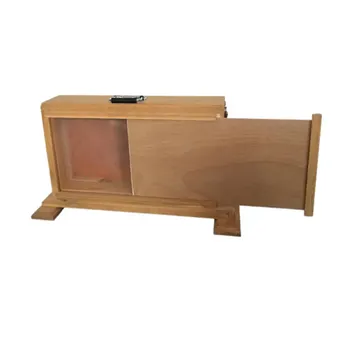
Commercial beekeepers should move from primitive hives to modern wooden Langstroth hives because movable frames make colony management, non-destructive harvesting, sanitation, and large-scale production possible. Traditional log, mud, bamboo, bark, and fixed-comb hives often limit inspections and require damaging the comb or brood nest during harvest, with reported yields commonly ranging from about 3 to 7 kg per hive annually. Langstroth hives can support substantially higher output, reaching up to 45 to 90 kg per hive in suitable conditions, although actual results depend on forage availability, colony strength, climate, and management.
The essential shift is from a fixed container to a standardized management system. Langstroth hives provide the movable frames and bee-space design needed for efficient commercial beekeeping, while precision hive-making machinery provides the dimensional accuracy, uniformity, and production capacity needed to deploy that system at scale.
Why Primitive Hives Limit Commercial Growth
Fixed Combs Restrict Colony Inspection
Primitive hives usually contain fixed combs that cannot be removed and examined individually. This makes it difficult to assess brood development, queen performance, food stores, pest pressure, and colony strength without seriously disturbing the nest.
Modern Langstroth frames can be removed, inspected, rearranged, and returned to the hive. Beekeepers gain direct visibility into colony conditions and can make management decisions before problems reduce productivity.
Harvesting Can Damage the Colony
Harvesting from hollow logs, earthen cavities, baskets, or other fixed-comb structures often requires breaking or destroying the honeycomb. The brood nest may be disturbed, and bees must rebuild comb before the colony can resume efficient honey production.
Movable-frame hives allow surplus honey to be removed while preserving the brood nest and reusable honeycomb. This supports repeated harvesting and reduces the disruption associated with traditional methods.
Low Output and Inconsistent Quality
Primitive hives commonly produce relatively low quantities of honey, often around 3 to 7 kg per hive per year. Their limited ventilation, difficult inspection, and inconsistent internal dimensions also create sanitation and management challenges.
Standardized Langstroth equipment creates better conditions for organized colony management, honey extraction, and hive maintenance. Under strong forage and suitable environmental conditions, production can be many times higher than in primitive systems.
What Langstroth Hives Enable
Movable Frames Improve Management
The central advantage of the Langstroth hive is its movable-frame architecture. Frames can be inspected for brood, rotated or repositioned, transferred between colonies, and used to support activities such as colony splitting and pollination management.
This flexibility turns beekeeping into a controllable production process rather than a harvest operation based mainly on external observation.
Bee Space Protects Hive Function
Langstroth hives are designed around the principle of bee space, the natural gap bees maintain between comb surfaces and hive components. When this space is standardized, frames can be removed without being permanently attached to the surrounding structure.
Correct bee space also supports frame interchangeability and prevents excessive propolis or comb attachment from slowing routine work.
Reusable Comb Reduces Colony Labor
When honeycomb remains intact, bees do not need to spend as much energy secreting wax and rebuilding it after every harvest. Reusing drawn comb allows colonies to allocate more effort toward brood rearing, foraging, and honey storage.
This improves the productive efficiency of each colony and supports more predictable commercial output.
Broader Bee Products Become Practical
Movable-frame systems create the hardware foundation for more than honey production. Better inspection and colony control support the production of beeswax, royal jelly, pollen, and propolis, as well as managed colony multiplication and pollination services.
These additional activities are difficult to organize consistently when colonies are housed in non-standardized, fixed-comb containers.
The Role of Hive-Making Machinery
Precision Manufacturing Creates Interchangeable Parts
Commercial beekeeping depends on components fitting together reliably. Hive-making machinery performs accurate cutting, shaping, and assembly so that boxes, frames, top bars, covers, and other wooden parts maintain consistent dimensions.
This precision enables frames and hive bodies to be interchanged across an apiary. A damaged component can be replaced without rebuilding an entire hive or adapting parts by hand.
Standardization Supports High-Density Apiaries
Uniform wooden boxes can be stacked, transported, inspected, and maintained using repeatable procedures. Standard dimensions are particularly important when an operation manages many colonies and must move equipment between apiaries or forage locations.
For distributors and wholesalers, standardized production also simplifies product specification, inventory planning, quality control, and customer support.
Mechanization Improves Production Capacity
Manual hive construction can be slow and produce variation between batches. Specialized machinery allows manufacturers to process larger volumes while maintaining consistent dimensions and assembly quality.
This helps equipment suppliers respond more quickly to commercial orders and provide a complete range of compatible hive components rather than isolated, inconsistent products.
Durable Construction Supports Long-Term Use
Precision-built wooden hives can be manufactured for greater structural consistency and durability under demanding environmental conditions. This matters for apiaries exposed to heat, transport, repeated handling, and regional climates such as Mediterranean conditions.
Longer-lasting equipment can reduce replacement frequency and help commercial operators maintain a stable inventory of usable hive bodies and frames.
Better Hardware Reduces Hive Disturbance
Accurate frames and well-fitting boxes make inspections, manipulation, and harvesting more efficient. Beekeepers can complete routine work with fewer adjustments and less unnecessary disruption to the colony.
For large apiaries, small improvements in handling efficiency become significant when multiplied across hundreds or thousands of hives.
Understanding the Trade-offs
Higher Initial Investment
Langstroth hives and machine-produced components require greater upfront investment than simple local containers. The transition may involve purchasing hive bodies, frames, supers, covers, tools, transport equipment, and extraction infrastructure.
The business case therefore depends on more than the price of one hive. Operators should evaluate expected productivity, labor savings, equipment lifespan, replacement parts, and the value of improved honey quality and additional bee products.
Management Skills Are Essential
Modern hives do not automatically produce high yields. Their advantages depend on proper inspection, disease control, frame manipulation, ventilation, seasonal management, and timely harvesting.
Beekeepers transitioning from primitive systems may need training in movable-frame handling and commercial colony management to realize the equipment's full value.
Yield Claims Depend on Conditions
Reported yields of 45 to 90 kg per hive represent potential performance under favorable conditions, not a universal guarantee. Local forage, weather, colony genetics, pests, disease, nutrition, and management quality can produce very different results.
Suppliers should present productivity as a management and environmental outcome rather than promising a fixed return from the hive alone.
Standardization Must Match the Market
A machinery investment is most useful when the manufacturer produces components that match the dimensions and standards used by its target customers. Incompatible frames, boxes, or top bars can eliminate the operational benefits of interchangeability.
Distributors should confirm product specifications, replacement-part availability, assembly quality, and after-sales technical support before committing to a supply program.
Making the Right Choice for Your Goal
Modern Langstroth equipment and precision manufacturing should be evaluated as one connected commercial system.
- If your primary focus is higher honey output: Use movable-frame Langstroth hives and strengthen inspection, disease-control, forage, and harvesting practices rather than relying on hive design alone.
- If your primary focus is colony health: Choose removable, reusable frames that allow thorough brood-nest inspection and non-destructive harvesting.
- If your primary focus is apiary scalability: Invest in standardized boxes and interchangeable components that can be stacked, transported, repaired, and managed consistently.
- If your primary focus is equipment distribution: Source a complete, dimensionally compatible product portfolio supported by reliable manufacturing, responsive service, and replacement-part availability.
- If your primary focus is manufacturing efficiency: Use precision hive-making machinery to improve cutting accuracy, assembly consistency, production volume, and product durability.
- If your primary focus is premium commercial supply: Prioritize suppliers that combine standardized products with rapid order fulfillment, technical expertise, and dependable customer support.
The transition to Langstroth hives is a move toward controlled, repeatable, and scalable beekeeping, with machinery providing the manufacturing foundation that makes that model commercially practical.
Summary Table:
| Aspect | Primitive Hives | Langstroth Hives |
|---|---|---|
| Frame design | Fixed combs, non-removable | Movable frames, inspectable |
| Harvesting | Destructive to comb and brood | Non-destructive, reusable comb |
| Honey yield | 3-7 kg/hive/year | Up to 45-90 kg/hive/year under good conditions |
| Management | Difficult inspection, high disturbance | Easy inspection, efficient colony control |
| Scalability | Limited by non-standard design | Standardized dimensions enable high-density apiaries |
| Role of machinery | Minimal | Critical for precision manufacturing and volume |
Ready to upgrade your apiary with high-quality Langstroth hives and precision machinery? HONESTBEE offers a complete range of beekeeping equipment designed for commercial success. For distributors, we provide OEM/ODM support, certified products, and reliable supply chains to boost your profit margins. Contact us today for a tailored solution and fast delivery. Get in touch now!
Related Products
- Solid Bottom Board Australian Pine Wood Langstroth Bottom Board for Wholesale
- Wooden Bee Hive Frames for Beekeeping and Wholesale
- Langstroth Solid Bottom Board for Beekeeping
- Long Langstroth Style Horizontal Top Bar Hive for Wholesale
- Professional Observation Hive: The Ultimate Portable Solution for Beekeeping Education, Exhibitions, and Colony Displays
People Also Ask
- In what conditions is a solid bottom board preferred over a screened bottom board? Maximize Hive Heat and Treatment
- What are the characteristics of a solid bottom board? A Guide to Hive Foundation & Climate Control
- What is the primary function of a solid bottom board on a beehive? Key Benefits for Hive Stability and Insulation
- What is the purpose of a solid bottom board in a hive? Essential for Winter Survival & Insulation
- How is the wood of the solid bottom board treated to enhance its durability? Discover the 100% Beeswax Dipping Secret