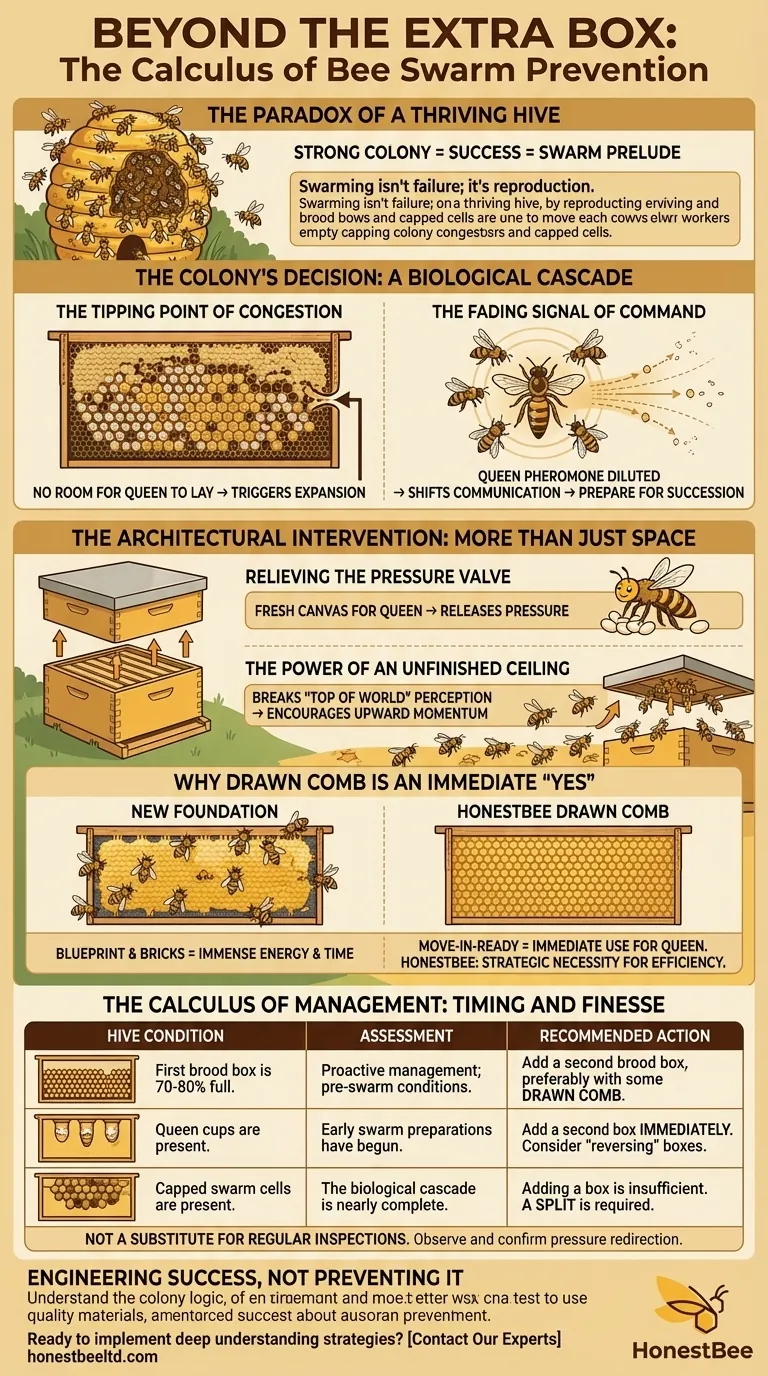
The Paradox of a Thriving Hive
To a beekeeper, a hive boiling with activity on a spring morning is a portrait of success. The colony is strong, the queen is productive, and the population is booming. Yet, this very success is the prelude to what many consider a failure: the swarm.
This is the central paradox of beekeeping. A swarm isn't a sign of a failing colony; it is the ultimate sign of a successful one, driven by a biological imperative to reproduce. The challenge, then, isn't to stop this impulse but to manage it. It requires moving beyond simple hardware solutions and understanding the psychological cascade that leads a colony to divide itself.
The Colony's Decision: A Biological Cascade
A colony's decision to swarm is not a moment of panic. It is a calculated, logical process triggered by specific environmental and social cues. It is the elegant engineering of nature at work.
The Tipping Point of Congestion
The most powerful trigger is spatial pressure in the brood nest. When a productive queen runs out of empty cells to lay eggs, a signal is sent throughout the colony: we have reached the limits of our home. This isn't just about physical space; it’s about the queen’s inability to perform her primary function, creating a bottleneck that the colony is programmed to resolve by expanding.
The Fading Signal of Command
A queen bee governs her colony through a chemical signature known as the queen pheromone. It suppresses the workers' instinct to raise new queens, acting as a constant message of stability and order. In a crowded, multi-story hive, this signal becomes diluted. Bees on the periphery no longer receive a strong "all is well" message, and the colony's internal communication system shifts, triggering the preparations for succession.
The Architectural Intervention: More Than Just Space
Adding a second brood box is often seen as simply giving the bees more room. In reality, it is a precise architectural and psychological intervention designed to disrupt the swarming cascade.
Relieving the Pressure Valve
The most immediate effect is alleviating brood nest congestion. By providing a new, empty frontier, you give the queen a fresh canvas. This immediately satisfies her biological drive to lay, releasing the primary pressure that initiated the swarm impulse. The entire colony senses this renewed potential and shifts its focus from division back to expansion.
The Power of an Unfinished Ceiling
Bees are genetically programmed to fill their cavity. By working their way up, they create what is sometimes called a "brood chimney." Adding a box on top breaks their perception that they have reached the top of their world. It presents a new, open vertical space, encouraging their natural upward momentum and redirecting energy that would have gone into swarming.
Why Drawn Comb is an Immediate "Yes"
The effectiveness of this intervention is magnified by the materials used.
- New Foundation: Is like giving the colony a blueprint and a pile of bricks. It requires immense energy and time to build out before the queen can use it.
- Drawn Comb: Is a move-in-ready home. It provides immediately usable cells for the queen.
For commercial apiaries where efficiency is paramount, using high-quality drawn comb from a reliable supplier like HONESTBEE isn't a luxury; it's a strategic necessity to ensure the intervention is accepted immediately.
The Calculus of Management: Timing and Finesse
Adding a box is a powerful tool, but its success depends entirely on a beekeeper's understanding of timing and process. It is not a "set-and-forget" solution.
| Hive Condition | Assessment | Recommended Action |
|---|---|---|
| First brood box is 70-80% full | Proactive management; pre-swarm conditions. | Add a second brood box, preferably with some drawn comb. |
| Queen cups are present | Early swarm preparations have begun. | Add a second box immediately. Consider "reversing" boxes. |
| Capped swarm cells are present | The biological cascade is nearly complete. | Adding a box is insufficient. A split is required. |
This isn't a substitute for regular inspections. The extra space buys you time and reduces the colony's motivation to leave, but a determined hive may still build swarm cells. You must continue to observe and confirm that the pressure has been successfully redirected.
Engineering Success, Not Preventing It
Effective swarm management isn't about fighting nature. It's about understanding the colony's internal logic and using sound principles—and the right equipment—to guide its incredible energy toward productivity and growth.
For commercial beekeepers and distributors, managing this process at scale demands consistency and reliability. Having a ready supply of high-quality brood boxes and drawn comb is fundamental to executing these architectural interventions precisely when they are needed. It allows you to work with the bees' natural impulses, building a stronger, more resilient apiary.
If you're ready to implement swarm management strategies that are built on a deeper understanding of honey bee biology, let's talk. Contact Our Experts
Visual Guide
Related Products
- HONESTBEE Collapsible Tiered Bee Swarm Catcher for Beekeeping
- HONESTBEE Professional Telescopic Pole Bee Swarm Catcher
- Heavy Duty Red Rubber Beekeeping Gloves with Vented Mesh Cotton Sleeves
- White Cotton Beekeeping Jacket and Veil for Bee Keepers
- Beekeeper Cowboy Hat and Veil for Beekeeping
Related Articles
- Swarm Catching for New Beekeepers: A Step-by-Step Safety Guide to Your First Successful Capture
- The Scent Plume Protocol: A Strategic Guide to Swarm Capture
- How Brood Behavior Reveals When to Feed Bees to Prevent Summer Migration
- Essential Beekeeping Equipment for Beginners: Functions, Selection, and Best Practices
- How Bees Manage Sugar During Brood Nest Expansion: Optimizing Hive Productivity