The Last Bottleneck
An apiarist can spend a season managing hives, nurturing colonies, and timing the harvest to perfection. The honey is extracted, tasting of buckwheat or wildflower—a pure expression of the local terroir.
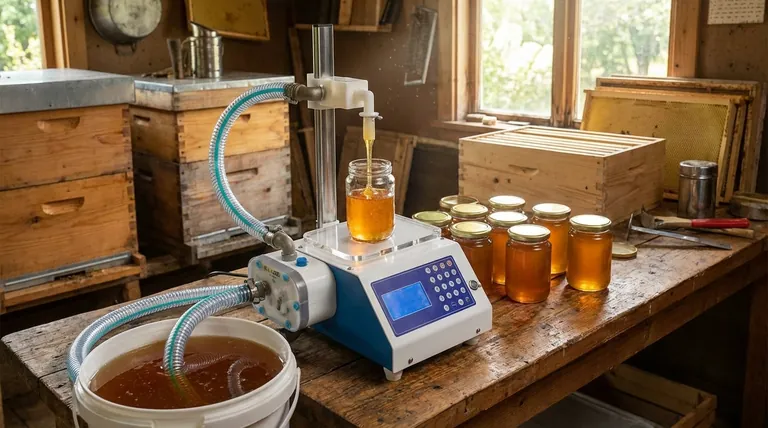
Then comes the final ten feet of the journey: getting that honey into a jar.
This is often where artistry meets a brutal industrial reality. Inaccurate fills, messy spills, and slow bottling can erode profit and morale. The frustration isn't a personal failing; it's a systems problem. It's a mismatch between the unique physics of honey and the mechanics of the machine meant to handle it.
Your Product Dictates the Technology
The most common mistake in selecting equipment is searching for the "best" filler. The psychological pull toward a single, catch-all solution is strong. But in the world of physics and packaging, there is no such thing.
The central principle is simple: the product is the boss.
Its physical properties—viscosity, density, tendency to crystallize—determine the correct technology. You don't choose a machine; you choose the machine that already understands your product.
Matching the Machine to the Medium: A Beekeeper's Guide
Honey is not a simple liquid. Its viscosity changes dramatically with temperature, moisture content, and floral source. This variability is the core challenge.
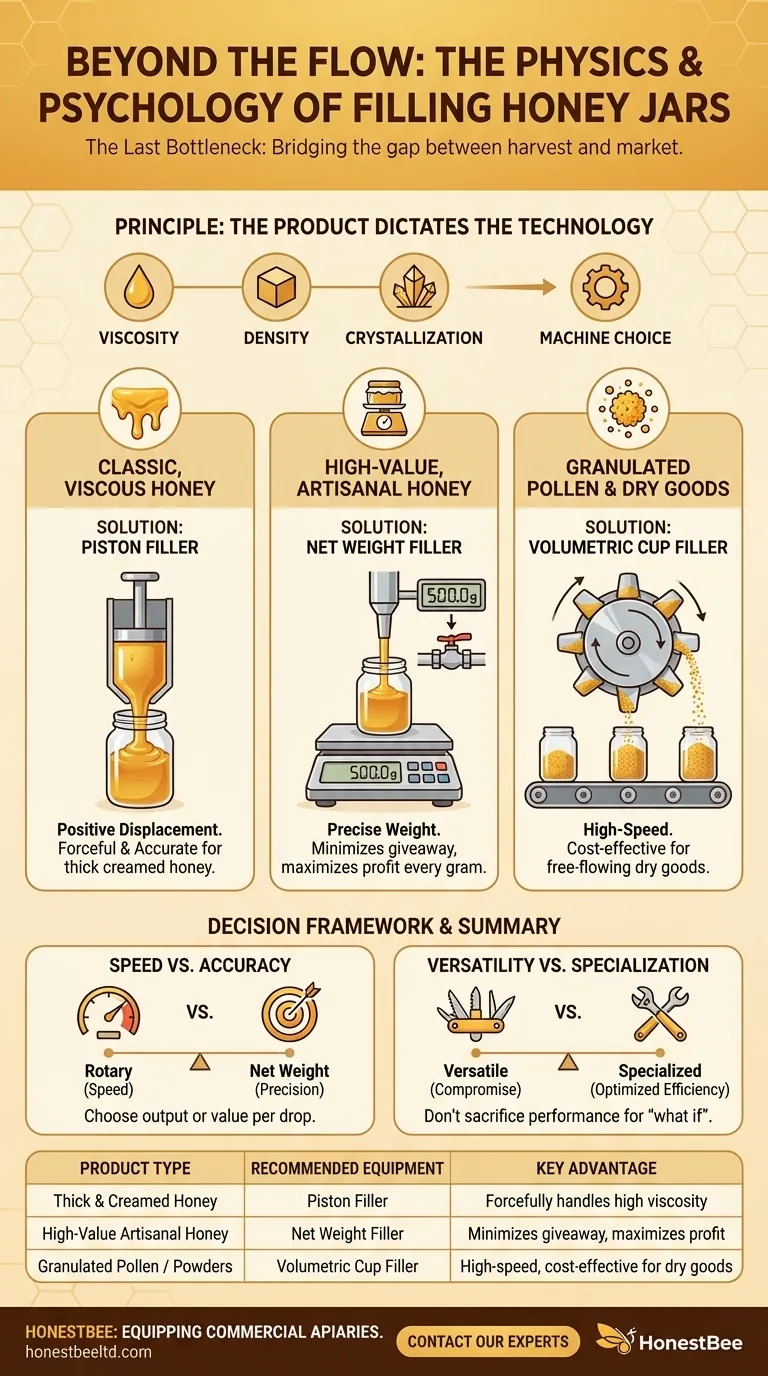
For Classic, Viscous Honey
Most honey is thick. It resists flowing. Attempting to fill it with equipment designed for water-thin liquids leads to inaccurate volumes, slow production, and mechanical strain.
This is the domain of the Piston Filler.
- How it works: A piston retracts inside a cylinder, drawing in a precise volume of honey. It then extends, pushing that exact volume into the jar.
- Why it works: This is a "positive displacement" method. It doesn't rely on gravity; it uses mechanical force to move the product. It is strong, reliable, and exceptionally accurate for thick materials like creamed honey, gels, or sauces.
For High-Value, Artisanal Honey
When you're bottling a rare, single-origin honey, every gram matters. Overfilling by just a small percentage on thousands of jars translates directly into lost revenue.
Here, the psychology shifts from volume to value. You need a Net Weight Filler.
- How it works: Instead of dispensing a set volume, it fills each jar to a precise target weight. It uses a load cell to constantly measure the weight, shutting off the flow at the exact moment the target is reached.
- Why it works: It eliminates all the variables. Temperature-induced changes in density no longer affect the fill amount. For high-value products, filling by weight is the only way to guarantee profitability and fairness to the customer.
For Free-Flowing Hive Products
What about other products, like granulated bee pollen or other dry goods? For materials that flow easily and consistently, a different logic applies.
A Volumetric Cup Filler is a simple, high-speed solution. It uses pre-measured cups that scoop and drop a set volume of product. It's fast and cost-effective, but best suited for products where pinpoint weight accuracy is less critical than throughput.
A Framework for Your Decision
Choosing the right machine is about understanding the trade-offs and aligning them with your business philosophy.
Speed vs. Accuracy
This is the classic operational dilemma. Rotary filling systems are built for speed and can package thousands of units per hour. Net weight fillers are built for precision, which can mean a more deliberate pace. Your choice reveals your priority: Is it maximizing unit output or maximizing the value of every drop?
Versatility vs. Specialization
There's a temptation to buy a machine that could handle anything you might produce in the future. But versatile machines often represent a compromise. A specialized machine, optimized for one task like filling viscous honey, delivers unmatched efficiency for that specific job. Don't sacrifice today's performance for a hypothetical "what if."
The Right Tool for the Apiary
To simplify the choice, map your primary product to the technology designed for it.
| Product Type | Recommended Equipment | Key Advantage |
|---|---|---|
| Thick & Creamed Honey | Piston Filler | Forcefully handles high viscosity with ease |
| High-Value Artisanal Honey | Net Weight Filler | Minimizes product giveaway, maximizes profit |
| Granulated Pollen / Powders | Volumetric Cup Filler | High-speed, cost-effective for dry goods |
The goal is to create a seamless system where the final step of your process—packaging—is as elegant and efficient as the natural process that created the product itself. This isn't just about avoiding frustration; it's about honoring the work that went into every jar.
At HONESTBEE, we equip commercial apiaries with the robust filling solutions needed to bridge that final gap between harvest and market, ensuring your product is packaged with the precision it deserves.
If you're ready to align your equipment with your goals, Contact Our Experts.
Visual Guide
Related Products
- Precision Durable Efficient HONESTBEE Rotary Honey Filling Machine
- Semi Automatic Small Honey Bottle Filling Machine Honey Filler
- Automatic Honey Filling and Filtering Machine for Beekeeping Bottle Filling
- Economy Small Honey Filling Machine Honey Bottle Filler Packaging Machine
- Double Nozzle Small Honey Filling Machine Honey Sachet Packing Packaging Equipment
Related Articles
- How to Choose Between Semi-Automatic and Fully Automatic Honey Filling Machines
- The Bottleneck in a Bottle: Why Manual Honey Filling Limits Your Apiary's Growth
- The Viscosity Principle: How a Honey Filling Machine Masters More Than Just Honey
- The Sticky Truth: Why Your Honey Filling Fails and How to Fix It for Good
- The Mechanics of Trust: Why Your Honey Filling Process is Your Brand's First Handshake