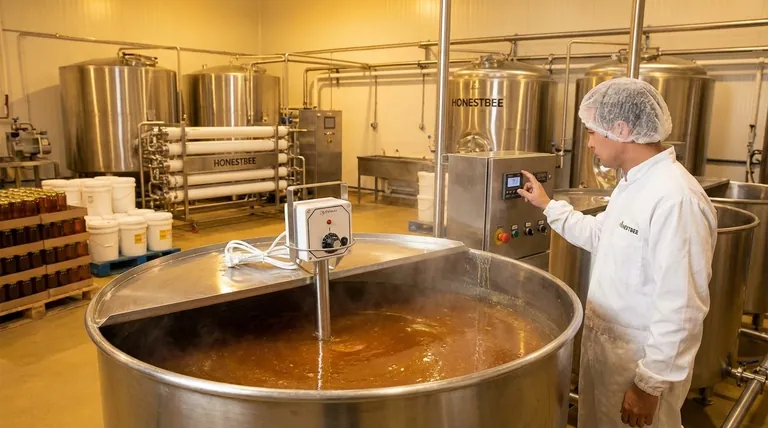
The Invisible Hand in Every Jar
Walk down any supermarket aisle, and you'll see a wall of honey. Golden, clear, and perfectly liquid. This uniformity isn't an accident of nature; it's the result of a deliberate, calculated decision made long before the jar was sealed.
The central force shaping that product is heat.
For a commercial apiary, applying heat is not just a step in a process. It is a strategic choice that defines the identity of your product. It's a decision that balances the psychology of the consumer—who often equates clarity with purity—against the very essence of the honey itself.
Understanding this trade-off is fundamental to running a successful honey operation.
The Fork in the Road: Two Goals, Two Temperatures
Heat is a tool, and like any tool, its impact depends on how it's wielded. In honey processing, there are two primary paths, each with a distinct purpose and outcome.
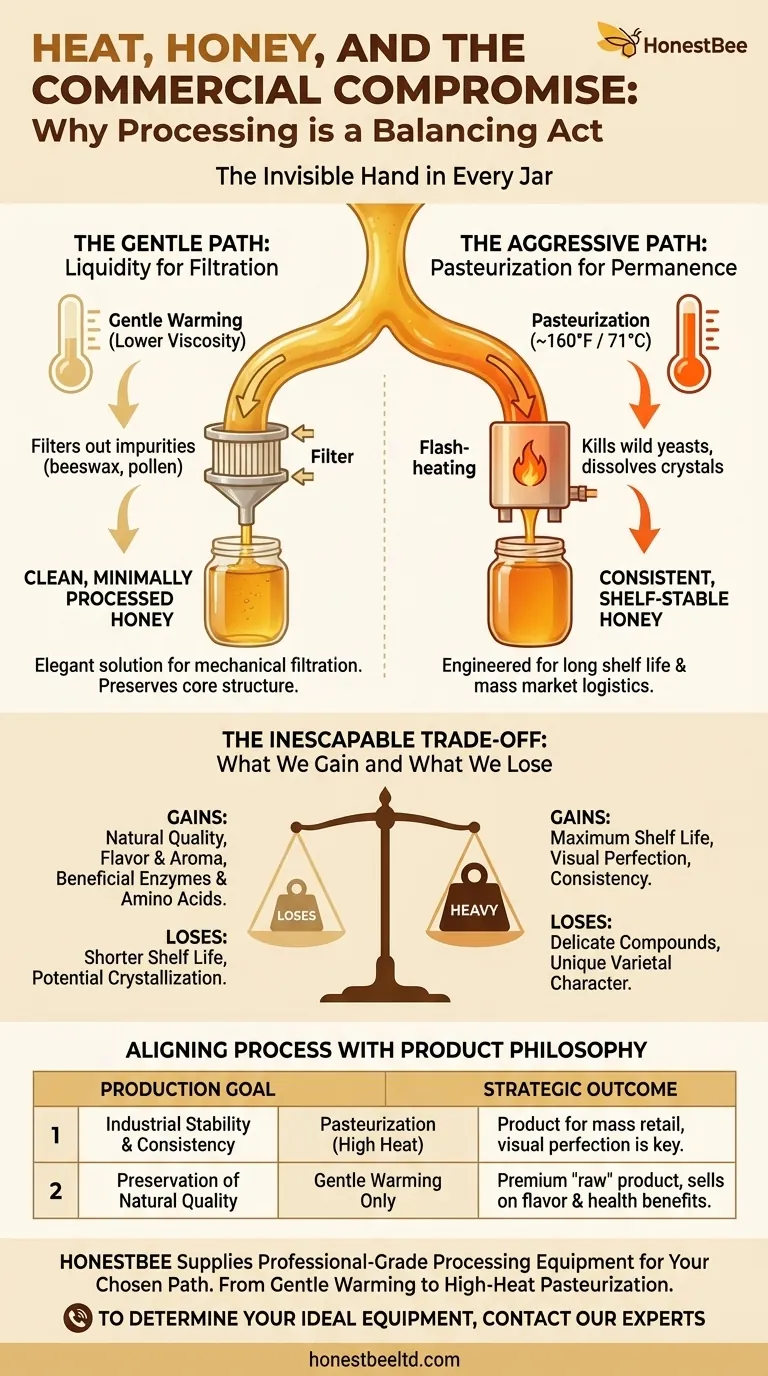
The Gentle Path: Liquidity for Filtration
Raw honey is thick, a testament to its low water content. This viscosity makes it incredibly difficult to filter out impurities like beeswax fragments, pollen, and other hive debris on a commercial scale. The process would be agonizingly slow and inefficient.
A gentle warming—just enough to lower the viscosity—is the elegant engineering solution. It makes the honey flow smoothly through filters, ensuring a clean product without fundamentally altering its core chemical structure. This is the minimalist's approach, a light touch to solve a mechanical problem.
The Aggressive Path: Pasteurization for Permanence
The second path is driven by a different, more demanding goal: defying nature's clock. Honey is susceptible to two natural processes: crystallization and fermentation from wild yeasts.
Pasteurization, a rapid "flash-heating" process to around 160°F (71°C), is a direct assault on both. It kills the yeasts that could cause fermentation and dissolves the microscopic sugar crystals that act as seeds for crystallization. The result is a product that remains liquid and stable on the shelf for months, even years. It’s a product engineered for the logistics of a global supply chain and the expectations of a mass-market consumer.
The Inescapable Trade-Off: What We Gain and What We Lose
The stability gained through pasteurization comes at a significant, often invisible, cost. This is the central compromise every large-scale producer must navigate.
The Cost of a Flawless Appearance
High heat is indiscriminate. While it destroys yeast and sugar crystals, it also degrades the delicate compounds that make honey special.
- Enzymes and Amino Acids: The beneficial enzymes inherent to raw honey, which are often cited for its health properties, are denatured and destroyed by high temperatures.
- Flavor and Aroma: The complex, volatile aromatic compounds that give varietal honey its unique character—the floral notes of clover, the richness of buckwheat—are burned off.
The trade-off is stark: we exchange a complex, living food for a consistent, shelf-stable sweetener. We sacrifice nuance for predictability.
A Matter of Definition: Global Standards and Identity
This isn't just a philosophical debate. Global standards like the Codex Alimentarius recognize the damage. They explicitly state that honey should not be heated to a degree that its "essential composition is changed or its quality is impaired."
This forces a critical question for any producer: at what point does processed honey cease to be the product nature intended? Your answer to this question defines your brand.
Aligning Process with Product Philosophy
Your approach to heat isn't just a technical decision; it's a business one. It reflects your target market and your core philosophy. There is no single "right" answer, only the answer that is right for your goals.
| Production Goal | Chosen Method | Strategic Outcome |
|---|---|---|
| Industrial Stability & Consistency | Pasteurization (High Heat) | A product with maximum shelf life, suited for mass retail and distribution where visual perfection is key. |
| Preservation of Natural Quality | Gentle Warming Only | A premium "raw" or minimally processed product that sells on flavor, terroir, and health benefits. |
The Right Tools for Your Chosen Path
Whether you aim for industrial-scale stability or artisan quality, your success depends on having precise, reliable, and efficient equipment. The choice to gently warm for filtration requires different machinery than a full-scale pasteurization line.
HONESTBEE supplies the professional-grade beekeeping and processing equipment that commercial apiaries and distributors need to execute their strategy flawlessly. We provide durable solutions for both gentle warming and high-heat pasteurization, understanding that each path requires specialized tools to succeed. We equip you to produce the exact product your business model demands.
To determine the ideal equipment for your operational goals, Contact Our Experts
Visual Guide
Related Products
- Electric Double Wall Honey Filtering Machine Purifier Equipment for Honey Processing Plant
- 0.5T Capacity Honey Dehumidifier Dryer with Vacuum Heating and Thickening Filtering Machine
- Heavy Duty Stainless Steel Honey Processing Machine Decrystallizing Tank
- Double Wall Honey Heating Stirring Homogenizer Mixing Machine with Various Capacity
- Economy Honey Homogenizer Mixer and Melting Machine for Beekeeping
Related Articles
- From Chaos to Clarity: The Physics and Psychology of Honey Filtering
- How Professional Honey Filtration Preserves Quality While Meeting Food Safety Standards
- The Sticky Bottleneck: Why Your Honey Filtering Fails and How to Fix It for Good
- Why Your Honey Filtering is Slow and Inconsistent—And How to Fix It for Good
- Optimizing Honey Filtration: How Mesh Sizes Shape Quality and Market Appeal













