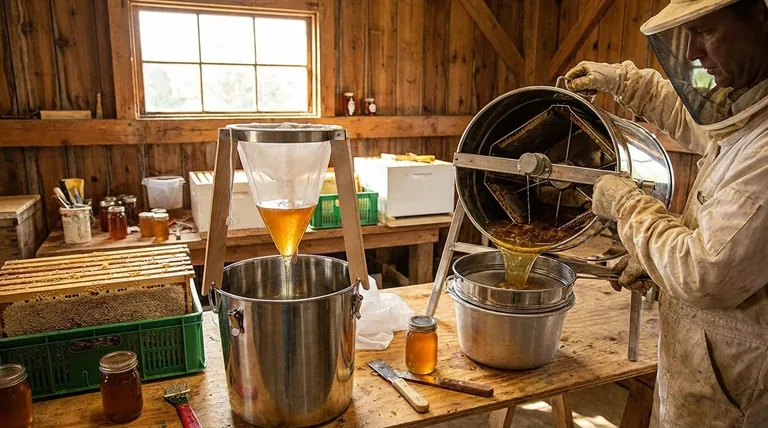
It's a familiar scene in any growing apiary: the extractor has been running for hours, and you have vats of beautiful, raw honey. But your production line has ground to a halt at the filtering station. The honey flow has slowed to a frustrating trickle, your fine-mesh filter is hopelessly clogged with wax and pollen, and your team is standing by, waiting. Every minute of this bottleneck costs you time, labor, and potential revenue during your busiest season.
Why 'Filtering Harder' Only Makes Things Worse
If you're facing this challenge, you're not alone. It's a universal growing pain for commercial beekeepers. In an attempt to scale up and produce a cleaner product, many fall into the same traps:
- Using finer and finer filters: It seems logical. To get a clearer product, use a smaller mesh. The result? The filter clogs almost instantly, stopping your workflow entirely and requiring constant, labor-intensive scraping and cleaning.
- Applying heat to speed things up: Gently warming honey lowers its viscosity and makes it flow faster. But this is a dangerous game. A little too much heat, and you begin to destroy the delicate enzymes and volatile aromatics that define high-quality raw honey, degrading the very product you’re trying to sell.
- Accepting the trade-off: Many operators simply resign themselves to a painful choice: either sell cloudy, debris-filled honey or spend a fortune on labor and time to produce a clear product, severely limiting their output.
These aren't solutions; they are symptoms of a deeper misunderstanding. The business consequences are severe: unpredictable production schedules, inflated labor costs, and—most damagingly—an inconsistent product that can erode your brand's reputation for quality.
The Two Jobs of Honey Cleaning: The Truth Hiding in Plain Sight
Here is the turning point: the core reason your filtering process is failing is that you're asking one tool to do two completely different jobs. The challenge of cleaning honey is not a single task, but a two-stage process rooted in simple physics.
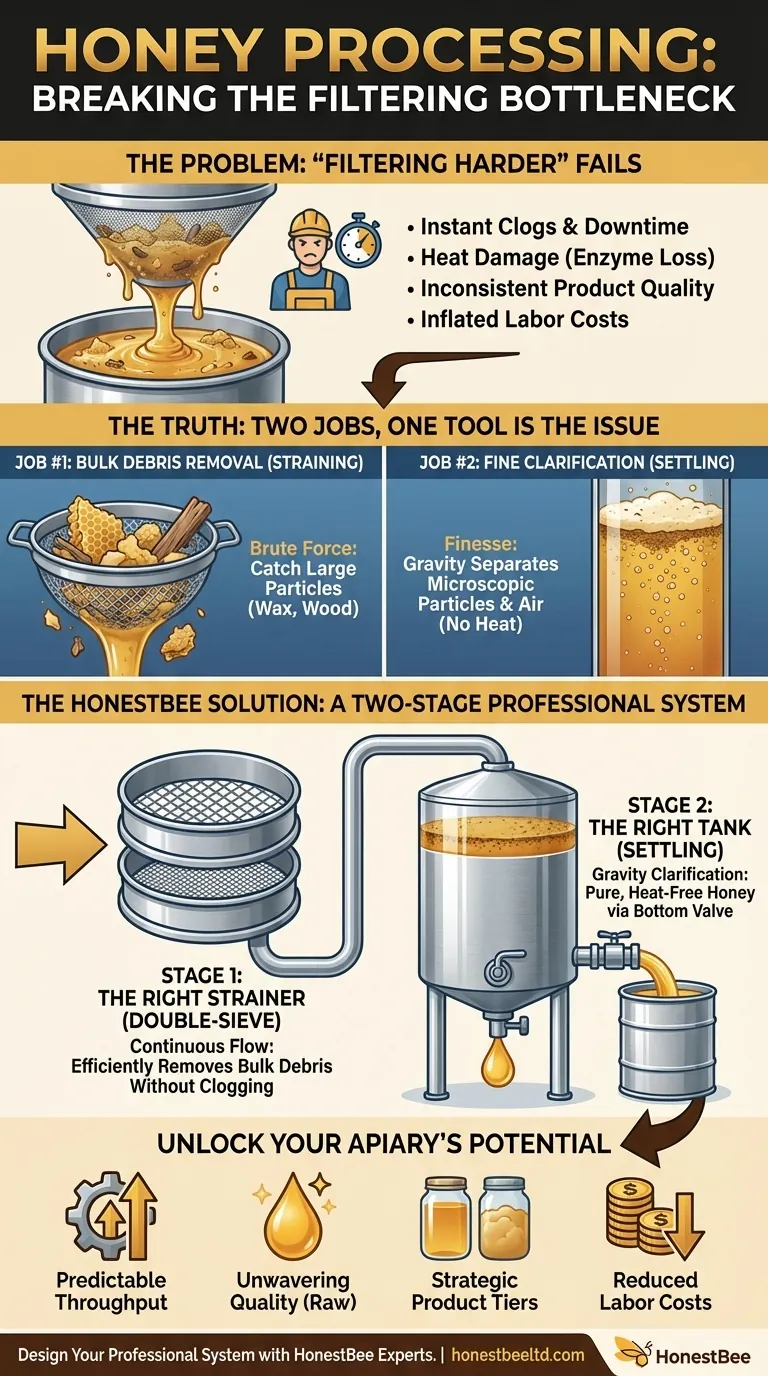
Job #1: Bulk Debris Removal (Straining) This is a brute-force mechanical job. Its only purpose is to catch the large, visible particles: bits of beeswax, wood splinters, and larger pieces of propolis. This task is best handled by a coarse strainer.
Job #2: Fine Clarification (Settling) This is a job of finesse. It’s about removing the microscopic, suspended particles—tiny air bubbles, fine pollen grains, and wax fragments—that make honey cloudy. These particles are often less dense than the honey itself. Trying to catch them with a filter is like trying to catch mist with a tennis racket. The correct method is to let gravity do the work. Over time, these particles will naturally float to the top.
The common "solutions" fail because they misapply the tools. Using a fine-mesh filter for bulk removal (Job #1) causes it to clog. Applying heat is a crude attempt to force honey through a filter that’s doing the wrong job (Job #2), compromising quality in the process. You are fighting physics, and it's a battle you will always lose.
The Right Tool for Each Job: From Brute Force to Finesse
To truly solve this problem and scale your operation, you don't need to "filter harder." You need to adopt a professional, two-stage system where each stage uses equipment designed specifically for the task at hand.
This is not a coincidence; it's by design. Professional-grade honey processing equipment is engineered around this two-stage principle.
Stage 1: The Right Strainer
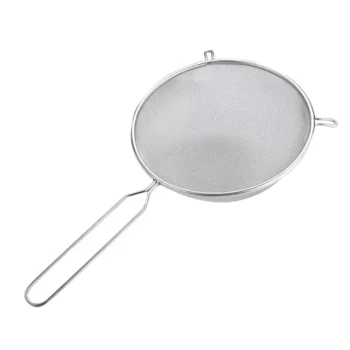
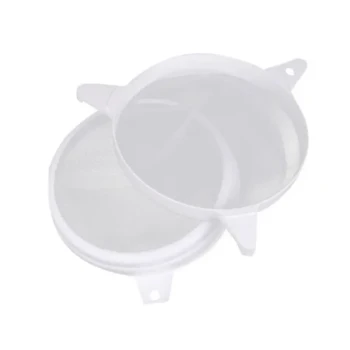
Instead of a single, fine filter, a proper commercial setup uses a double-sieve system. A coarse strainer sits on top to handle Job #1—catching the big debris. Below it, a medium strainer catches the next level of particles. This progressive system allows for a continuous, high-volume flow without constant clogging, efficiently preparing the honey for the next stage.
Stage 2: The Right Tank
For true, heat-free clarity, the honey then moves into a dedicated honey settling tank. This is more than just a bucket. It’s a purpose-built vessel, often with a tall, narrow profile to accelerate separation, and a crucial feature: a honey gate (valve) at the very bottom. After letting the honey sit, the lighter waxes and impurities form a layer at the top. You can then drain the perfectly clear, pure honey from the bottom, leaving the impurities behind.
HONESTBEE’s wholesale equipment is built on this fundamental understanding. Our durable, food-grade stainless steel strainers and settling tanks aren't just pieces of metal; they are the embodiment of a workflow that resolves the conflict between quality and scale. They are designed to work with the physics of honey, not against it.
Beyond the Bottleneck: Unlocking Your Apiary's True Potential
When you stop fighting your filtering process and equip your operation with the right system, everything changes. The bottleneck disappears. What does this new reality look like?
- Predictable Throughput: You can reliably process hundreds or thousands of pounds of honey per day, meeting deadlines and fulfilling large wholesale orders with confidence.
- Unwavering Quality: Your honey will have a consistent clarity and purity that strengthens your brand. You no longer have to compromise on the "raw" quality your customers value.
- Strategic Product Tiers: You now have the process control to create different products for different markets. Sell a premium, crystal-clear settled honey to gourmet retailers, and a minimally-strained, pollen-rich honey to health food markets—all from the same harvest.
- Reduced Labor Costs: Your team can be re-tasked from babysitting clogged filters to more valuable activities like bottling, labeling, and shipping, directly boosting your bottom line.
By solving this one "sticky" problem, you unlock the capacity for genuine growth.
Your honey is exceptional. Your processing system should be too. Instead of battling with makeshift solutions, it's time to implement a professional workflow that allows your business to scale without compromising the quality of your product. Let's discuss the specific bottlenecks in your operation and design a system that works for you. Contact Our Experts.
Visual Guide
Related Products
- Professional Stainless Steel Honey Filtering Machine with Water Bath Heating for Beekeeping
- Electric Double Wall Honey Filtering Machine Purifier Equipment for Honey Processing Plant
- Professional Stainless Steel Honey Filter with Support Handle
- Professional Honey Filter with Tripod Support Stand
- Professional Cone-Shaped Honey Filter with Reinforced Steel Ring
Related Articles
- The Sticky Bottleneck: Why Your Honey Filtering Fails and How to Fix It for Good
- Why Your Honey Filtering Process is Failing (And It’s Not the Honey’s Fault)
- Why Your Honey Filtering is Slow and Inconsistent—And How to Fix It for Good
- Optimizing Honey Filtration: How Mesh Sizes Shape Quality and Market Appeal
- Beyond the Sticky Mess: Why Your Honey Filtering Method Is Secretly Killing Your Growth