The Illusion of a Single Solution
When we think of raising queen bees, we often imagine a single, special kind of hive—a royal nursery.
This is a powerful, but incorrect, mental model.
The truth is more systematic and far more interesting. High-quality queen rearing isn't about one piece of equipment; it's a meticulously engineered process. It’s an assembly line, moving a developing monarch through a series of controlled environments, each designed to manipulate the colony's deepest biological instincts.
It is less about a single tool and more about a deliberate architecture.
Phase 1: Inducing a Controlled Crisis
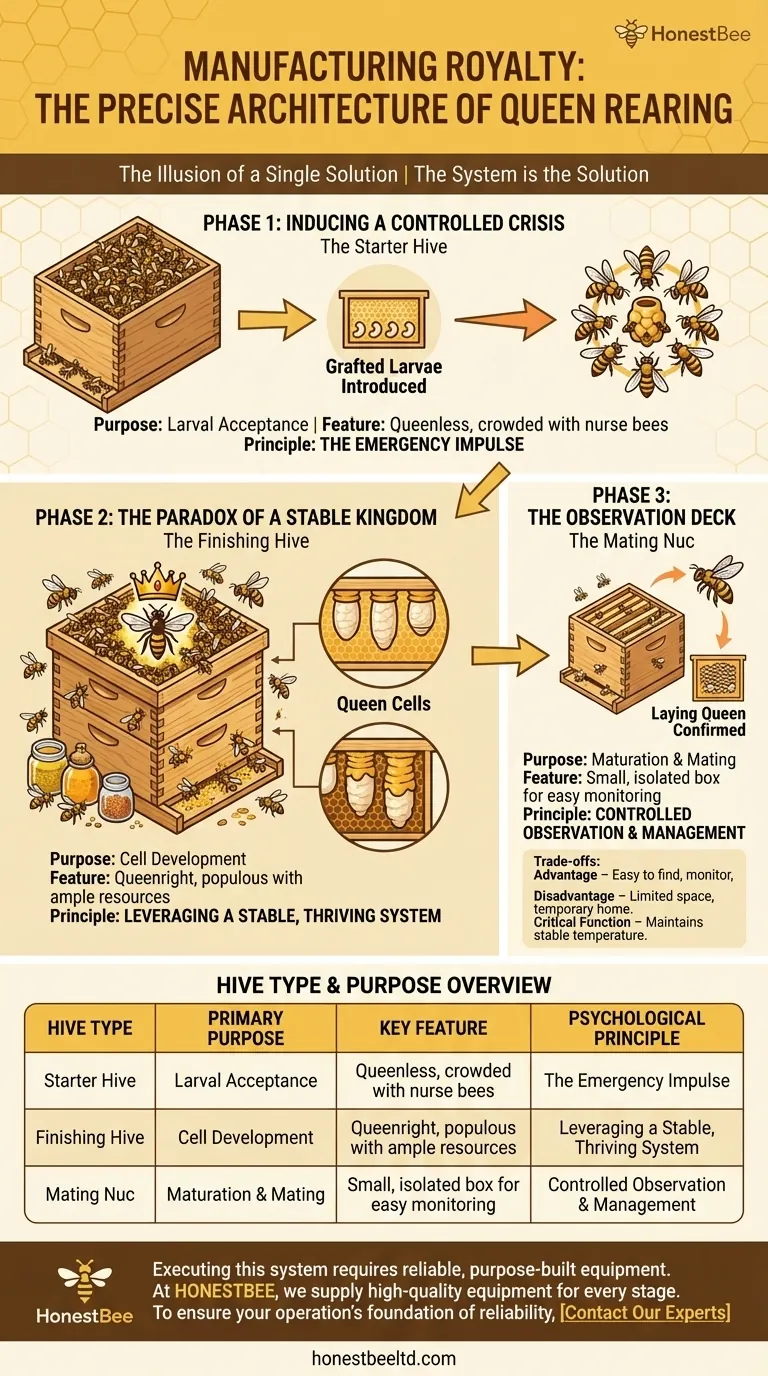
The Starter Hive
The journey begins by manufacturing a crisis.
A "starter hive" is a box filled with a specific kind of tension. It is intentionally made queenless, but packed densely with young nurse bees—the ones physiologically primed to produce royal jelly.
This absence of a queen triggers a powerful, primal instinct: the emergency impulse. The colony, sensing its own mortality without a monarch, becomes desperate to create a new one. When a beekeeper introduces frames of grafted larvae, the bees don't hesitate. They get to work immediately, feeding the chosen few lavishly.
The goal here is pure acceptance. The starter hive is a psychological trigger, engineered to convince a colony to invest its resources in royalty.
Phase 2: The Paradox of a Stable Kingdom
The Finishing Hive
Once the queen cells are started and accepted, they are moved to a completely different environment.
The "finisher" is the paradox of queen rearing. It is a large, powerful, and queenright colony. It already has a laying queen, yet it is tasked with raising her potential rivals.
This works because the hive is strong and stable. Abundant with pollen, nectar, and a massive workforce of nurse bees, it has the resources to nourish the developing queens through the long nine-day period until their cells are capped. The finisher is not a state of emergency; it is a thriving kingdom with surplus capacity, and the beekeeper is simply redirecting that capacity.
It's a system designed for long-term, robust development, leveraging the power of a fully functional society.
Phase 3: The Observation Deck
The Mating Nuc
The final stage is the most specialized. After the queen cell is mature, it is moved to a "mating nuc" (nucleus hive).
This is a small, miniature hive, containing only a few frames of bees and food. Its design isn't optimized for the colony's long-term growth, but for the beekeeper's immediate need: observation.
In a full-sized hive of 50,000 bees, finding a newly mated queen to confirm she is laying well is a monumental task. In a mating nuc of a few thousand, it’s simple.
A Study in Trade-offs
The mating nuc is a perfect example of engineering for a specific purpose, acknowledging its inherent limitations.
- Advantage: Its small size makes the virgin queen easy to find, monitor, and manage after she returns from her dangerous mating flights.
- Disadvantage: Its limited space is not a permanent home. It will quickly become crowded, restricting the queen's laying pattern. She must be moved.
- Critical Function: The small cluster can more easily maintain a stable temperature, which is crucial for the queen's health and the development of her first brood.
The nuc is a temporary home, a safe harbor designed for one purpose: to get a queen successfully mated and proven.
The System is the Solution
Success in queen rearing doesn't come from a single piece of equipment. It comes from mastering the workflow between these three distinct environments. Each hive is a specialized tool, designed to solve a different problem in the queen's developmental journey.
| Hive Type | Primary Purpose | Key Feature | Psychological Principle |
|---|---|---|---|
| Starter Hive | Larval Acceptance | Queenless, crowded with nurse bees | The Emergency Impulse |
| Finishing Hive | Cell Development | Queenright, populous with ample resources | Leveraging a Stable, Thriving System |
| Mating Nuc | Maturation & Mating | Small, isolated box for easy monitoring | Controlled Observation & Management |
Executing this system at a commercial scale requires equipment that is reliable, durable, and built for its specific task. Any failure in the chain—a poorly constructed nuc that gets chilled, or a starter that isn't configured for maximum bee density—compromises the entire operation.
At HONESTBEE, we supply commercial apiaries and distributors with the high-quality, purpose-built equipment needed for every stage of this intricate process. We understand that a successful queen rearing operation is a system, and every component must be flawless.
To ensure your operation is built on a foundation of reliability, Contact Our Experts.
Visual Guide
Related Products
- No Grafting Queen Rearing Kit: System for Royal Jelly Production and Queen Rearing
- Premium Nicot Style Queen Rearing Kit with Hair Roller Bee Cages
- Nicot Queen Rearing Kit for Beekeeping and Grafting in Nicot System
- JZBZ Langstroth Queen Rearing Frame for Beekeeping
- Premium Nicot Style Cell Bar Holder and Queen Cell Cup Holder System
Related Articles
- The Art of Deception: Integrating Queen Rearing Kits into the Hive Mind
- Mastering Queen Rearing: A Beekeeper’s Guide to Reliable Production
- Biology's Unforgiving Schedule: Mastering the Two Critical Windows of Queen Rearing
- The Beekeeper's Dilemma: Engineering Control in Queen Rearing
- The Architect of the Hive: Turning Queen Rearing from Art to Engineering