The Moment That Defines an Apiary
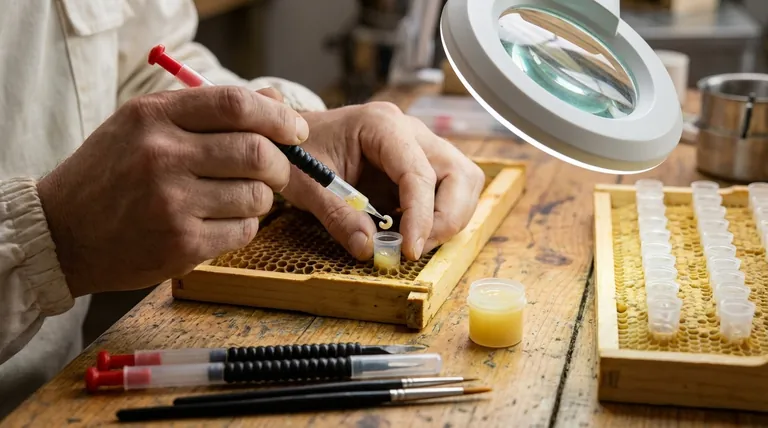
Imagine a workbench, lit by a single, bright lamp. A beekeeper leans forward, eyes focused through a magnifying glass. On a small frame, thousands of hexagonal cells hold the future, but their attention is on one: a tiny, C-shaped larva, almost translucent, floating in a pool of royal jelly.
In their hand is a slender tool. The next movement, a microscopic scoop-and-lift lasting less than a second, will determine the genetic lineage of thousands of bees and the productivity of an entire yard next season.
This is grafting. It’s not just a task; it’s microsurgery with agricultural consequences.
The Psychology of the Graft
At its core, grafting is the manual transfer of a chosen worker larva into an artificial queen cup. This simple act signals a "finisher" colony to do what it does best: raise a queen.
But the process is steeped in psychological pressure. You are making a deliberate choice—selecting for gentleness, for honey production, for disease resistance. You are attempting to replicate your best genetics on a massive scale.
The subject of this operation is unimaginably fragile. The ideal larva is just 12 to 24 hours old. It is a life form at the very edge of viability, and the beekeeper's hand is the sole arbiter of its future. Success requires a calm mind and a steady hand.
An Operator's Instruments
The grafting tool is more than just a piece of equipment; it's an extension of the beekeeper's will. The choice of tool reflects a philosophy—a balance between efficiency, risk, and precision.
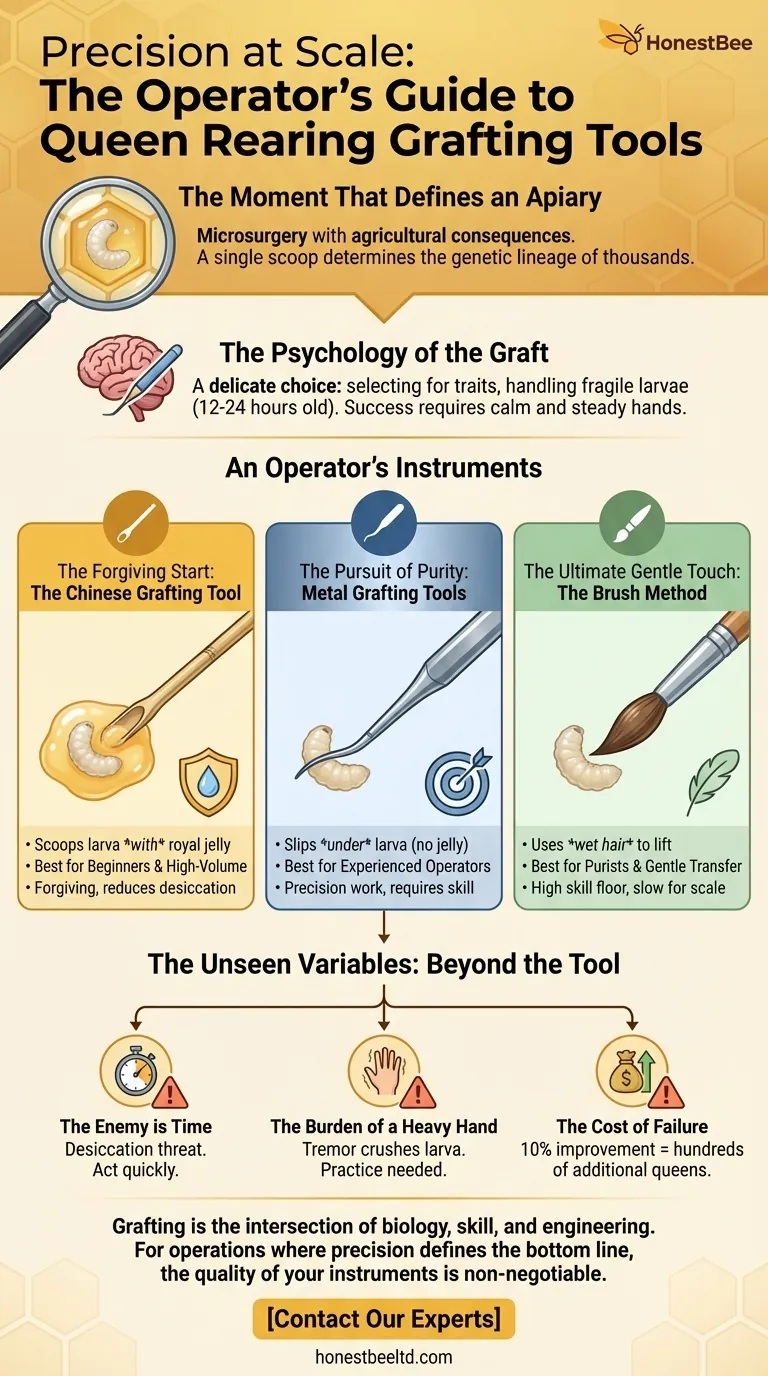
The Forgiving Start: The Chinese Grafting Tool
This is the most common tool for a reason. It is designed to mitigate risk. A thin, flexible reed with a tiny scoop at the end allows the operator to lift the larva and its bed of royal jelly.
This is a profound advantage. The royal jelly acts as a buffer, protecting the larva from physical damage and, crucially, from drying out (desiccation). For beginners or commercial operations training new technicians, this tool provides a safety net. It’s built for repetition and forgiveness.
The Pursuit of Purity: Metal Grafting Tools
Crafted from stainless steel, German or Swiss-style tools are instruments of pure precision. Their fine, flexible tips are designed to slip underneath the larva, lifting it cleanly without any surrounding jelly.
This requires immense skill and confidence. There is no buffer. The reward, however, is a clean transfer and unparalleled tactile feedback. It's the choice of an experienced operator who trusts their hands and seeks a connection to the work that only a fine instrument can provide. It's less a tool and more a scalpel.
The Ultimate Gentle Touch: The Brush Method
Some purists use a single, wetted sable hair from an artist's brush. Using surface tension alone, they lift the larva from its cell.
This method is exceptionally gentle, introducing the absolute minimum of foreign contact. It is, however, the most difficult to master and is often too slow for large-scale commercial queen rearing. It represents an ideal, a testament to the delicate nature of the task.
The Unseen Variables: Beyond the Tool
An expert can make almost any tool work. A novice will struggle with the finest instrument. Success in grafting is a system, and the tool is just one component.
- The Enemy is Time: From the moment a larva is lifted from its cell, the clock is ticking. Desiccation is a constant threat. Grafting must be performed quickly, often in a humidity-controlled environment.
- The Burden of a Heavy Hand: The larva can be crushed or punctured by the slightest tremor or miscalculation. Practice, often on larger, more expendable drone larvae, is the only way to develop the necessary muscle memory.
- The Cost of Failure: In a commercial apiary, success rates are everything. A 10% improvement in graft acceptance can translate to hundreds of additional queens, impacting revenue and expansion capability.
This is why, at scale, the quality of your equipment is not a luxury; it's a core component of your operational efficiency. A reliable tool that feels consistent in the hand, graft after graft, removes a critical variable from a deeply complex equation.
Grafting Tool Selection at a Glance
| Tool Type | Primary Method | Best For | Key Consideration |
|---|---|---|---|
| Chinese Grafting Tool | Scoops larva with royal jelly | Beginners; High-volume commercial operations | Forgiving, reduces desiccation |
| Metal Grafting Tool | Slips under larva (no jelly) | Experienced operators; Precision work | Requires a steady, skilled hand |
| Brush-Style Tool | Uses wet hair to lift larva | Purists; The most gentle transfer possible | High skill floor, slow for scale |
The act of grafting is a beautiful intersection of biology, human skill, and engineering. It's a quiet moment on which an entire operation pivots. For operations where precision and reliability define the bottom line, the quality of your instruments is non-negotiable. Contact Our Experts
Visual Guide
Related Products
- Plastic Chinese Queen Grafting Tool for Bee Queen Rearing
- Stainless Steel Beekeeping Queen Grafting Tool for Honey Bee Rearing
- Stainless Steel Queen Grafting Tool for Beekeeping and Bee Queen Grafting
- Black 2 Pack Beekeeper Queen Grafting Tool for Bee Queen Larva Transferring Needle
- Plastic Beekeeping Honey Bee Larvae Grafting Tools for Queen Rearing and Chinese Grafting
Related Articles
- How to Master Queen Rearing with Precision Grafting Tools
- Microsurgery in the Apiary: The Unseen Power of the Queen Grafting Tool
- How to Improve Queen-Rearing Success: Biologically Optimized Grafting Techniques
- The Grafting Tool Dilemma: A Micro-Decision with Macro-Impact for Commercial Apiaries
- How to Mark Queen Bees Safely: Tools and Techniques for Hive Success