The Moment of Truth in a Single Drop
Imagine a hot afternoon at the height of the nectar flow. An entire season of work—countless hours of bee flight, hive management, and careful observation—rests on one deceptively simple question: "Is the honey ready?"
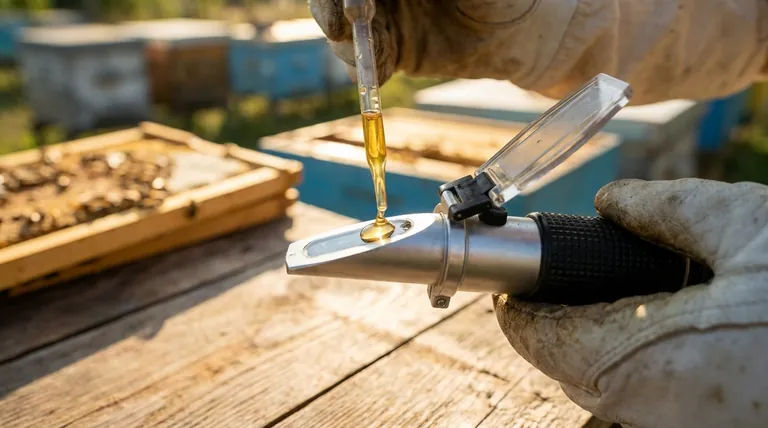
You place a single, golden drop on the cool glass of a refractometer. The number you see will dictate your next action. Do you begin the harvest, confident in a stable, high-quality product? Or do you wait, risking over-curing or a change in weather?
We have a cognitive bias to trust the number a tool gives us. We see a digital readout or a sharp line on a scale and accept it as fact. But with a honey refractometer, the truth isn't in the device; it's in the discipline of the operator. The accuracy of that number is earned, not given.
Why Moisture Is the Defining Metric
Measuring water content isn't just a task; it's the most critical quality control checkpoint in beekeeping. An inaccurate reading doesn't just lead to a bad data point; it leads to a spoiled harvest.
The Invisible Threat of Fermentation
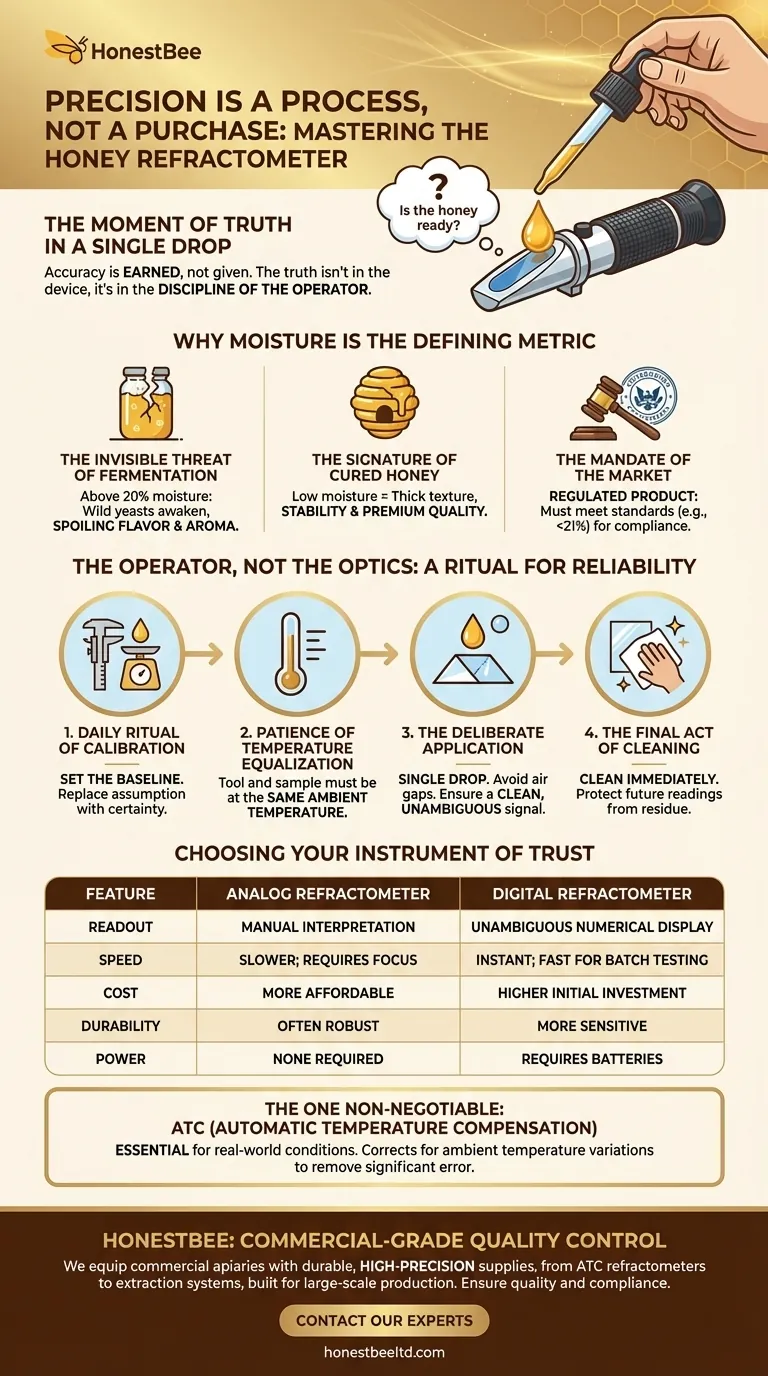
Honey's legendary shelf life comes from its low water content. It’s a hostile environment for microbes. But push the water content above 20%, and the wild yeasts naturally present in honey awaken. Fermentation begins, spoiling the flavor, aroma, and value of the entire batch. A faulty reading is an open invitation to this disaster.
The Signature of Cured Honey
Low moisture content is the hallmark of expertly cured honey. It's what gives premium honey its thick, viscous texture and guarantees its stability in the pantry. An accurate measurement is your confirmation that the bees have done their work and the honey is ready for bottling.
The Mandate of the Market
For commercial producers, accuracy is not optional. Honey is a regulated product. To be legally sold as "honey" in most markets, it must meet specific moisture standards, typically below 21%. Your refractometer isn't just a quality tool; it's your instrument for compliance.
The Operator, Not the Optics: A Ritual for Reliability
A reliable measurement is the result of a repeatable process. It's a ritual where each step builds on the last, systematically removing variables and doubt. Trusting your reading begins long before you apply the honey.
Step 1: The Daily Ritual of Calibration
Before the first measurement of the day, you must calibrate. This isn't a suggestion; it's the foundation of all subsequent readings. It sets the baseline and corrects for any drift. The human tendency is to assume the tool is fine because it was fine yesterday. Calibration is the disciplined act of replacing assumption with certainty.
Step 2: The Patience of Temperature Equalization
Impatience is the enemy of accuracy. A refractometer left in a hot truck and honey brought from a cool hive will produce a skewed, unreliable reading. For the laws of physics to work in your favor, the tool and the sample must be at the same ambient temperature. This simple act of waiting is a crucial part of the process.
Step 3: The Deliberate Application
Place a single drop on the prism. Just enough to cover the surface when the daylight plate is closed. Too much creates a mess; too little creates air gaps. After closing the plate, a gentle wiggle can dislodge air bubbles that obscure the reading line. This isn't just about being neat; it’s about creating a clean, unambiguous signal for the optics to read.
Step 4: The Final Act of Cleaning
This is the step that protects all future work. Immediately after taking a reading, clean the prism and plate with a soft, damp cloth. Allowing honey to dry on the glass creates a residue—a ghost of the last measurement that will corrupt every single one that follows. Meticulous cleaning is a commitment to the integrity of your next reading.
Choosing Your Instrument of Trust
While the operator's process is paramount, the tool itself still matters. The choice between analog and digital models depends on your operational needs, but one feature is non-negotiable.
The Workhorse vs. The Oracle
| Feature | Analog Refractometer | Digital Refractometer |
|---|---|---|
| Readout | Manual interpretation of a scale | Unambiguous numerical display |
| Speed | Slower; requires focus | Instant, fast for batch testing |
| Cost | More affordable | Higher initial investment |
| Durability | Often very robust, no electronics | More sensitive to drops and moisture |
| Power | None required | Requires batteries |
The One Non-Negotiable: ATC
For any beekeeper working in real-world conditions—a honey house, a vehicle, or the field—Automatic Temperature Compensation (ATC) is essential. It automatically corrects for ambient temperature variations, removing a significant potential for error. A professional tool has ATC; a hobbyist toy may not.
For commercial apiaries and distributors, where consistency and compliance are the bedrock of the business, investing in professional-grade equipment is the only sound choice. The speed of a digital refractometer with the reliability of ATC minimizes human error and maximizes throughput, protecting every batch.
At HONESTBEE, we equip commercial beekeeping operations with the durable, high-precision supplies they need for rigorous quality control. Our wholesale focus ensures you have access to reliable tools, from ATC refractometers to complete extraction systems, built for the demands of large-scale production. Ensure the quality and compliance of your harvest. Contact Our Experts
Visual Guide
Related Products
- Digital Honey Refractometer for Precision Measurement of Optimal Honey Quality
- Precision Honey Refractometer Instrument for Quality Assessment
- Premium Heat-Resistant Glass Honey Dipper
- Modern Stainless Steel Honey Dipper Stirrer
- Heavy Duty 304 Stainless Steel Honey Dipper
Related Articles
- The Physics of Perfection: Why a Single Number Determines Your Honey's Fate
- How to Accurately Test Honey Readiness: Science-Backed Methods for Beekeepers
- How to Perfect Honey Moisture Levels: A Beekeeper’s Guide to Refractometer Mastery
- From Ambiguity to Certainty: The Practical Case for Digital Honey Refractometers
- Precision in a Drop: Why Your Honey Refractometer Might Be Lying to You