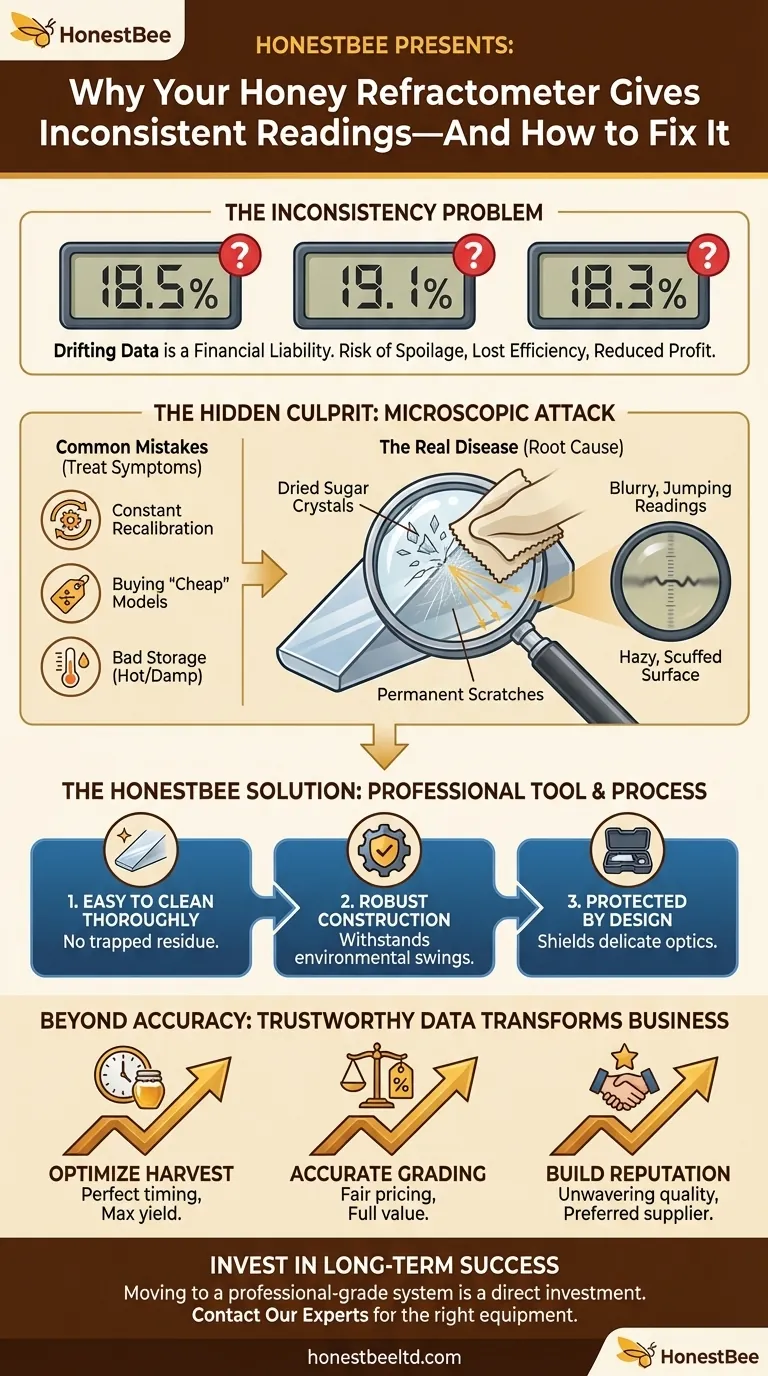
You take a moisture reading from a honey super. It’s 18.5%. A good, safe number. But to be sure, you test another sample from the same batch an hour later. Now it’s 19.1%. The next morning, it’s 18.3%.
Which number is real? This drifting data isn't just frustrating; it's a financial liability. A single percentage point can be the difference between a premium, stable product and a fermented, unsellable batch. For a commercial apiary, that kind of uncertainty is unacceptable.
Why Recalibrating and Replacing Your Refractometer Isn't Working
If you're facing this problem, you’ve likely tried the usual fixes. You recalibrate the instrument constantly. You question if you bought a "cheap" model. You might even buy a new one every couple of seasons, hoping the problem will go away. But it always comes back.
This cycle of doubt has serious business consequences:
- Risk of Spoilage: Shipping honey with moisture content even slightly above 18.6% can lead to fermentation, resulting in returned shipments, financial loss, and a damaged reputation.
- Lost Efficiency: Time spent double-checking measurements, questioning data, and troubleshooting equipment is time taken away from managing your hives and growing your business.
- Reduced Profit: Harvesting honey based on an inaccurate low reading means pulling frames too early, resulting in a lower total yield.
The reason these common solutions fail is that they treat the symptom—the bad reading—instead of the real disease. The problem isn't that your refractometer is inherently faulty. The problem is that a silent, almost invisible process is slowly destroying its ability to see clearly.
The Real Culprit: A Microscopic Attack on Your Prism
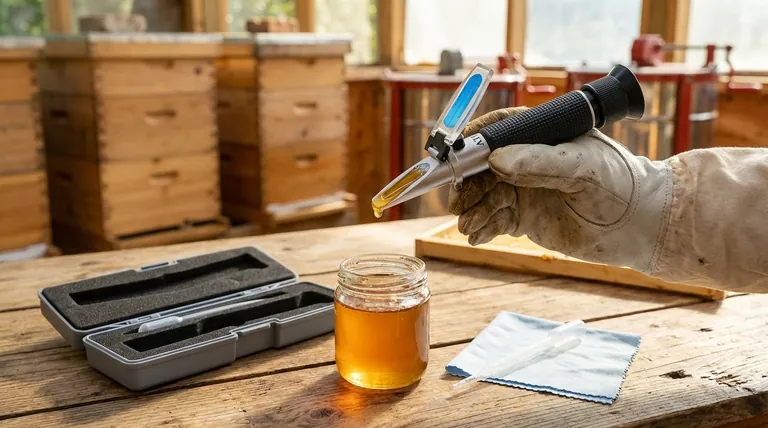
A refractometer is a precision optical instrument. It works by measuring how light bends as it passes through your honey sample, and this all happens on the surface of a delicate glass prism. For an accurate reading, that surface must be perfectly clean and smooth.
The root of inconsistent readings lies in what happens after you take a measurement.
When a thin film of honey is left on the prism, it dries. As the water evaporates, the sugars crystallize, forming microscopic, razor-sharp structures. To your eye, the prism might just look a little smudged. But at a microscopic level, it's like leaving a patch of fine-grit sandpaper sitting on delicate glass.
When you later wipe away this dried honey, those hard sugar crystals are dragged across the prism, creating tiny, permanent scratches. Over time, this cumulative damage creates a hazy, scuffed surface that scatters light instead of refracting it cleanly. The result? A blurry line in the eyepiece and readings that jump all over the place.
This is why a brand-new refractometer works perfectly at first, only to become unreliable over time. It's not failing; it's being slowly damaged by a process that could have been prevented. Storing it in a hot truck or a damp shed only accelerates the decay, causing internal components to warp or foster mold.
The Solution: A Professional Tool Designed for a Professional Process
To break this cycle of damage, you need to stop thinking about storage as an afterthought. It is a critical part of the measurement process. And to implement that process reliably, you need a tool built for the demands of a commercial operation.
The solution isn't just to "clean it better." It's to have a system where the correct process is the easiest one to follow. This requires a tool that is:
- Easy to Clean Thoroughly: Built with smooth, accessible surfaces that don't trap residue.
- Robustly Constructed: Able to withstand the temperature and humidity swings of a real-world work environment without losing calibration.
- Protected by Design: Comes with a durable, form-fitting case that shields the delicate optics from dust, impact, and environmental hazards.
At HONESTBEE, our professional-grade refractometers are supplied with this philosophy in mind. They are not just designed to take a reading; they are designed to preserve their accuracy over thousands of readings. The robust build and the protective case aren't features; they are essential components of a reliable measurement system.
Beyond Accuracy: The Business of Trustworthy Data
When you can finally trust your refractometer every single time, it changes more than just your mood. It transforms your entire operation.
The nagging question of "Is this reading right?" disappears. In its place comes the confidence to make critical business decisions:
- Harvest at the perfect moment to maximize yield without risking spoilage.
- Accurately grade and price your honey, ensuring you get the full value for your premium product.
- Build a reputation for unwavering quality and consistency, making you a preferred supplier for distributors and customers.
Ultimately, a reliable instrument frees you from worrying about your tools and lets you focus on what you do best: producing exceptional honey.
Your honey's quality is non-negotiable, and the data you use to verify it should be too. Moving from an unreliable tool to a professional-grade system is one of the most direct investments you can make in your business's long-term success. If you're ready to put an end to inconsistent readings for good, our team can help you select the right equipment for your scale and needs. Contact Our Experts.
Visual Guide
Related Products
- Digital Honey Refractometer for Precision Measurement of Optimal Honey Quality
- Precision Honey Refractometer Instrument for Quality Assessment
- Premium Heat-Resistant Glass Honey Dipper
- Modern Stainless Steel Honey Dipper Stirrer
- Heavy Duty 304 Stainless Steel Honey Dipper
Related Articles
- The Physics of Perfection: Why a Single Number Determines Your Honey's Fate
- How to Accurately Test Honey Readiness: Science-Backed Methods for Beekeepers
- How to Perfect Honey Moisture Levels: A Beekeeper’s Guide to Refractometer Mastery
- From Ambiguity to Certainty: The Practical Case for Digital Honey Refractometers
- Precision in a Drop: Why Your Honey Refractometer Might Be Lying to You