A Successful Hive is a System on the Brink
To an outsider, a thriving beehive in late spring seems like a perfect system. Thousands of workers operate with a single purpose, the queen lays with relentless efficiency, and the air hums with productivity.
But to a beekeeper, this peak performance is also a moment of high alert.
Success creates a fundamental problem: space. A colony's instinct is to grow and hoard. When it runs out of room to do either, its next logical step is not to slow down, but to divide and conquer—to swarm. The entire system, including half the workforce and the old queen, simply leaves.
This is not just a loss of bees; it's a catastrophic failure in honey production. The solution is an act of simple, elegant engineering: adding another box.
The Hive's Two Primal Directives
A beehive's architecture is a physical manifestation of its two core biological drives. Understanding this is key to managing it.
The Brood Box: The Drive to Reproduce
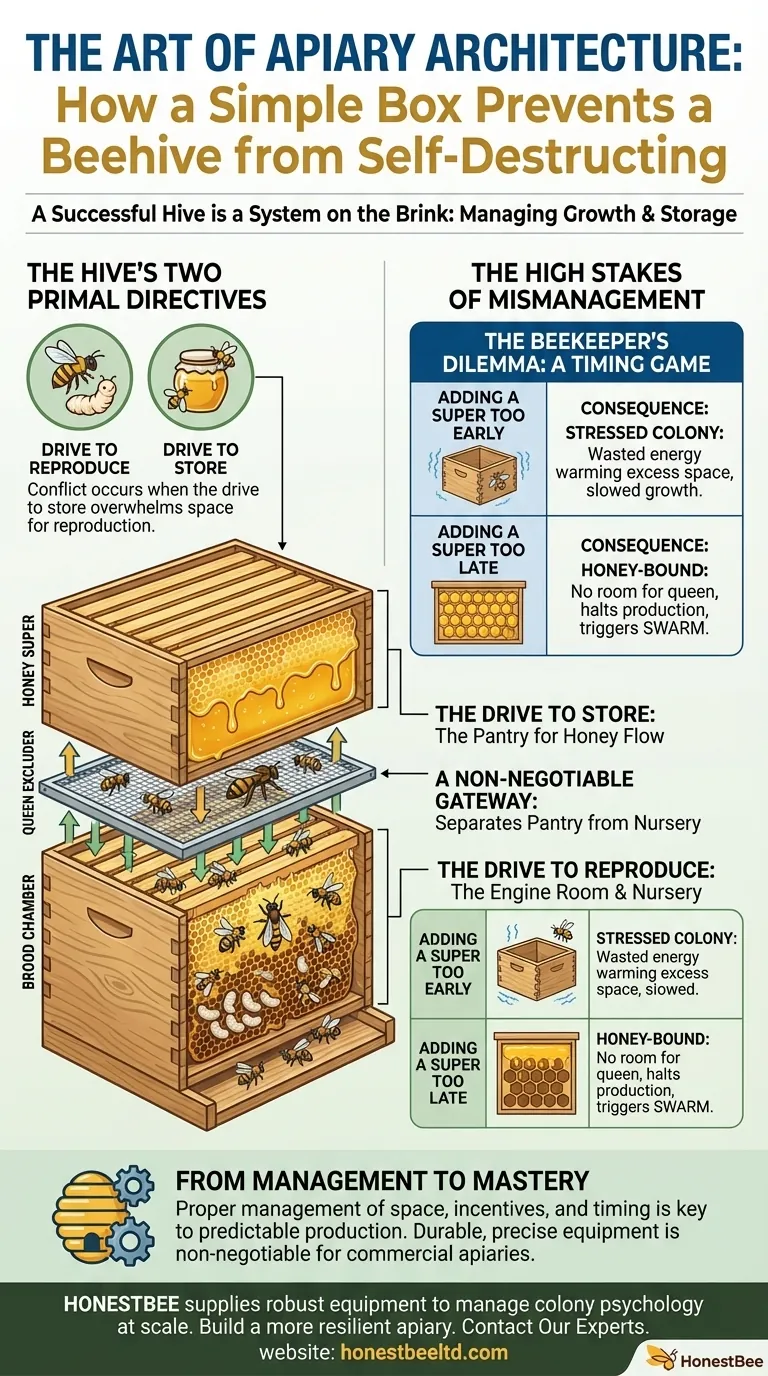
The bottom of the hive is the brood chamber. This is the engine room, the nursery, and the heart of the colony. The queen's sole purpose is to fill it with the next generation of bees. Every decision the colony makes is to protect and expand this core function.
The Honey Flow: The Drive to Store
When nectar is abundant, a second instinct takes over: frantic, obsessive storage. This "honey flow" is a brief window to secure enough resources to survive the long winter. The bees' psychology shifts to hoarding, and they will fill every available cell with nectar.
These two directives can come into conflict. When the drive to store overwhelms the space needed to reproduce, the system breaks.
Engineering a Solution: Separating Pantry from Nursery
The honey super is the tool that resolves this conflict. It is not merely a box for honey; it is an architectural intervention designed to manage the colony's psychology.
By placing an empty box—the honey super—on top of the hive, the beekeeper provides an outlet for the bees' hoarding instinct. But it only works because of a critical component that sits between the two zones.
The Queen Excluder: A Non-Negotiable Gateway
The queen excluder is a simple screen. The gaps are large enough for worker bees to pass through but too small for the larger queen.
This unassuming device enforces a critical rule: the brood chamber is for babies, and the supers are for pantry. Without it, the queen would follow the workers upstairs and turn the honey storage into an extension of the nursery, leading to a messy, complicated harvest. The excluder ensures the honey remains pure and the colony's two primary functions stay separate and efficient.
The High Stakes of Mismanagement
The concept is simple, but the timing is everything. A beekeeper's intervention, or lack thereof, can be the difference between a record harvest and an empty hive.
The core challenge is avoiding a state of "honey-bound" congestion.
This happens when a beekeeper adds a super too late. During a strong honey flow, the workers, desperate for storage space, will start filling the brood cells with nectar. The queen runs out of room to lay, the production of new bees grinds to a halt, and the colony's internal logic concludes that the only option is to swarm.
The Beekeeper's Dilemma: A Timing Game
| Timing Error | The Consequence | The System's Response |
|---|---|---|
| Adding a Super Too Early | A vast, empty space is added before the colony is strong enough to manage it. | The colony becomes stressed, spending energy patrolling and warming the excess space instead of growing. |
| Adding a Super Too Late | The colony runs out of storage space during a peak nectar flow. | The hive becomes "honey-bound," triggering preparations to swarm and a sharp drop in productivity. |
This isn't just about losing honey. For a commercial operation, a swarm is a loss of assets, a disruption of logistics, and a direct hit to the bottom line. Predictability is paramount.
From Management to Mastery
Properly managing honey supers is the bridge between simply keeping bees and running a successful, predictable honey production operation. It is an exercise in managing space, incentives, and timing.
For commercial apiaries, where efficiency and yield are measured at scale, the quality of this equipment is non-negotiable. Warped boxes that don't stack cleanly, frames that break under the weight of honey, or poorly manufactured queen excluders that harm bees are not just inconveniences; they are liabilities that threaten the stability of the entire system.
Durable, precisely-built honey supers and queen excluders are the foundational tools for implementing a sound management strategy. At HONESTBEE, we supply commercial apiaries and distributors with the robust beekeeping equipment necessary to manage colony psychology at scale, ensuring each hive has the architecture it needs to be productive and stable.
If you are ready to build a more resilient and productive apiary, we can help. Contact Our Experts
Visual Guide
Related Products
- Heavy Duty Castellated Iron Frame Spacer for Honey Supers
- Durable 16 Way Circular Bee Escape for Efficient Honey Harvesting
- Digital Honey Refractometer for Precision Measurement of Optimal Honey Quality
- Precision Honey Refractometer Instrument for Quality Assessment
- Professional Plastic Honey Dipper for Easy Honey Drizzling
Related Articles
- How Stored Honey Frames Accelerate Colony Recovery: A Beekeeper’s Guide
- Hive Architecture: How One Empty Box Prevents a Colony's Collapse
- How Honey Frames Naturally Manage Queen Bees Without Compromising Colony Health
- Bee Space: The Architectural Principle Governing a Honeybee Society
- The Beekeeper's Dilemma: Managing Vertical Space and Colony Psychology