The Unseen Hurdle in Queen Rearing
Imagine this: a beekeeper meticulously prepares a state-of-the-art queen rearing kit. Every step is followed by the book. The kit is placed in a strong, populous colony. A week later, they open the hive to find the plastic box bone-dry and utterly ignored. The queen has laid eggs in every available cell around it, but not a single one inside.
This isn't a mechanical failure. It's a biological one.
The colony did not just fail to use the kit; it actively rejected it. The fundamental challenge of queen rearing isn't just placing an object inside a hive. It's about integrating a foreign piece of plastic into the complex, living system of the colony so seamlessly that the bees, and most importantly the queen, accept it as their own.
It is an act of careful, calculated deception.
Speaking the Language of the Hive
To trick a superorganism, you must first understand how it thinks. A bee colony operates on a language of scent, architecture, and instinct. Success depends on speaking this language fluently.
The Power of a Lived-In Home
A new, sterile frame with fresh foundation is an alien object. It smells of plastic and clean wood, not of home.
A dark, drawn-out brood comb, however, is a different story. It is coated in propolis. It carries the distinct pheromones of the colony and the queen. It bears the memory of thousands of bee footsteps and generations of brood. It is a living artifact.
By choosing a well-used brood frame to house the rearing kit, you are wrapping your foreign object in the most powerful camouflage available: the scent of the colony itself. You are making the strange feel familiar.
The Queen's Mental Map
A queen doesn't lay eggs randomly. She operates within a specific zone—the brood nest, the nursery of the hive. This area is distinct from the pantry (honey storage) and the periphery.
Placing a rearing kit in a frame of capped honey is like putting a crib in a kitchen. It’s functionally wrong. The worker bees will see it as empty storage and fill it with nectar. The queen, searching for a nursery, will pass right by.
The kit must be placed in the heart of the action, on the active edge of the brood nest, where the queen expects to find prime real estate for the next generation.
The Surgical Precision of Integration
Once you understand the 'why', the 'how' becomes an exercise in precision. Each step is designed to minimize the colony's awareness that an artificial object has been introduced.
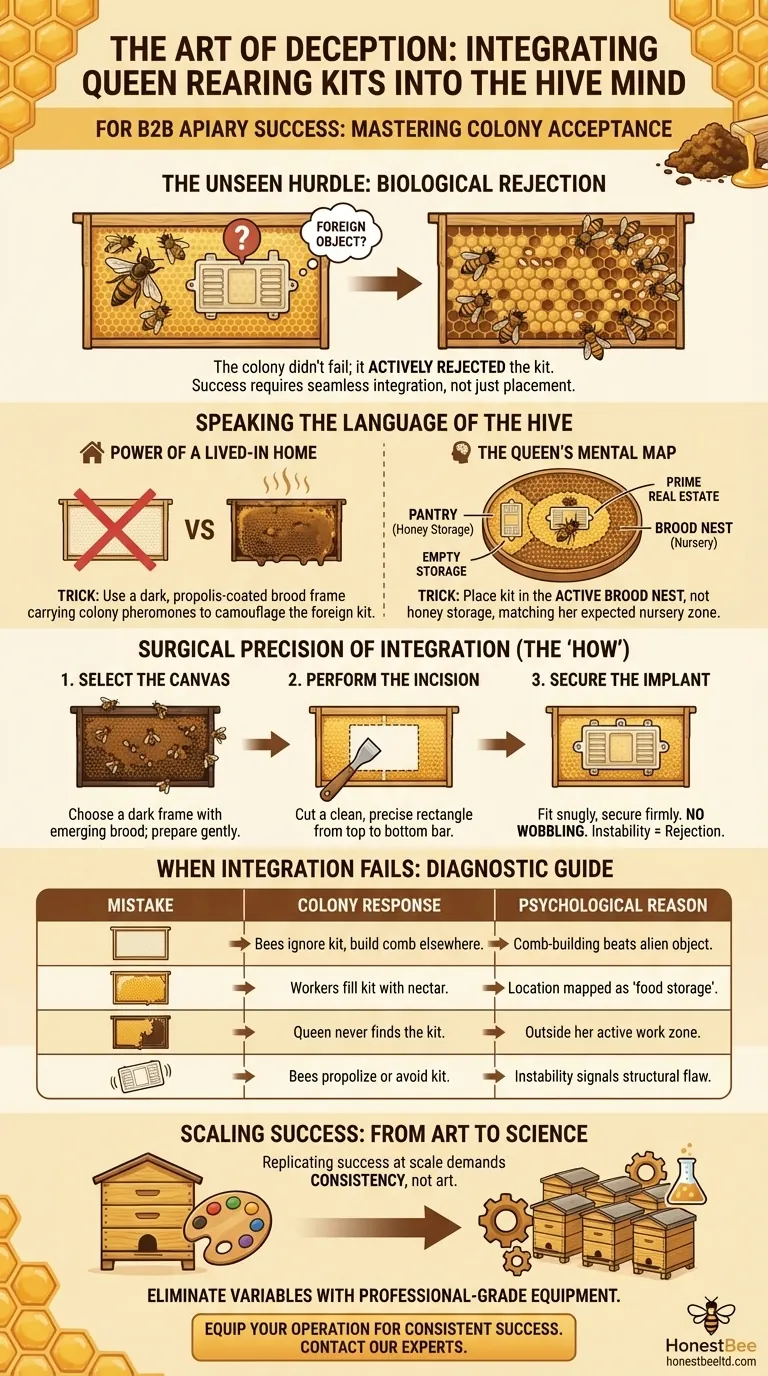
- Select the Canvas: Choose a dark brood frame, preferably one from which brood has recently emerged. This is the most desirable real estate for a queen. Gently brush the bees off.
- Perform the Incision: With a sharp hive tool, cut a clean, rectangular section from the center of the comb, extending from the top bar to the bottom bar. Precision matters; jagged edges are unnatural.
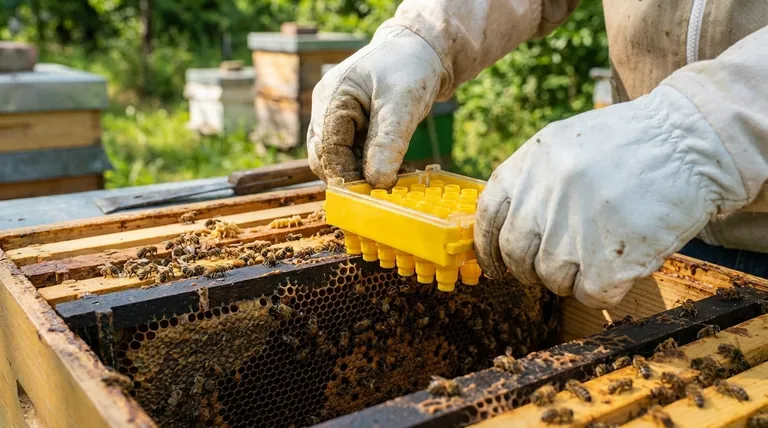
- Secure the Implant: Fit the plastic comb box into the opening, flush against the underside of the top bar. Secure it firmly with screws or staples. It must not wobble. Any instability marks it as a foreign body to be investigated, sealed off, or ignored.
When Integration Fails: A Diagnostic Table
Failure often provides the clearest lessons. Most rejections can be traced back to a specific misstep in this integration process.
| The Mistake | The Colony's Response | The Psychological Reason |
|---|---|---|
| Using a new, undrawn frame | Bees ignore the plastic kit, focusing on drawing wax. | The natural task of comb-building is more attractive than the alien object. |
| Using a frame of capped honey | Workers fill the kit with nectar. | The location is mentally mapped as "food storage," not a "nursery." |
| Placing the frame on the hive edge | The queen never finds or uses the kit. | It’s outside her active work zone, isolated from brood care signals. |
| The kit is loose or wobbly | Bees propolize the kit heavily or avoid it entirely. | Instability signals a structural flaw or foreign invader to be contained. |
Scaling Success: From Art to Science
Mastering this process for one hive is an art. Replicating it successfully across a commercial apiary of hundreds of hives is a science.
At that scale, you cannot afford variables. Consistency is everything. The success of a large-scale queen rearing operation depends on equipment that is uniform, durable, and precisely manufactured. A warped frame, a poorly fitting kit, or unreliable supplies can introduce the very instability and foreignness you are working so hard to eliminate, leading to cascading failures.
This is where professional-grade equipment becomes non-negotiable. For commercial apiaries and equipment distributors focused on productivity, HONESTBEE supplies the robust, wholesale beekeeping equipment that removes these variables. Our products are designed for the rigors of large-scale operations, allowing you to focus on the biology, not on equipment failure.
Ultimately, successful integration is a fusion of deep biological understanding and precise, reliable engineering. By mastering both, you can guide the hive to build the future of your apiary.
If you are ready to equip your operation for consistent success, Contact Our Experts.
Visual Guide
Related Products
- Premium Nicot Style Queen Rearing Kit with Hair Roller Bee Cages
- Jenter Queen Rearing Kit Complete Set for Bee Breeding
- Nicot Queen Rearing Kit for Beekeeping and Grafting in Nicot System
- No Grafting Queen Rearing Kit: System for Royal Jelly Production and Queen Rearing
- Retractable Chinese Queen Rearing Grafting Tools Equipment
Related Articles
- Mastering Queen Rearing: A Beekeeper’s Guide to Reliable Production
- Maximizing Queen Cage Value: A Beekeeper's Guide to Safe Reuse & Long-Term Savings
- An Engineered Truce: The Psychology of the Queen Cage
- Harnessing the Emergency Impulse: The Biology of Commercial Queen Rearing
- Biology's Unforgiving Schedule: Mastering the Two Critical Windows of Queen Rearing