The Beekeeper's Dilemma: Order vs. Growth
A beehive is a masterpiece of organized chaos. It’s a bustling city with a single, obsessive purpose: survival and expansion.
As the beekeeper, you are the city planner. Your primary challenge is imposing a structure that serves your goal—efficient honey production—without disrupting the colony's fundamental nature. This brings you to a single, critical decision point, embodied by a simple piece of equipment: the queen excluder.
The core dilemma is this: how do you separate the hive’s nursery from its pantry?
The Anatomy of a Vertical City
To manage the hive, you must first see it as a system of specialized zones. In a modern vertical hive, two areas are paramount.
The Nursery: A Realm of Constant Growth
The brood chamber is the heart of the colony. It's the engine room, the nursery, where the queen lays thousands of eggs a day. This is where the future workforce is raised. The entire colony's energy is centered here.
The Pantry: A Vault for Liquid Gold
Above the brood chamber sit the honey supers. These are the warehouses, intended for one purpose only: storing the immense surplus of nectar collected by the foragers, which they transform into honey. This is the zone you intend to harvest.
When these two zones mix—when the queen lays eggs in the honey supers—your harvest becomes complicated, messy, and inefficient.
The Excluder: A Simple Machine, A Profound Impact
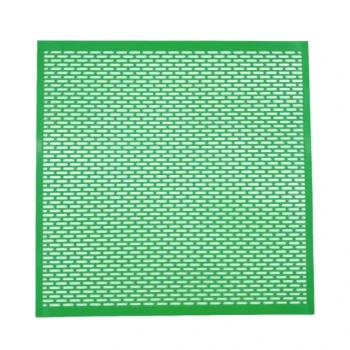
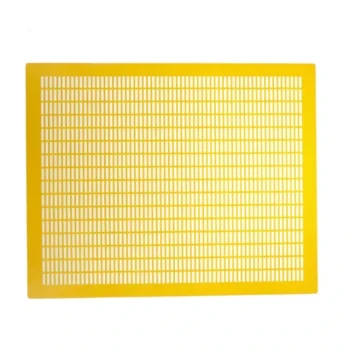
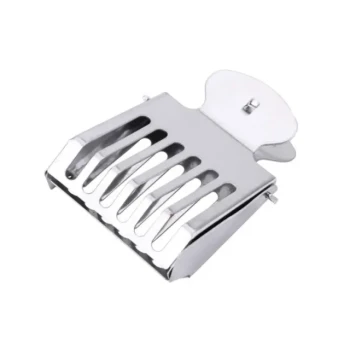
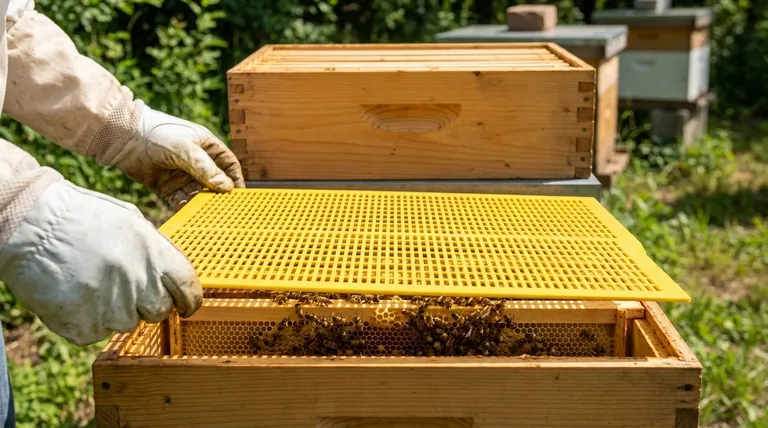
The queen excluder is an elegant solution to this problem. It's a grid with gaps engineered to a precise dimension: large enough for worker bees to pass through, but too small for the queen’s larger thorax.
By placing it between the brood chamber and the honey supers, you create a calculated boundary. You enforce a rule: the queen stays in the nursery.
This single intervention ensures the honey supers remain pristine—filled with nothing but pure, clean honey. It transforms harvesting from a delicate operation of avoiding brood into a simple, streamlined process. It's a triumph of simple engineering.
But imposing order on a natural system always comes with trade-offs.
The Unintended Consequences of Control
The excluder is not just a physical barrier; it can become a psychological one. Understanding its potential downsides is the mark of an advanced beekeeper.
The Psychological Barrier
Some colonies hesitate at the excluder. The workers, who travel between the nursery and pantry hundreds of times a day, may perceive it as an obstacle, slowing traffic. This friction, sometimes called a "honey barrier," can reduce the rate at which they fill the supers.
The Risk of Internal Congestion
If workers are reluctant to move honey upstairs, they may store it in the most convenient place: the brood chamber. This creates a dangerous bottleneck. The nursery's cells fill with honey, leaving the queen with no room to lay. This "honey-bound" condition stifles colony growth and can trigger the colony's ultimate emergency protocol: swarming.
The Strength Prerequisite
A queen excluder is a tool for strong, thriving colonies. A weaker hive lacks the population pressure and foraging force to effectively utilize the space above the barrier. For them, the excluder is not a management tool but an unnecessary impediment.
A Framework for Decision-Making
The choice to use a queen excluder is not about right or wrong; it's about aligning your equipment with your goals. It's a strategic decision, not a default setting.
| Component | Primary Function | Relation to Queen Excluder |
|---|---|---|
| Brood Chamber | Nursery for queen to lay eggs and raise brood. | The excluder confines the queen to this section. |
| Honey Supers | Boxes for honey storage and ripening. | Placed above the excluder to keep them brood-free. |
| Queen Excluder | A grid that acts as a physical barrier. | Placed between the brood chamber and honey supers. |
Your choice depends on your objective:
- For maximum honey purity: Use the excluder. It guarantees clean frames and simplifies extraction, a critical factor for commercial operations.
- For rapid colony expansion: Remove the excluder. It gives the queen unrestricted space, but you must accept brood in your upper boxes.
- If you see reduced production: Re-evaluate. Ensure the colony is strong enough and not honey-bound. The excluder may be revealing a deeper issue.
Engineering for Predictable Success
Ultimately, the queen excluder is a tool of precision. It allows you to create a predictable, efficient system for honey production. But the effectiveness of that system depends entirely on the quality of its components.
A poorly made excluder with rough edges can damage bees' wings, amplifying the "psychological barrier" and slowing your operation. This is why commercial apiaries and distributors rely on wholesale equipment that is durable, uniform, and precision-engineered. At HONESTBEE, we supply beekeeping equipment designed to minimize friction and maximize productivity, ensuring your strategic interventions yield the best results.
Building a more profitable apiary starts with equipment that works with your bees, not against them. To learn how our high-quality supplies can streamline your operation, Contact Our Experts.
Visual Guide

Related Products
- High Performance Plastic Queen Excluder for Beekeeping and Apiary Management
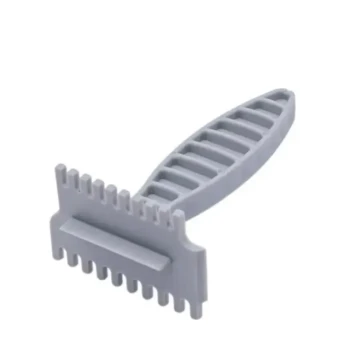
- Lightweight Durable Plastic Queen Excluder Scraper for Beekeeping
- Professional Plastic Queen Excluder for Modern Beekeeping
- Metal Queen Bee Excluder for Beekeeping
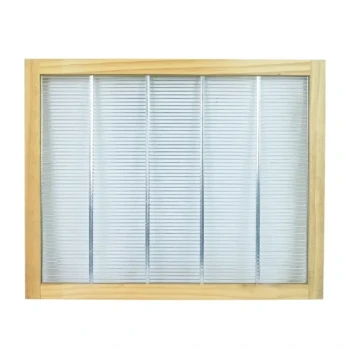
- Premium Wood Framed Metal Wire Queen Bee Excluder
Related Articles
- How Plastic Queen Excluders Improve Hive Longevity and Colony Health
- Plastic Queen Excluders vs. Alternatives: A Beekeeper’s Guide to Smarter Hive Management
- Why Plastic Queen Excluders Outperform Metal and Wood: Science, Savings, and Hive Protection
- How to Choose Queen Excluders Based on Colony Behavior and Queen Traits
- The Geometry of Order: Why the Queen Excluder is a Beekeeper's Most Strategic Tool