The Hidden Cost of a Crooked Comb
Imagine this: a beekeeper, veiled and calm, lifts the lid on a promising hive. Instead of neat, parallel rows of honeycomb, they find a chaotic lattice of cross-comb. The frames are fused together, impossible to remove without tearing apart the colony’s work, spilling honey, and risking the life of the queen.
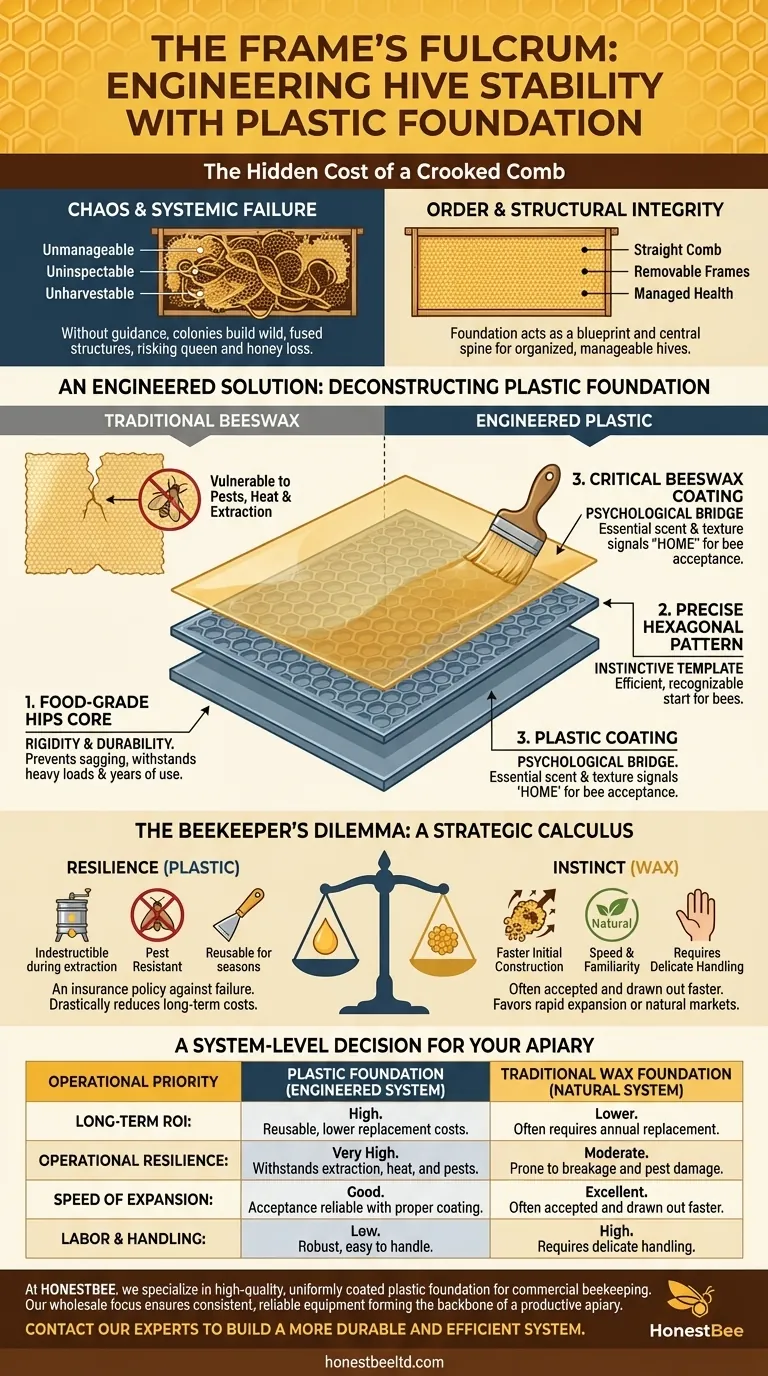
This isn't just a nuisance; it's a systemic failure. The hive has become unmanageable, uninspectable, and unharvestable. The root cause is a lack of guidance—a failure of the hive's internal architecture.
A Blueprint for Order
Foundation is the beekeeper's solution to this chaos. It is a blueprint, a contract offered to the bees. By providing a clear guide, we encourage them to build straight, manageable comb within the confines of a removable frame.
This simple intervention transforms the hive from a wild, unknowable space into an organized system that can be managed for health and productivity. The foundation sheet acts as a central spine, providing the structural integrity needed to support thousands of bees and kilos of honey, especially during the violent, high-speed spin of an extractor.
An Engineered Solution: Deconstructing Plastic Foundation
While traditional beeswax foundation has been used for centuries, plastic foundation represents a deliberate engineering choice, designed to solve the inherent weaknesses of wax.
The Material Matters: More Than Just Plastic
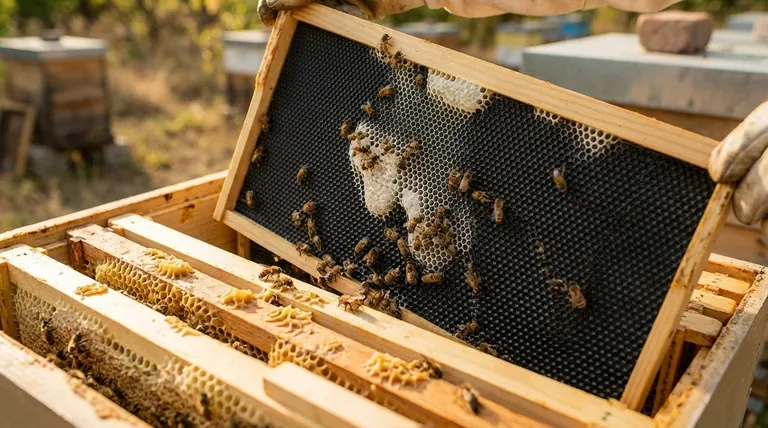
The best plastic foundation isn't just any plastic. It’s typically made from food-grade High Impact Polystyrene (HIPS). This material is selected for a specific set of properties: it's rigid enough to prevent sagging under heavy loads, durable enough to withstand years of use, and stable enough not to warp in summer heat. It is an investment in permanence.
The surface is imprinted with the perfect hexagonal cell pattern that bees instinctively recognize, giving them an efficient and familiar template to start their work.
The Critical Negotiation: The Beeswax Coating
Here is the most fascinating part of the design—a psychological bridge between human engineering and animal instinct. Bees will not work on bare plastic. It is alien to them.
For a plastic foundation to succeed, it must be coated in a thin layer of beeswax. This wax is not for structure; it is for communication. It’s the scent and texture that signals "home" and "start building here." A proper coating is the single most important factor for acceptance, turning an inert object into an active part of the colony.
The Beekeeper's Dilemma: A Calculus of Durability vs. Acceptance
Choosing between plastic and wax is not about which is "better." It's a strategic trade-off that reflects a beekeeper's goals, scale, and philosophy.
The Case for Resilience
Plastic foundation is an insurance policy against failure.
- It is virtually indestructible during honey extraction, a common point of failure for fragile wax.
- Pests like wax moths can tunnel through comb but cannot destroy the plastic base.
- The frames can be scraped clean of old comb and reused for season after season, drastically reducing long-term costs.
For a commercial apiary, where equipment failure translates directly to lost revenue and time, this durability isn't a luxury; it's a core operational advantage.
The Case for Instinct
The primary challenge with plastic is bee acceptance. Some colonies, even with a perfect wax coating, are slower to build on plastic compared to a pure beeswax foundation.
For operations focused on rapid colony expansion or those catering to a market for "all-natural" products, the speed and familiarity of traditional wax can be a deciding factor. It requires more careful handling but often results in faster initial comb construction.
A System-Level Decision for Your Apiary
Ultimately, your choice of foundation dictates the workflow and economic model of your entire operation. It is an architectural decision with long-term consequences.
| Operational Priority | Plastic Foundation (Engineered System) | Traditional Wax Foundation (Natural System) |
|---|---|---|
| Long-Term ROI | High. Reusable for years, lower replacement costs. | Lower. Often requires annual replacement. |
| Operational Resilience | Very High. Withstands extraction, heat, and pests. | Moderate. Prone to breakage and pest damage. |
| Speed of Expansion | Good. Acceptance is reliable with proper coating. | Excellent. Often accepted and drawn out faster. |
| Labor & Handling | Low. Robust and easy to handle without damage. | High. Requires delicate handling to avoid breakage. |
For commercial apiaries and equipment distributors, the calculus often favors a system built for longevity and efficiency. The ability to reuse foundation year after year isn't just about saving money on materials; it’s about creating a more predictable, scalable, and resilient operation.
At HONESTBEE, we specialize in supplying high-quality, uniformly coated plastic foundation designed for the rigors of commercial beekeeping. Our wholesale focus ensures you receive consistent, reliable equipment that forms the backbone of a productive apiary. To build a more durable and efficient system, you need a foundation you can trust. Contact Our Experts
Visual Guide
Related Products
- Assembled Wooden Bee Frames with Plastic Foundation for Durability and Convenience by HONESTBEE
- Plastic Bee Frame Beekeeping Hive Frames for Wholesale
- Food Grade Plastic bee Foundation for Bee Frames
- Professional Insulated Plastic Bee Hives
- Durable Plastic Interlocking Hive Connector for Beekeeping
Related Articles
- How to Clear Bees from Frames Without Compromising Honey Quality or Colony Health
- Beyond the Scrape: A Systemic Approach to Bee Frame Management
- The Pragmatic Hive: Engineering Resilience with Wood Frames and Plastic Foundation
- Why Wooden Beehive Frames Outperform Alternatives: Science, Sustainability, and Beekeeper Experiences
- Why Your Plastic Frames Are Warping—And Costing You More Than You Think