The All-Too-Common Mistake
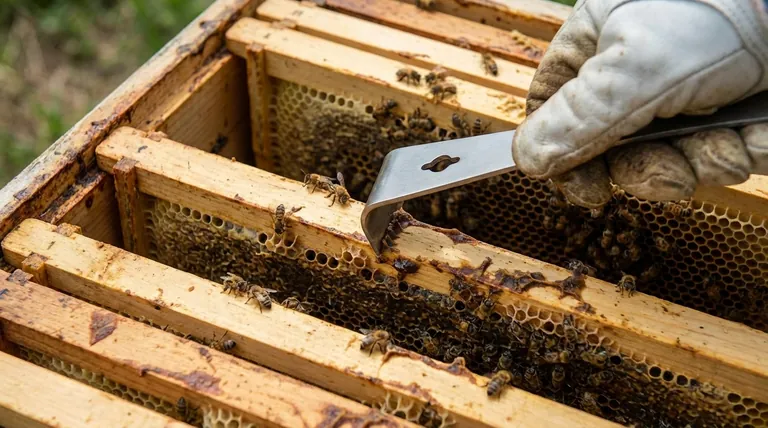
A beekeeper stands over an open hive. The goal is simple: inspect a single frame. But it's stuck. Glued in place.
The novice instinct, a deeply human one, is to apply more force. A sharp tug, a quick jerk. The frame finally rips free, but at a cost: a sickening crunch of crushed bees and the immediate, rising hum of an agitated colony.
This moment reveals a fundamental misunderstanding not of beekeeping, but of physics and psychology. The problem wasn't a lack of strength; it was an incorrect approach to a delicate system.
A World Sealed by Propolis
To understand the solution, you must first respect the problem. Frames aren't just resting in the hive; they are sealed in place by the bees with a substance called propolis.
This resinous glue is the bees' master building material. They use it to seal drafts, reinforce the structure, and maintain an antiseptic environment. For the bees, it's architectural integrity. For the beekeeper, it’s a powerful adhesive that turns a simple lift into a complex challenge.
Attempting to fight this adhesive with brute force is like trying to solve a puzzle with a hammer. You’ll break the pieces long before you find the solution.
Your Tool is a Lever, Not a Pry Bar
This is where the hive tool enters the scene. Most beginners see it as a small crowbar. This is a psychological error.
A crowbar is for demolition. A hive tool is for controlled separation. Its primary function is to act as a lever, transforming a small, gentle force from your hand into a powerful, precise pressure capable of breaking the propolis seal without a violent shock to the system.
A well-designed hive tool, crafted from durable steel with a precise hook, becomes an extension of a calm beekeeper's intent. For commercial apiaries, where hundreds of hives are inspected, the quality of this simple lever isn't a luxury; it's the foundation of efficiency and colony health. HONESTBEE specializes in supplying these professional-grade tools, understanding that reliability at scale starts with the basics.
The Method: A System of Finesse
The correct technique for lifting a frame isn't a single action. It’s a deliberate, multi-step process designed to respect the hive's construction.
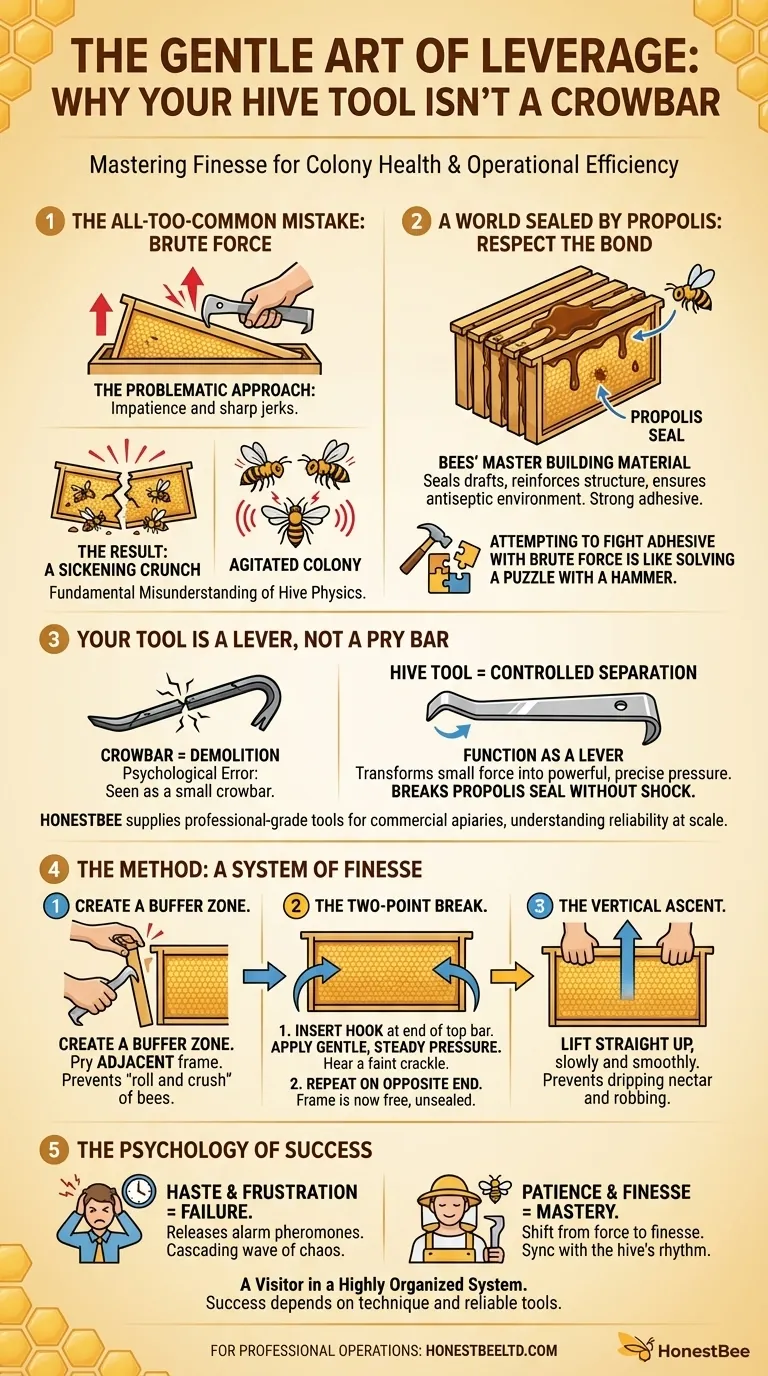
Step 1: Create a Buffer Zone
The most critical step happens before you even touch the frame you want to inspect. Use your hive tool to gently pry an adjacent frame a few millimeters away.
This small action is everything. It creates a space, a buffer that prevents the catastrophic "roll and crush" of bees between frames. It’s a gesture of foresight.
Step 2: The Two-Point Break
Now, focus on your target frame.
- Insert the hook of your hive tool between one end of the top bar and the hive wall.
- Apply gentle, steady pressure. You’re not lifting; you’re just breaking the seal. You’ll hear a faint crackle.
- Repeat on the opposite end of the same frame.
The frame is now free, unsealed on both sides without having been violently moved.
Step 3: The Vertical Ascent
With the frame loose, slide the hook under one side of the top bar to lift it just enough to get your fingers on it. Grasp the top bar firmly with both hands and lift it straight up, slowly and smoothly.
Keeping the frame vertical prevents fresh nectar from dripping, an event that can trigger robbing behavior from other bees.
The Psychology of Failure
Mistakes in this process are rarely due to a lack of knowledge. They stem from impatience.
The "roll and crush" is a failure to think one step ahead. It releases alarm pheromones, a chemical signal that instantly puts the entire colony on the defensive. A simple mistake creates a cascading wave of chaos, turning a peaceful inspection into a stressful confrontation.
Aggressive prying is a failure of control. It’s the result of frustration. But the hive doesn’t reward haste. It rewards calm, methodical action. The bees operate on their own time, and a successful beekeeper learns to sync with that rhythm.
Mastering this simple lever-and-lift technique is more than just a mechanical skill. It’s a shift in mindset—from one of force to one of finesse. It’s the recognition that you are a visitor in a highly organized, delicate system. Your success, whether managing ten hives or a thousand, depends on the quality of your technique and the reliability of your tools.
For professional operations demanding equipment that withstands constant use and enables this precise work, having the right supplier is critical. Contact Our Experts
Visual Guide
Related Products
- HONESTBEE Professional Long Handled Hive Tool with Precision Cutting Blade
- Professional Multi-Function Stainless Steel Hive Tool
- HONESTBEE Premium Italian Style Hive Tool with Hardwood Handle
- Ergonomic Plastic Frame Spacer Tool for Rapid Hive Management Beekeeping
- Professional Grade Foldable Beehive Handles
Related Articles
- Force and Finesse: The Hive Tool as the Beekeeper's Critical Interface
- The Essential Guide to Hive Tools in Modern Beekeeping
- The Apiary as a System: Why Your Hive Tool is More Than Just Steel
- How to Choose Hive Tools That Match Your Beekeeping Workflow
- The Beekeeper's Scalpel: How a Simple Hive Tool Governs Apiary Health


















