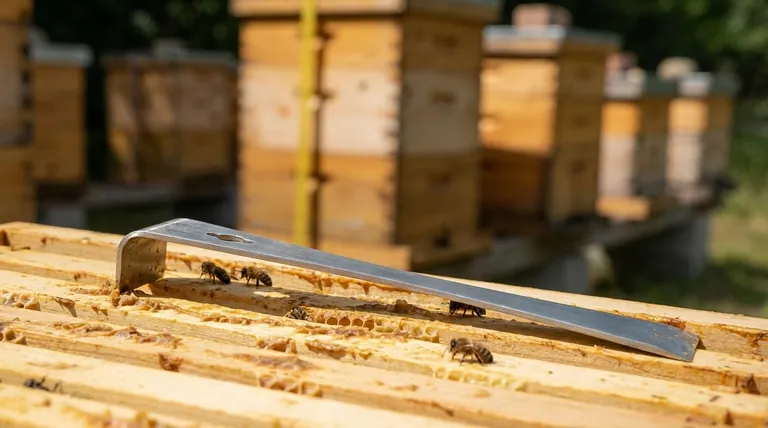
The Beekeeper's Paradox
A honeybee hive is a fortress. The colony engineers it for perfect climate control and defense, sealing every seam and crack with a potent, sticky resin called propolis. For the bees, this creates a single, solid, biosecure unit.
For the beekeeper, it presents a paradox: How do you inspect, manage, and care for a colony that has intentionally made itself impenetrable?
The answer lies not in brute force, but in controlled, intelligent force. The answer is the hive tool. It is less a crowbar and more a key, designed to interact with the hive's own engineering and psychology.
An Extension of the Beekeeper's Will
A hive inspection is a delicate conversation. Hasty, clumsy movements are perceived as a threat, releasing alarm pheromones and turning a calm colony defensive. Your hive tool is the medium for this conversation.
Its true function is to allow you to be firm yet gentle, decisive yet quiet. A well-designed tool feels like an extension of your own hands, translating your intent into precise, effective action. A poor one creates friction, frustration, and chaos.
The Anatomy of a Purpose-Built Instrument
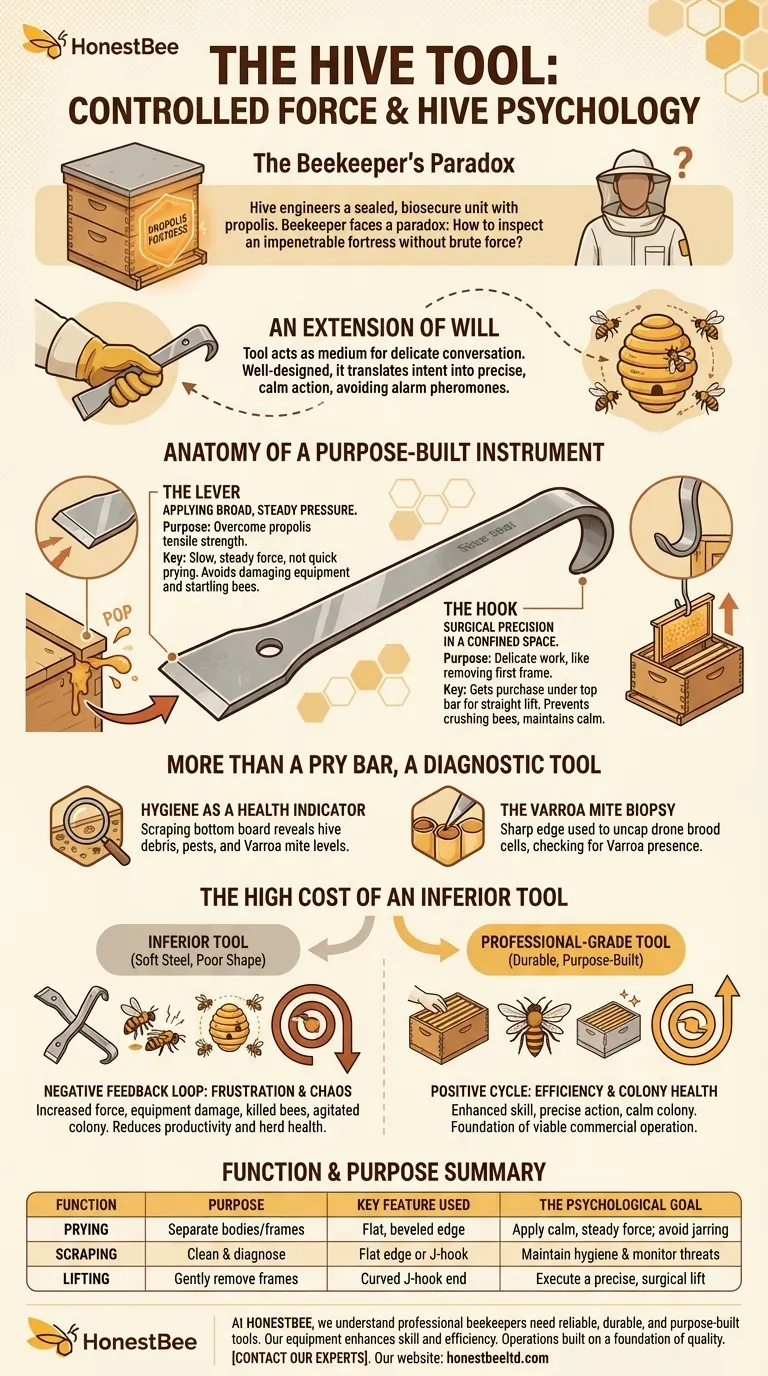
The standard hive tool is a study in purposeful design. It is not one tool, but two, fused into a single piece of steel. Each end solves a different physical problem.
The Lever: Applying Broad, Steady Pressure
The flat, beveled edge is a lever. Its purpose is to overcome the incredible tensile strength of propolis when separating heavy hive bodies or an inner cover.
The mistake is to think of it as a tool for quick, jerky prying. That damages equipment and startles the bees. Its genius is in allowing the beekeeper to apply slow, steady, and distributed pressure, causing the propolis seal to release with a gentle pop rather than a violent crack.
The Hook: Surgical Precision in a Confined Space
The J-hook end is for more delicate work. Removing the first frame from a tightly packed box is one of the most high-stakes moments of an inspection. There is no room for error.
The hook allows you to get purchase under the frame's top bar and lift it straight up, avoiding the rolling motion that crushes bees against the adjacent frame. It is the difference between a smooth lift and an incident that puts the entire colony on edge.
More Than a Pry Bar, A Diagnostic Tool
While a hive tool's primary functions are mechanical, its most advanced applications are diagnostic. It allows you to read the subtle language of the hive.
-
Hygiene as a Health Indicator: Scraping the bottom board is not just cleaning. You are surveying the hive's debris for signs of pests like wax moth larvae or a high count of dropped Varroa mites, giving you a direct window into the colony's health.
-
The Varroa Mite Biopsy: The most significant threat to honeybee health is the Varroa mite, which reproduces under the capped cells of developing bees. The sharp edge of a hive tool can be used to uncap a few drone brood cells—a quick, minimally invasive biopsy to check for the presence of these parasites.
The High Cost of an Inferior Tool
For a commercial beekeeper, efficiency and colony temperament are everything. This is where the quality of a hive tool reveals its true economic impact.
A tool made from soft steel will bend under the weight of a heavy super, forcing you to use more force and risk damaging the wooden boxes. A poorly shaped J-hook won't grip a frame properly, leading to slips that can kill dozens of bees, including, potentially, the queen.
This creates a negative feedback loop. A bad tool leads to frustrating inspections, which agitates the colony, which makes future inspections even more difficult and time-consuming. It's a direct tax on your productivity and your herd's health.
For commercial apiaries and distributors, where every minute and every colony counts, professional-grade equipment isn't a luxury; it's the foundation of a viable operation. The hive tool is the most-used piece of equipment you own, and its quality should reflect that.
| Function | Purpose | Key Feature Used | The Psychological Goal |
|---|---|---|---|
| Prying | Separate hive bodies & frames sealed by propolis | Flat, beveled edge | Apply calm, steady force; avoid jarring |
| Scraping | Clean components & perform diagnostic checks | Flat edge or J-hook | Maintain hygiene & monitor for threats |
| Lifting | Gently remove the first frame from a box | Curved J-hook end | Execute a precise, surgical lift |
At HONESTBEE, we understand that professional beekeepers need tools that are reliable, durable, and purpose-built for the rigors of commercial work. Our equipment is designed to enhance your skill and efficiency, not hinder it. To ensure your operations are built on a foundation of quality.
Visual Guide
Related Products
- HONESTBEE Professional Long Handled Hive Tool with Precision Cutting Blade
- Professional Multi-Function Stainless Steel Hive Tool
- HONESTBEE Premium Italian Style Hive Tool with Hardwood Handle
- Ergonomic Plastic Frame Spacer Tool for Rapid Hive Management Beekeeping
- Professional Grade Foldable Beehive Handles
Related Articles
- Force and Finesse: The Hive Tool as the Beekeeper's Critical Interface
- The Essential Guide to Hive Tools in Modern Beekeeping
- The Apiary as a System: Why Your Hive Tool is More Than Just Steel
- How to Choose Hive Tools That Match Your Beekeeping Workflow
- The Beekeeper's Scalpel: How a Simple Hive Tool Governs Apiary Health


















