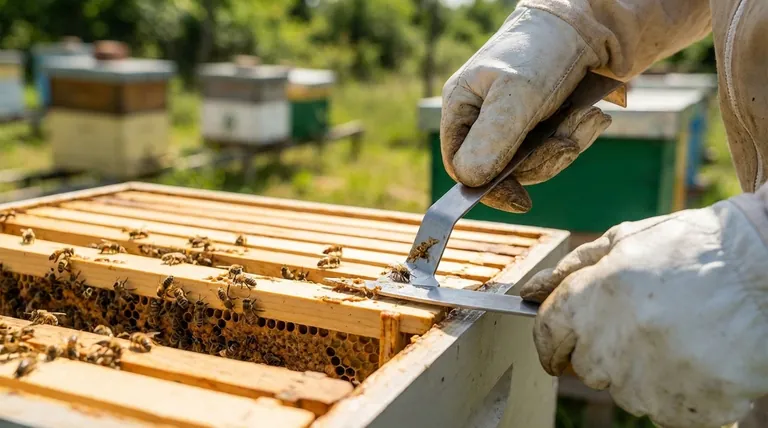
The Illusion of the Simple Lift
In beekeeping, few moments are as fundamental as lifting a frame from the hive. It appears simple. A straightforward physical task. Yet, this is where the seasoned professional and the struggling novice are most clearly distinguished.
The novice expects the frame to lift freely. The professional expects resistance.
This mental shift is everything. It acknowledges that a beehive is not a cabinet of neatly filed drawers, but a living, breathing structure, actively engineered and sealed by its inhabitants. Understanding this resistance is the first step toward mastering the hive.
The Architecture of Resistance
Frames don't lift easily because bees are master architects and civil engineers. They work tirelessly to seal their home against intruders and the elements, using two primary materials.
Propolis: The Bees' Structural Epoxy
Bees manufacture a potent, resinous substance called propolis. It's far more than "bee glue." It is a structural epoxy they apply to every seam and crack, cementing frames to the hive body and to each other with surprising tenacity. This bond creates a solid, unified interior.
Brace Comb: Purposeful Infill
Bees abhor a vacuum. Any gap that doesn't conform to the principle of "bee space" is filled with extra wax constructions known as brace or burr comb. This wax acts as a physical barrier, connecting frames and further locking the hive's internal structure in place.
The Choreography of a Calm Inspection
A successful frame lift is not an act of strength but a fluid, two-part process. It's a choreography that requires the hive tool to be an extension of your hand, not just a separate tool you pick up and put down.
Step 1: The Surgical Separation
Before any lift is attempted, the propolis seals must be broken. This isn't brute-force prying. It's a precise, surgical action. Use the flat end of your hive tool to cleanly sever the bonds between the frame ends and the hive wall, and then between adjacent frames.
Step 2: The Controlled Ascent
With the seals broken, slide the hooked end of the tool under the frame's top bar. This is the critical moment. You lift slowly and steadily with the tool, while your other hand is ready to grip the frame.
Because the tool is still in your hand, you are prepared for the unexpected resistance of a missed propolis seal or a hidden piece of brace comb. This readiness provides three crucial advantages:
- Instant Response: You can immediately re-apply leverage or scrape away comb without pause.
- Seamless Motion: The entire process is one continuous, smooth action, which is calming for the bees.
- Absolute Control: You never have to awkwardly set a half-lifted frame back down to retrieve your tool.
The Cognitive Cost of a Fumbled Tool
Failing to keep the tool in hand creates a cascade of inefficiencies and psychological friction. It replaces a state of flow with a cycle of frustration.
The Cycle of Interruption
The most common mistake is setting the tool down to get a two-handed grip. When the frame sticks, your workflow is broken. You must halt, awkwardly lower the frame, locate the tool, and restart. This sequence of fumbled movements agitates the colony and shatters your focus.
The Fallacy of Force
When a smooth lift fails, the instinct is to yank. This is a cognitive failure, an admission that control has been lost. Using brute force is a high-risk gamble. It stresses the bees, shatters delicate comb, and risks dropping the frame—a catastrophic event if it crushes the queen.
From Conscious Practice to Unconscious Skill
Treating the hive tool as an ever-present part of your hand transforms inspections from a chaotic struggle into a predictable, calm procedure. It’s a small habit that builds a foundation of mastery.
| Habit | Mindset | Outcome |
|---|---|---|
| Setting Tool Down | Reactive, Interrupted | Stress, Inefficiency, Risk to Bees |
| Tool Remains in Hand | Proactive, Fluid | Control, Efficiency, Colony Safety |
This mastery isn't just about technique; it's about having equipment that can withstand the demands of professional practice. A tool that bends, slips, or feels awkward in the hand disrupts the very flow state you are trying to achieve.
For commercial apiaries and beekeeping distributors, this principle scales. Every second saved, every ounce of disruption avoided, and every colony kept calm contributes directly to the bottom line. This is why professionals rely on HONESTBEE for beekeeping supplies. Our hive tools are designed not as accessories, but as essential extensions of the professional's hand—durable, ergonomic, and built for the beekeeper who understands that efficiency is born from seamless control.
For apiaries and distributors committed to this level of operational excellence, having the right equipment is non-negotiable. Contact Our Experts
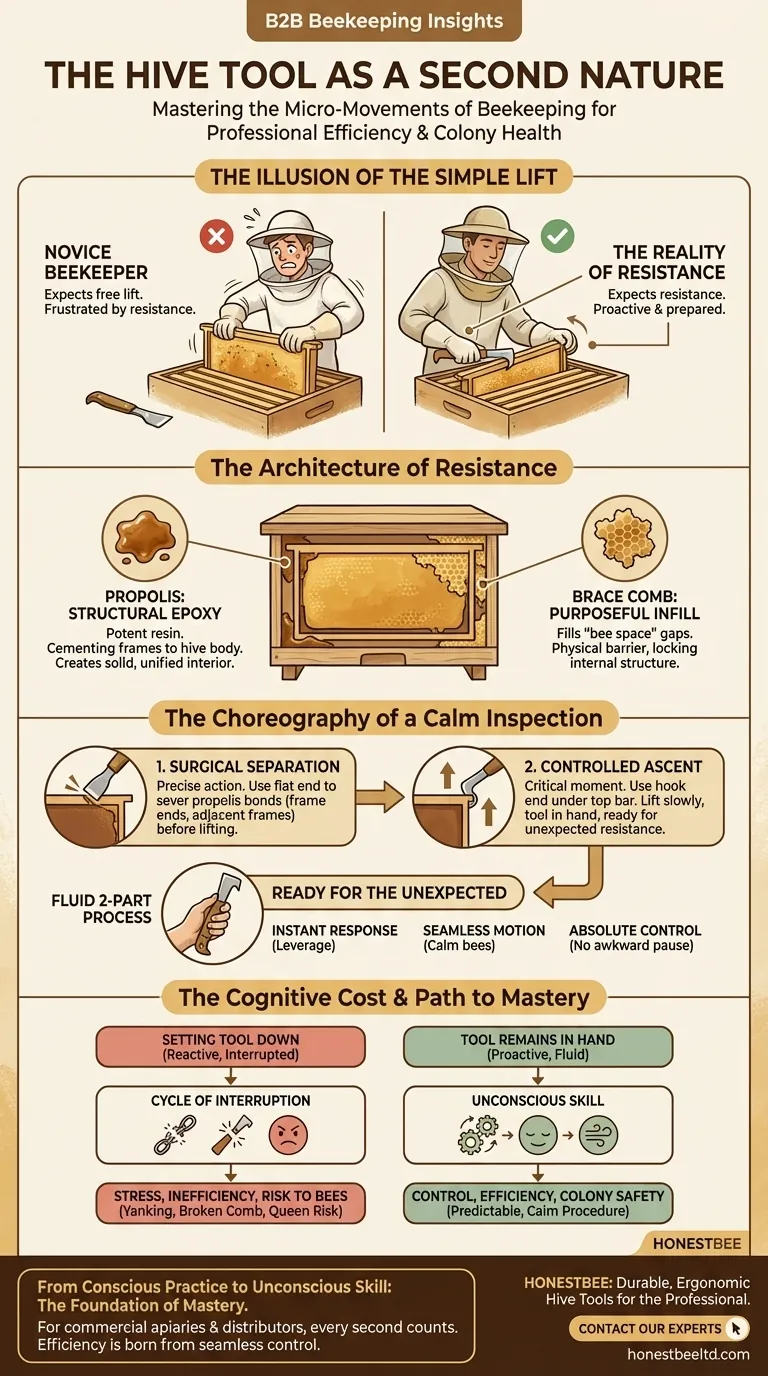
Visual Guide
Related Products
- HONESTBEE Professional Long Handled Hive Tool with Precision Cutting Blade
- Professional Multi-Function Stainless Steel Hive Tool
- HONESTBEE Premium Italian Style Hive Tool with Hardwood Handle
- Ergonomic Plastic Frame Spacer Tool for Rapid Hive Management Beekeeping
- Professional Grade Foldable Beehive Handles
Related Articles
- Force and Finesse: The Hive Tool as the Beekeeper's Critical Interface
- The Essential Guide to Hive Tools in Modern Beekeeping
- The Apiary as a System: Why Your Hive Tool is More Than Just Steel
- How to Choose Hive Tools That Match Your Beekeeping Workflow
- The Beekeeper's Scalpel: How a Simple Hive Tool Governs Apiary Health


















