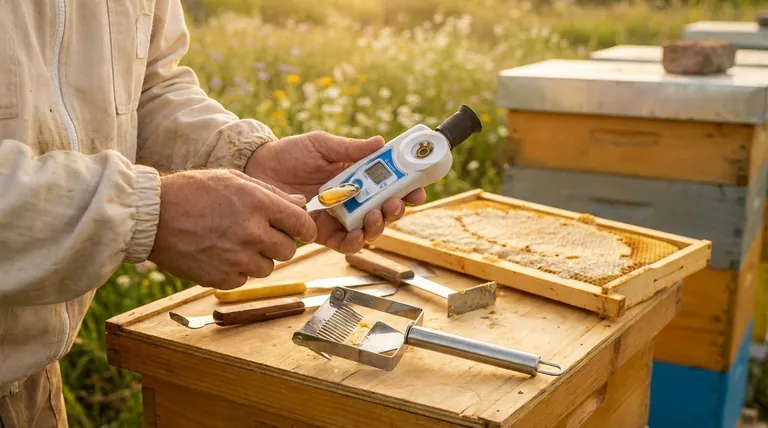
The Unseen Threat in Every Harvest
A honey harvest represents an entire season of meticulous work. It’s a physical manifestation of investment, labor, and ecological partnership. Yet, all of it can be undone by an invisible factor: a few percentage points of excess water.
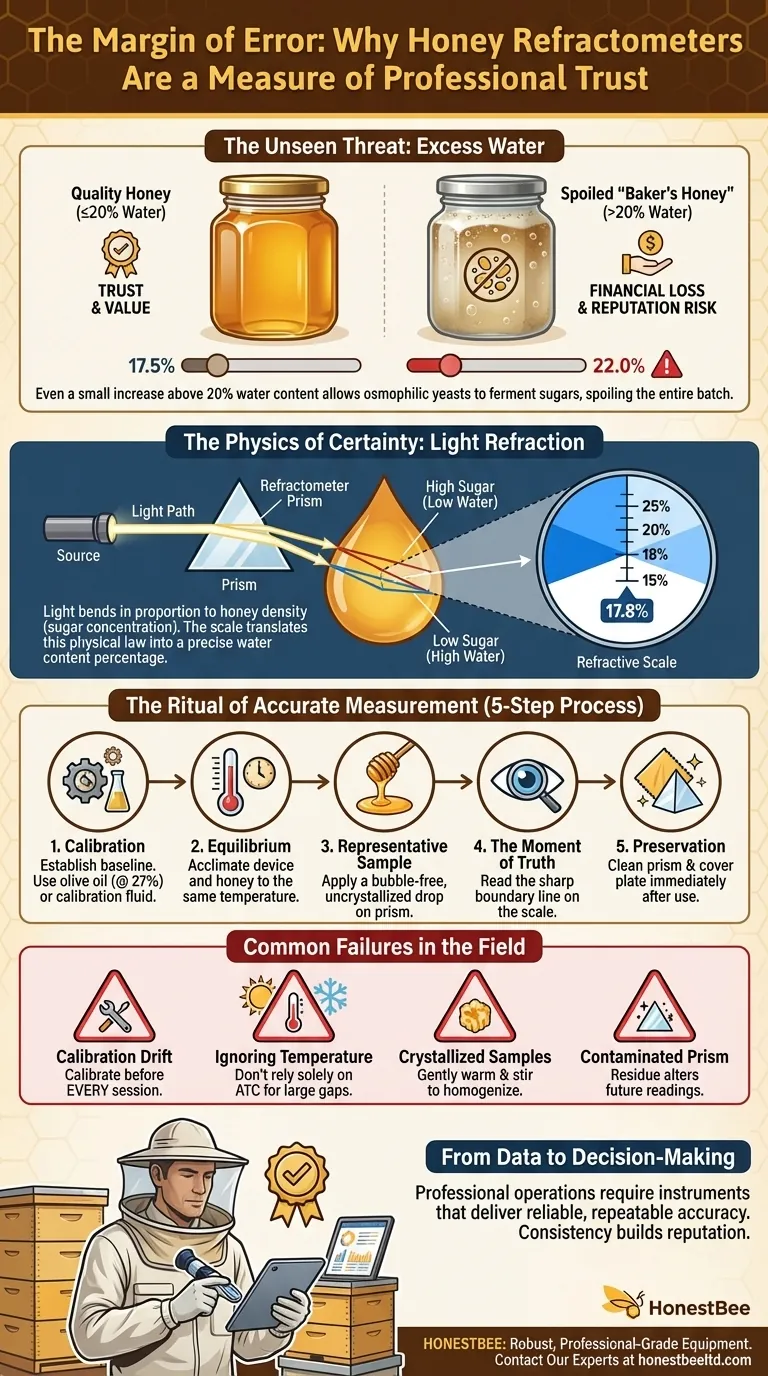
This is not a minor detail. Honey with a water content above 20% becomes a breeding ground for osmophilic yeasts. These naturally occurring microbes will ferment the sugars, spoiling the entire batch and downgrading it to "baker's honey"—or worse, a complete loss.
For a commercial apiary, this is a catastrophic financial and reputational failure. For a distributor, it’s a breach of trust with every client. The refractometer isn't just a tool for measurement; it's a tool for risk management.
Beyond Spoilage: The Standard of Quality
Beyond the biological risk, there are legal and commercial standards. Regulatory bodies often mandate that honey's water content not exceed a specific threshold, typically around 21%.
Meeting this standard is the bare minimum. True quality, the kind that builds a brand, comes from consistently producing stable, delicious honey. A precise reading is your guarantee that every jar meets that promise.
The Physics of Certainty
A refractometer operates on an elegant and immutable principle of physics: the refraction of light.
When light passes through the device's prism into a drop of honey, it bends. The angle of this bend is directly proportional to the density of the honey—specifically, its concentration of dissolved solids (sugars).
Higher sugar concentration means lower water content and a greater bend in the light. The device’s scale translates this physical law into a single, critical number: the water content percentage. It is a simple, analog confirmation of quality.
The Ritual of Accurate Measurement
Accuracy is not a feature of the tool; it is a product of the process. For professionals, using a refractometer is less a task and more a ritual, where each step is foundational to the next.
Step 1: The Foundation of Calibration
Before any measurements are taken, the instrument must be calibrated. This act establishes your baseline for truth. An uncalibrated tool doesn’t give you bad data; it gives you misinformation.
- Action: Use the supplied calibration fluid or a drop of pure olive oil.
- Target: Olive oil should register precisely at 27% water content on a honey refractometer.
- Adjustment: Turn the calibration screw until the boundary line rests exactly on the target value.
Step 2: The Law of Equilibrium
The laws of physics are sensitive to temperature. For a reading to be accurate, the refractometer and the honey sample must be at the same ambient temperature.
While many professional models feature Automatic Temperature Compensation (ATC), this system is designed to correct for minor fluctuations, not major discrepancies. Testing cold honey with a warm refractometer introduces a variable that compromises certainty. Best practice is to let both acclimate together.
Step 3: The Representative Sample
Place one or two drops on the prism. The objective is a sample that is free of air bubbles and crystallization, as both will distort the path of light and corrupt the reading.
Gently close the cover plate to spread the honey into a thin, even film. A slight wiggle can help expel trapped air. This small sample must speak for the entire batch, so it must be perfect.
Step 4: The Moment of Truth
Hold the device toward a natural light source. Look through the eyepiece and focus it until the scale is sharp. The reading is the point where the boundary between the blue and white fields intersects the scale.
This line represents the water content. It is the definitive data point upon which you will decide to harvest, extract, or wait.
Step 5: Preserving the Instrument
Cleanliness is a core part of the measurement process. Immediately after use, wipe the prism and cover plate with a soft, damp cloth.
Dried honey residue from a previous test will alter the refractive index of the next sample, guaranteeing an incorrect reading. Neglecting this step is choosing to compromise all future work.
Common Failures in the Field
Small mistakes in process cascade into significant errors in judgment. Awareness is the best defense.
- Calibration Drift: Calibrating once a season is not enough. Calibrate before every session to eliminate foundational error.
- Ignoring Temperature: Relying solely on ATC for large temperature gaps is a gamble. Patience costs nothing; a spoiled batch costs everything.
- Crystallized Samples: Testing honey that has begun to crystallize will not yield a representative reading. Gently warm and stir the batch to ensure your sample is homogenous.
- A Contaminated Prism: A forgotten cleaning session renders the tool unreliable. This is the easiest failure to prevent.
From Data to Decision-Making
For commercial apiaries and beekeeping equipment distributors, the stakes are simply too high for ambiguity. The quality of your tools must match the quality of your commitment. A consumer-grade refractometer may be fine for a hobbyist, but a professional operation requires instruments that deliver reliable, repeatable accuracy under field conditions.
This is the standard we support at HONESTBEE. We provide the robust, professional-grade beekeeping supplies and equipment that successful commercial operations depend on. Your reputation is built on consistency, and consistency is built on precision.
To ensure every batch upholds your standard of excellence, you need equipment you can trust. Contact Our Experts
Visual Guide
Related Products
- Digital Honey Refractometer for Precision Measurement of Optimal Honey Quality
- Precision Honey Refractometer Instrument for Quality Assessment
- Premium Heat-Resistant Glass Honey Dipper
- Modern Stainless Steel Honey Dipper Stirrer
- Heavy Duty 304 Stainless Steel Honey Dipper
Related Articles
- The Physics of Perfection: Why a Single Number Determines Your Honey's Fate
- How to Accurately Test Honey Readiness: Science-Backed Methods for Beekeepers
- How to Perfect Honey Moisture Levels: A Beekeeper’s Guide to Refractometer Mastery
- From Ambiguity to Certainty: The Practical Case for Digital Honey Refractometers
- Precision in a Drop: Why Your Honey Refractometer Might Be Lying to You