The Illusion of the Infallible Tool
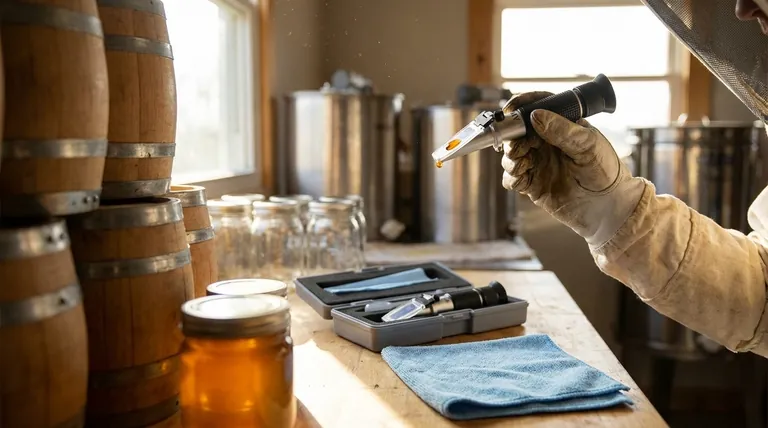
An operator in a commercial apiary places a drop of golden honey on a refractometer prism. The reading: 18.5% moisture. Perfect. He wipes it quickly and tests a sample from the next barrel, harvested the same day. The reading: 19.2%.
Suddenly, a seed of doubt is planted. Is the first barrel safe for storage? Is the second one at risk of fermenting? The immediate suspect is the instrument. We have a deep-seated psychological bias to blame our tools when results are inconsistent.
But a refractometer is a simple, elegant piece of optical engineering. It doesn't lie. It merely shows you what it sees. More often than not, the inconsistency isn't in the device's glass, but in the operator's process. The instrument is an amplifier of our discipline, or our lack thereof.
The Trinity of Trustworthy Data
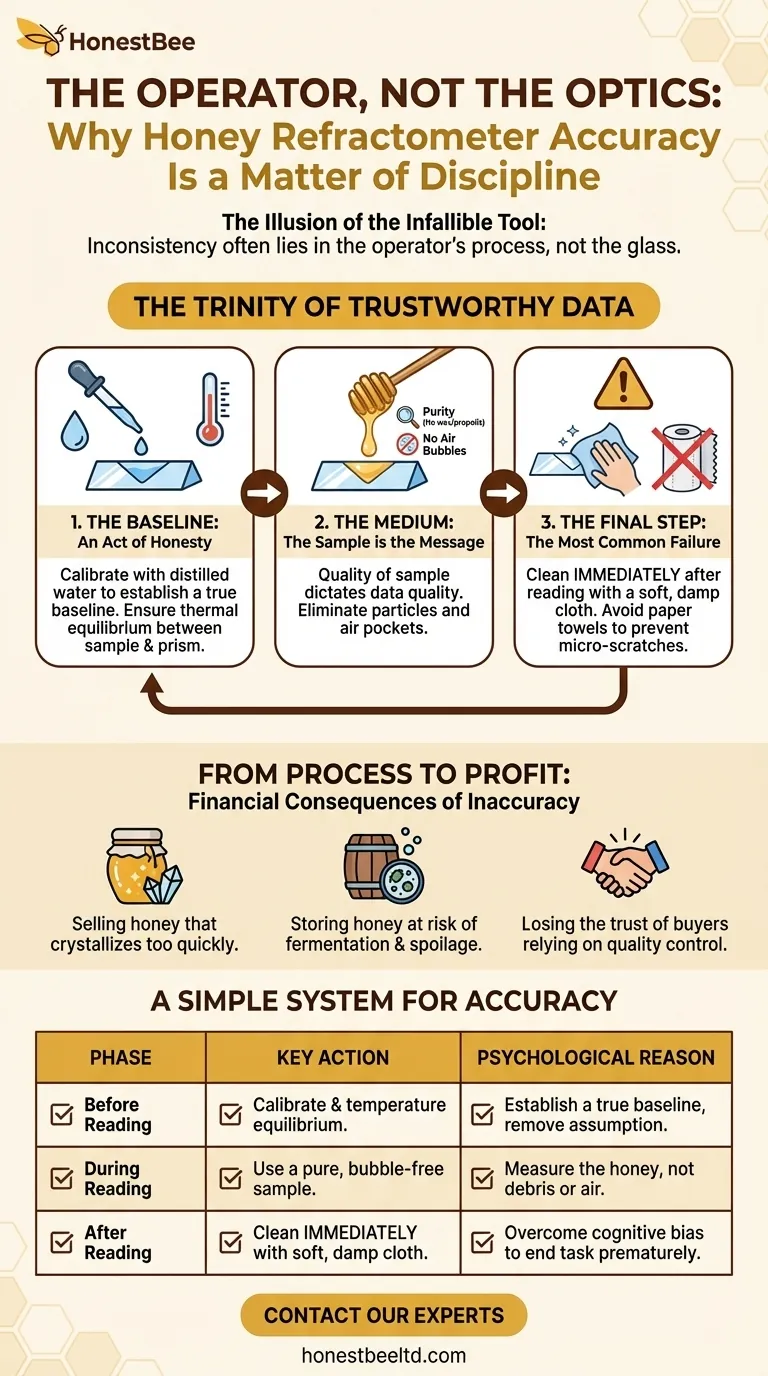
Accurate measurement isn't a single action; it's a three-part system. Each part is equally critical. Treating calibration, sample preparation, and cleaning as separate, optional steps is the root cause of most erroneous readings. They are a single, indivisible workflow.
1. The Baseline: An Act of Honesty
Before you measure your honey, you must first measure your instrument. Calibration with distilled water isn't just a technical prerequisite; it's a commitment to an honest baseline. You are asking the tool, "Are you ready to tell me the truth?"
This commitment extends to temperature. Physics is indifferent to your schedule. The refractive index of honey shifts with temperature. If your honey is cool from the storage tank and your refractometer is at room temperature, the reading will be wrong. Achieving thermal equilibrium between the sample and the prism is a non-negotiable part of establishing that honest baseline.
2. The Medium: The Sample is the Message
The quality of the honey sample you provide to the prism directly dictates the quality of the data you receive.
-
Purity is Paramount: Tiny particles of wax or propolis are like static on a clear radio channel. They obstruct and scatter the light, corrupting the signal your refractometer is trying to read.
-
No Room for Nothingness: Air bubbles are pockets of nothing masquerading as data. When you close the daylight plate, any trapped air creates an empty space that bends light incorrectly. A gentle wiggle to expel these bubbles is the difference between a measurement and a guess.
The Most Common Point of Failure: The Final Step
Here is the most critical psychological trap in the entire process: we view taking the reading as the end of the task.
It is not. The most crucial step for future accuracy is what you do after you get your number.
The Unseen Residue
Cleaning the prism immediately is the single most important habit for maintaining a refractometer. Why do so many operators fail here? Because the task feels complete. The cognitive reward—getting the data—has been delivered.
But honey left on the prism begins to dry instantly. It leaves behind a microscopic, often invisible, film of sugar. This film will alter the refractive index for the very next sample you test, creating a chain of compounding errors.
The Scourge of Micro-Scratches
In a rush, it's tempting to grab a paper towel to wipe the prism clean. This is a short-term convenience that creates long-term damage. Paper towels contain abrasive wood fibers that create micro-scratches on the delicate prism surface.
These tiny scratches accumulate over time, permanently degrading the instrument's ability to provide a clear, accurate reading. Using a soft, dedicated, damp cloth isn't a suggestion; it's a requirement for the instrument's longevity.
From Process to Profit
In a commercial beekeeping operation, these small procedural details have significant financial consequences. An inaccurate moisture reading can lead to:
- Selling honey that crystallizes too quickly.
- Storing honey that is at risk of fermentation and spoilage.
- Losing the trust of buyers who rely on your quality control.
A disciplined process requires tools that can be trusted. For high-volume operations where consistency is the backbone of the business, you cannot afford equipment that introduces its own uncertainty. The tool should be the one variable you don't have to second-guess.
At HONESTBEE, we supply wholesale beekeeping equipment designed for the rigors of commercial use. Our precision instruments are built to provide reliable data, so you can focus on the discipline of your process.
A Simple System for Accuracy
| Phase | Key Action | The Psychological Reason It Matters |
|---|---|---|
| Before Reading | Calibrate and ensure temperature equilibrium. | It forces you to establish a true baseline, removing assumption. |
| During Reading | Use a pure, bubble-free sample. | It ensures you are measuring the honey, not debris or air. |
| After Reading | Clean immediately with a soft, damp cloth. | It overcomes the cognitive bias to end the task prematurely. |
The power of a precision instrument is only unlocked by the hands of a disciplined operator. For commercial apiaries that understand the value of a reliable system, having the right equipment is the foundation.
Visual Guide
Related Products
- Digital Honey Refractometer for Precision Measurement of Optimal Honey Quality
- Precision Honey Refractometer Instrument for Quality Assessment
- Premium Heat-Resistant Glass Honey Dipper
- Modern Stainless Steel Honey Dipper Stirrer
- Heavy Duty 304 Stainless Steel Honey Dipper
Related Articles
- The Physics of Perfection: Why a Single Number Determines Your Honey's Fate
- How to Accurately Test Honey Readiness: Science-Backed Methods for Beekeepers
- How to Perfect Honey Moisture Levels: A Beekeeper’s Guide to Refractometer Mastery
- From Ambiguity to Certainty: The Practical Case for Digital Honey Refractometers
- Precision in a Drop: Why Your Honey Refractometer Might Be Lying to You