The Illusion of a Simple Test
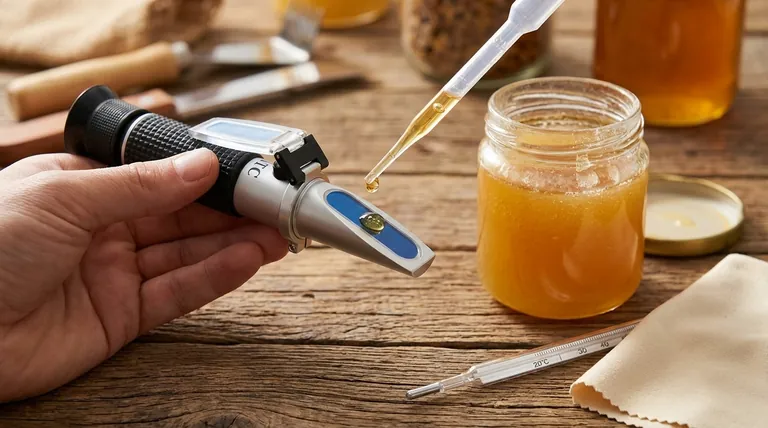
It seems like one of the purest moments in beekeeping. You take a single, golden drop of honey, place it on a refractometer, and in an instant, you get a number—a hard fact about its moisture content. A measure of quality.
But then you test another sample from the same batch and get a different number. And another. The certainty evaporates, replaced by a nagging doubt. Is it the honey? The instrument? Or you?
This frustration is common. The reality is that the number on the screen is only as trustworthy as the sample you provide. The instrument doesn't lie, but it can be easily misled. The real work of measurement happens before you even close the cover plate.
The Physics of Deception: What Your Instrument Actually Sees
A refractometer operates on a beautifully simple principle: it measures how light bends (or refracts) as it passes through the honey. That angle of refraction correlates directly to the concentration of dissolved solids—primarily sugar—which tells you the moisture content.
The instrument assumes it is measuring one thing and one thing only: pure, liquid honey. Any deviation from this ideal state is a variable that distorts the path of light and corrupts the data.
The Solid Impurity: Wax, Propolis, and Debris
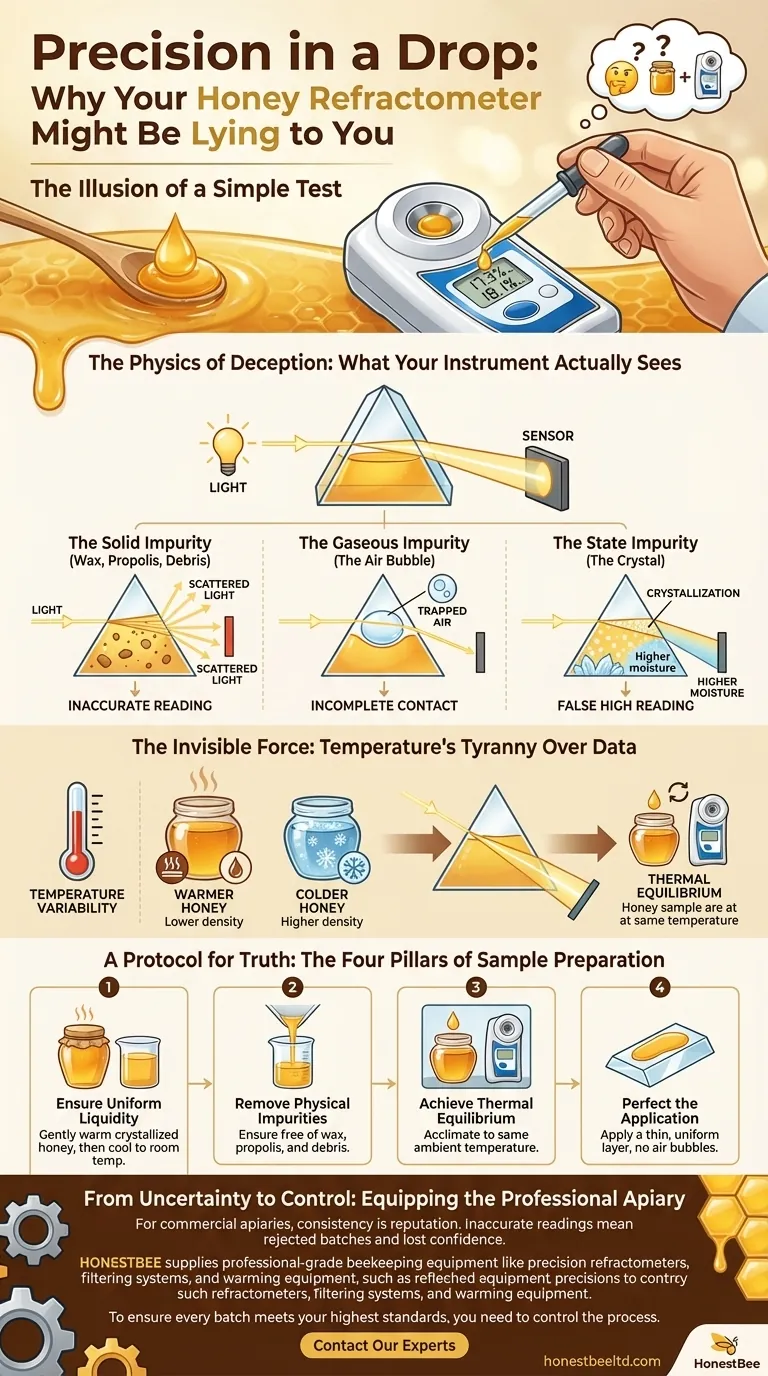
Think of trying to see through a foggy window. Tiny particles of wax, propolis, or even ambient dust in your honey sample act like obstacles. They scatter and block the light, preventing a clean, direct path through the liquid. This almost always results in a false reading, an error born from microscopic contamination.
The Gaseous Impurity: The Air Bubble
An air bubble is a pocket of nothing. When trapped between the honey and the prism, it creates a void where the instrument's sensor has no contact with the sample. The refractometer is forced to interpret an incomplete picture, averaging a reading across both honey and air. Applying the honey in a thin, uniform layer is the only way to squeeze out these pockets of interference.
The State Impurity: The Crystal
Crystallized honey is perhaps the most deceptive variable. It is not a uniform liquid. It's a mixture of solid glucose crystals and a residual liquid fructose solution.
Critically, this liquid portion has a higher moisture content than the honey as a whole. When you test crystallized honey, the refractometer can only measure that liquid part. The result is a falsely high moisture reading that doesn't represent the true composition of your batch.
The Invisible Force: Temperature's Tyranny Over Data
Even a perfectly clean, liquid sample can produce a flawed reading if its temperature isn't managed. This is the most common and least understood source of error.
The density and refractive index of honey change with its temperature. A warmer sample is less dense, and light travels through it differently than through a colder one. Most refractometers are calibrated for a specific baseline, typically room temperature (around 20°C / 68°F).
If your honey is warmer than the instrument, or the instrument is colder than the ambient air, the reading will be skewed. For a truly accurate measurement, you must achieve thermal equilibrium—a state where the honey, the refractometer, and the environment are all at the same stable temperature. Patience is a prerequisite for precision.
A Protocol for Truth: The Four Pillars of Sample Preparation
Achieving a trustworthy measurement isn't about luck; it's about process. By systematically eliminating variables, you can have confidence in every reading.
| Preparation Step | Key Action | Why It's Critical |
|---|---|---|
| 1. Ensure Uniform Liquidity | Gently warm crystallized honey in a water bath until dissolved, then cool fully to room temperature. | Measures the entire sample, not just the high-moisture liquid part, preventing false readings. |
| 2. Remove Physical Impurities | Ensure the sample is free of wax, propolis, and other debris. | Solid particles scatter light and distort the instrument's measurement. |
| 3. Achieve Thermal Equilibrium | Allow the honey sample and the refractometer to acclimate to the same ambient temperature. | Honey's refractive index is temperature-dependent; equilibrium ensures calibration accuracy. |
| 4. Perfect the Application | Apply a thin, even layer to the prism, ensuring no air bubbles are trapped. | Bubbles create voids and prevent the sensor from making full contact with the honey. |
From Uncertainty to Control: Equipping the Professional Apiary
This pursuit of precision isn't just an academic exercise. For commercial apiaries and distributors, consistency is the foundation of reputation and profitability. An inaccurate reading can lead to a rejected batch, a loss of buyer confidence, or honey that spoils in storage.
Eliminating these variables requires not just the right knowledge, but also the right tools. The process of warming, filtering, and accurately measuring honey demands equipment built for reliability and repeatability. This is the gap between amateur craft and professional-grade production.
HONESTBEE supplies professional-grade beekeeping equipment designed specifically to solve these challenges. Our precision refractometers, filtering systems, and warming equipment provide commercial operators the control they need to move from uncertainty to absolute confidence in their quality control. We provide the tools to build a system of truth.
To ensure every batch meets your highest standards, you need to control the process from start to finish. Contact Our Experts
Visual Guide
Related Products
- Digital Honey Refractometer for Precision Measurement of Optimal Honey Quality
- Precision Honey Refractometer Instrument for Quality Assessment
- Premium Heat-Resistant Glass Honey Dipper
- Modern Stainless Steel Honey Dipper Stirrer
- Heavy Duty 304 Stainless Steel Honey Dipper
Related Articles
- The Physics of Perfection: Why a Single Number Determines Your Honey's Fate
- How to Accurately Test Honey Readiness: Science-Backed Methods for Beekeepers
- How to Perfect Honey Moisture Levels: A Beekeeper’s Guide to Refractometer Mastery
- From Ambiguity to Certainty: The Practical Case for Digital Honey Refractometers
- Beyond Brix: Why Your Honey's Future Depends on a Single, Temperature-Compensated Number