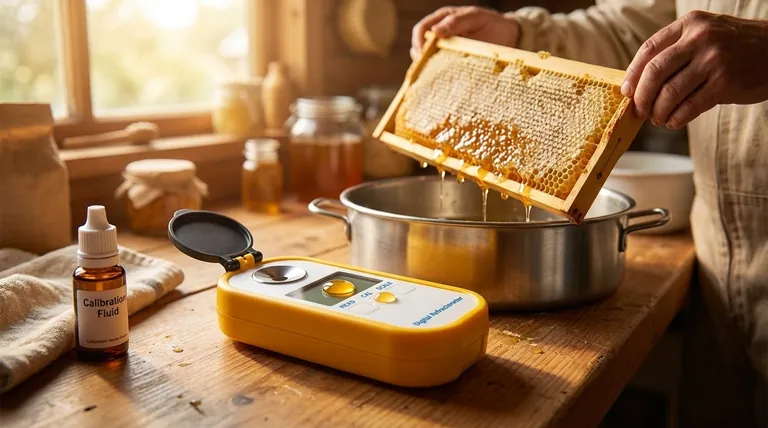
The Illusion of a Perfect Number
Imagine a commercial beekeeper standing in the honey house. The air is thick with the sweet, floral scent of a fresh harvest. A frame is uncapped, and golden honey flows. Everything looks perfect.
He places a drop of honey on a refractometer and sees the reading: 17.8%. It's a beautiful number, sitting comfortably within the ideal range for bottling. He trusts it. The entire batch is extracted and barreled based on this single data point.
Two months later, a customer calls. The honey is sour, slightly fizzy. The batch has started to ferment. The trusted number was a lie.
This scenario isn't a failure of the honey or the beekeeper; it's a failure of trusting an instrument without first anchoring it to reality. This is the crucial, often-overlooked role of calibration.
Anchoring Data to Reality
We have a cognitive bias to trust a measurement from a specialized tool. The sharp line on a refractometer's scale feels definitive. But the instrument, by itself, only provides a relative measurement.
Calibration is the process that turns this relative number into an absolute, trustworthy fact.
Think of it like setting a scale to zero before weighing ingredients. You press "tare" to establish a true baseline. For a refractometer, calibration adjusts the internal scale against a known standard—a reference oil with a precise, stable refractive index. This act transforms the tool from a guesser into a scientific instrument.
The Standard Procedure: A 30-Second Ritual
The process is simple but non-negotiable.
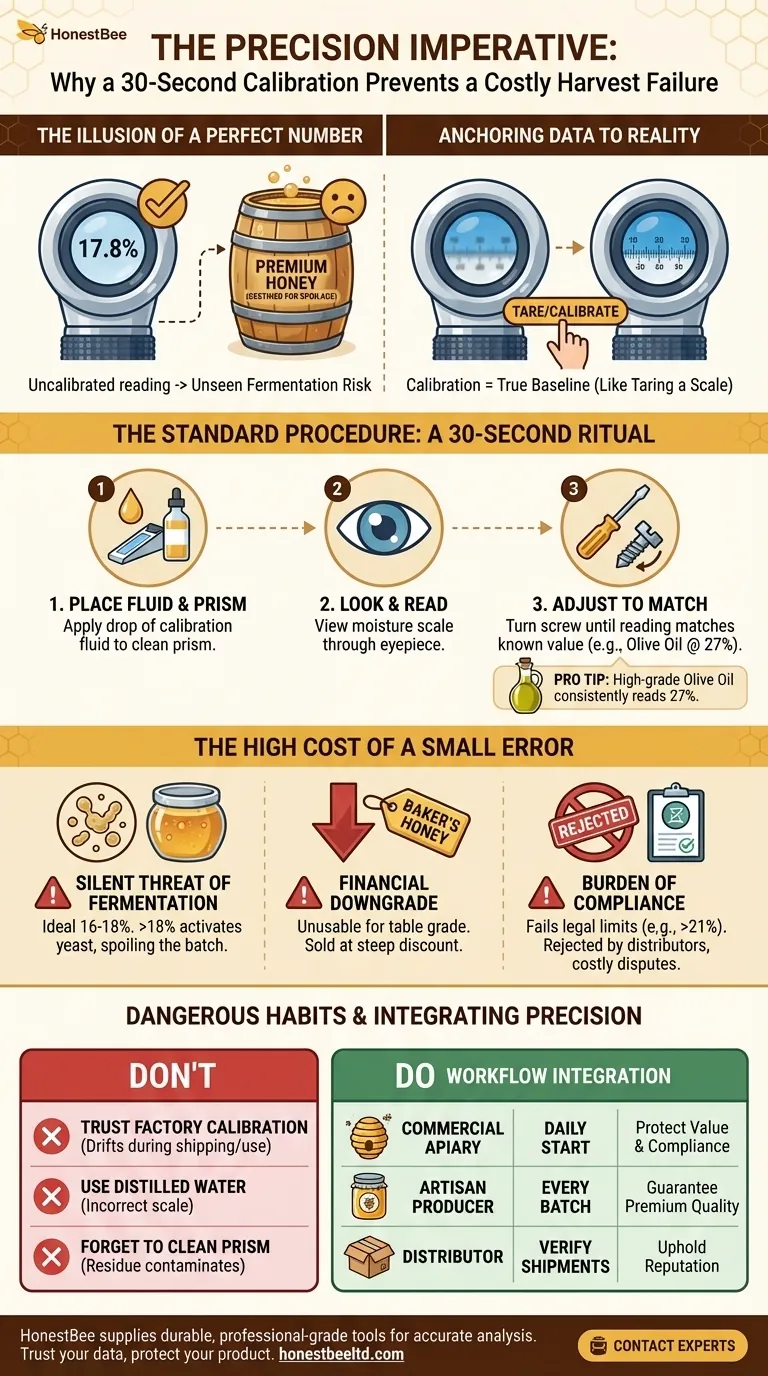
- Place a drop of calibration fluid on the clean prism.
- Look through the eyepiece and read the moisture scale.
- Use the provided tool to turn the adjustment screw until the reading exactly matches the known value of the fluid.
If you lose the reference fluid, high-grade olive oil is a reliable substitute. It consistently corresponds to a 27% moisture reading on a honey refractometer.
The High Cost of a Small Error
Skipping this 30-second ritual introduces enormous risk. An uncalibrated refractometer might be off by 1-2%, a seemingly tiny error with cascading financial and reputational consequences.
The Silent Threat of Fermentation
The ideal moisture content for stable honey is between 16-18%. Above this threshold, dormant osmophilic yeasts, naturally present in all honey, can activate. They begin consuming the sugars, producing alcohol and carbon dioxide.
If your refractometer reads 17.5% but the true value is 19.5%, you are unknowingly bottling a time bomb. The entire batch is destined to spoil.
The Financial Downgrade to "Baker's Honey"
Fermented honey is unusable for table grade. It’s often salvaged and sold at a steep discount as "baker's honey," a low-value commodity used in commercial baking. Proper calibration is a direct defense against this catastrophic financial loss. It's the difference between a premium product and a salvage operation.
The Burden of Compliance
To be legally marketed as "honey" in many regions, moisture content must fall below a specific limit, often around 21%. A batch that fails this standard due to an inaccurate reading can be rejected by distributors, leading to costly disputes and damage to your commercial reputation.
Dangerous Habits and Misconceptions
The failure to calibrate often stems from a few common, dangerous assumptions.
"It Was Calibrated at the Factory"
This is perhaps the most hazardous belief. A refractometer is a sensitive optical instrument. The vibrations and temperature shifts during shipping alone can knock it out of alignment. Regular use and environmental changes cause further drift. Calibration isn't a one-time event; it must be done before each testing session, just as a musician tunes their instrument before every performance.
"I'll Just Use Distilled Water"
Never use water to calibrate a honey refractometer. These instruments are specifically designed and scaled for the high refractive index of dense sugar solutions. Calibrating to water's zero point will actively introduce error and guarantee inaccurate readings for honey.
Forgetting to Clean the Prism
After every single measurement—including calibration—the prism must be wiped clean with a soft, damp cloth. Any residue from the previous sample will contaminate the next, rendering the new reading invalid. A clean prism is a prerequisite for an accurate measurement.
Integrating Precision into Your Workflow
Building a habit of calibration is the foundation of quality control in any beekeeping operation, from artisan producer to large-scale commercial apiary. The goal dictates the frequency, but the principle is universal.
| Operation Type | Calibration Protocol | Primary Goal |
|---|---|---|
| Commercial Apiary | Calibrate at the start of each day's extraction and processing. | Protect financial value and ensure legal/commercial compliance. |
| Artisan Honey Producer | Calibrate before testing each small batch. | Guarantee premium quality, perfect texture, and shelf stability. |
| Equipment Distributor | Verify calibration on new shipments to ensure quality for customers. | Uphold reputation and provide reliable, ready-to-use tools. |
This commitment to precision begins with professional-grade equipment. A high-quality refractometer is designed to hold its calibration longer and withstand the rigors of daily use in a commercial environment. At HONESTBEE, we supply commercial apiaries and beekeeping distributors with the durable, reliable tools needed for accurate honey analysis.
Protecting your product starts with trusting your data, and trusting your data starts with calibration. Contact Our Experts
Visual Guide
Related Products
- Precision Honey Refractometer Instrument for Quality Assessment
- Digital Honey Refractometer for Precision Measurement of Optimal Honey Quality
Related Articles
- The Physics of Perfection: Why a Single Number Determines Your Honey's Fate
- How to Accurately Test Honey Readiness: Science-Backed Methods for Beekeepers
- Why Your Honey Refractometer Gives Inconsistent Readings—And How to Fix It for Good
- The Physics of Trust: Why Your Honey Refractometer Lies Without Temperature Discipline
- Beyond Brix: Why Your Honey's Future Depends on a Single, Temperature-Compensated Number

