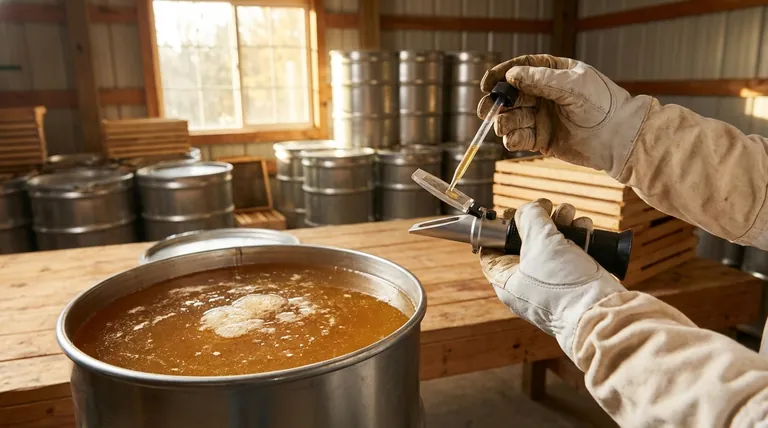
It’s a moment every commercial beekeeper dreads. You open a 55-gallon drum of honey you harvested weeks ago, ready for a major sale, only to be hit by a sour, slightly alcoholic smell. The honey is fizzy. Fermented. A whole season of work, thousands of dollars in potential revenue—gone. The only thing you can do is dump it.
What went wrong? You did everything right. The bees were healthy, the nectar flow was strong, and you used the same harvesting techniques you’ve trusted for years. Yet, the batch is a total loss.
The High-Stakes Guessing Game You Can't Afford to Lose
This scenario isn't just bad luck; it's a systemic risk in the beekeeping industry, and it stems from relying on traditional methods that are little more than educated guesses.
For generations, beekeepers have used approximations to decide when honey is "ripe":
- The "Shake Test": Shaking a frame to see if nectar drips out.
- The "80% Rule": Harvesting only when 80-90% of the cells are capped with wax.
- Experience & "Feel": Relying on a gut feeling developed over years in the field.
While these methods have their place, for a commercial operation, they are a dangerous liability. A single misjudgment can lead to catastrophic business consequences:
- Direct Financial Loss: An entire harvest can be rendered worthless, destroying your profit margin for the season.
- Damaged Reputation: Selling a batch that ferments on a distributor's or customer's shelf can permanently damage your brand's reputation for quality.
- Contractual Failure: For large-scale producers, failing to meet the quality specifications of a wholesale contract can lead to penalties and lost business.
Relying on guesswork is like betting your entire business on a coin flip. The stakes are simply too high.
The Invisible Culprit: It’s Not Bad Luck, It’s Water
The transition from a stable, valuable product to a spoiled, worthless one is not random. It is controlled by a single, invisible factor: water content.
This is the fundamental truth that traditional methods miss.
The 18.6% Tipping Point
Every batch of honey naturally contains dormant yeast spores. They are harmless as long as the honey is sufficiently "dry." But when the water content rises above a critical threshold—generally 18.6%—these yeasts activate. They begin consuming the sugars in the honey, producing alcohol and acids.
This is fermentation. It’s a simple, scientific switch. Below 18.6%, your honey is stable for years. Above it, it’s a ticking time bomb.
Why Experience Isn't Enough
This is why the old methods fail. The "shake test" doesn't give you a number. Judging by capped cells is misleading; a frame can be 90% capped with perfectly dry honey, but the remaining 10% of uncapped honey might have a 22% water content. When you extract and mix it all together, the average moisture level for the entire batch can easily tip over the 18.6% danger line.
Your experience can't see water molecules. Your gut feeling can't measure a percentage. You aren't fighting bad luck; you're fighting physics, and you're doing it blind.
From Guesswork to Guarantee: The Right Tool for the Job
If the difference between profit and loss comes down to a single, precise number, then the solution becomes clear: you must stop guessing and start measuring.
To solve this problem at its root, you need a tool specifically designed to give you that number, accurately and instantly. You need a honey refractometer.
A refractometer is not just another gadget; it is the physical embodiment of the solution to this fundamental problem. It is designed with one purpose: to measure the precise percentage of water in a honey sample.
This simple tool transforms your operation:
- It Replaces Guesswork with Certainty: A single drop of honey provides a definitive, scientific reading. You know, without a doubt, if your honey is safe to harvest and store.
- It Directly Addresses the Root Cause: Unlike the "shake test," which only observes a symptom, the refractometer measures the underlying cause of spoilage—water content.
- It Empowers Data-Driven Decisions: You can test honey from different supers or even different parts of a frame to make strategic decisions about harvesting, ensuring every drop you extract meets quality standards.
A refractometer is the non-negotiable tool for any professional who sees beekeeping not just as a passion, but as a business.
Beyond Preventing Spoilage: Turning Honey into a Bankable Asset
Once you eliminate the risk of fermentation, you unlock a new level of professional control and profitability. The question changes from "Will my honey be okay?" to "How can I maximize the value of my honey?"
With the certainty provided by a professional-grade refractometer, you can now:
- Guarantee Wholesale Quality: Provide a Certificate of Analysis with every drum you sell, showing the exact moisture content. This builds immense trust with distributors and commands premium pricing.
- Optimize Harvest Timing: Harvest with confidence the moment your honey hits the ideal moisture range, maximizing your yield without the risk of spoilage or unnecessary waiting.
- Create Stable, High-Value Products: Precisely manage the final texture and shelf-life of your honey, securing the consistency that high-end markets demand.
- Mitigate Market Risk: Confidently store your honey for long periods, allowing you to hold your inventory and sell when market prices are most favorable. Your honey becomes a stable, bankable asset, not a perishable liability.
Ultimately, taking control of this one critical number is the first step to taking full control of your business. At HONESTBEE, we understand that professional apiaries and distributors require tools that are reliable, accurate, and built for the demands of a commercial operation. We provide the equipment that turns your hard work into guaranteed quality. If you're ready to move beyond guesswork and secure the value of every harvest, let's talk about the right tools for your specific needs. Contact Our Experts.
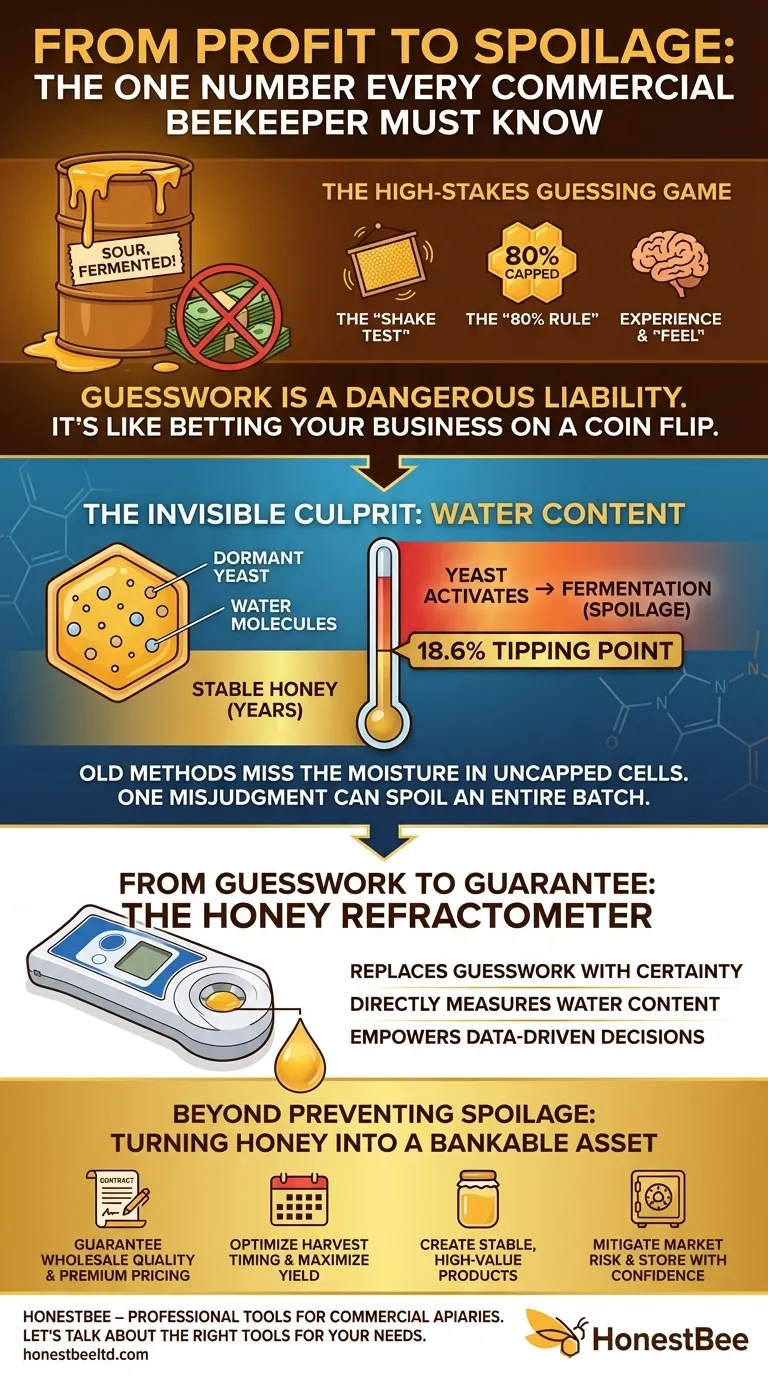
Visual Guide
Related Products
- Precision Honey Refractometer Instrument for Quality Assessment
- Digital Honey Refractometer for Precision Measurement of Optimal Honey Quality
Related Articles
- The Physics of Perfection: Why a Single Number Determines Your Honey's Fate
- How to Accurately Test Honey Readiness: Science-Backed Methods for Beekeepers
- Why Your Honey Refractometer Gives Inconsistent Readings—And How to Fix It for Good
- The Physics of Trust: Why Your Honey Refractometer Lies Without Temperature Discipline
- Beyond Brix: Why Your Honey's Future Depends on a Single, Temperature-Compensated Number

