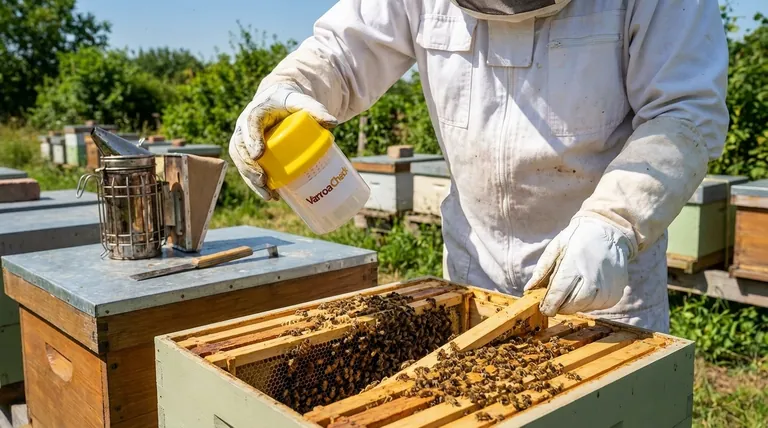
The Illusion of a Simple Number
A beekeeper pulls a sample and completes an alcohol wash. The result: 9 mites.
Is this good news or bad news?
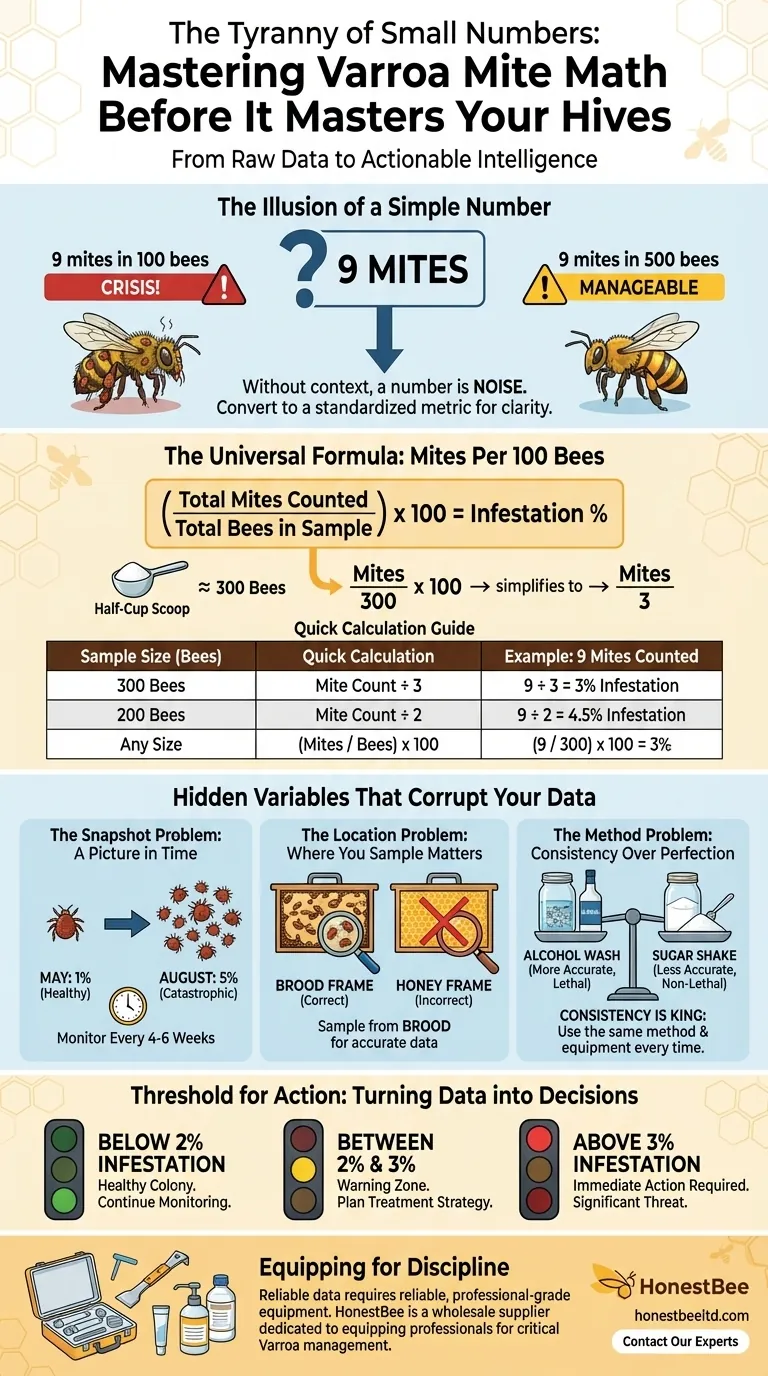
The human mind craves a simple answer. We are wired to react to a number. But in the complex system of a honey bee colony, a raw number is not information; it is noise. 9 mites in a sample of 100 bees is a crisis. 9 mites in a sample of 500 bees is a manageable concern.
Without context, a number is a story without a plot. The first discipline of effective Varroa management is resisting the urge to react to the raw count and, instead, translating it into actionable intelligence.
From Raw Data to a Common Language
The goal of a mite count is not just to get a number, but to get a standardized metric. By converting your count into a percentage—specifically, "mites per 100 bees"—you create a universal data point.
This standardized language allows you to compare your hive's health over time, benchmark against established treatment thresholds, and communicate clearly with other apiarists. It transforms a subjective observation into an objective diagnostic tool.
The Universal Formula
The principle is simple and works for any sample size.
(Total Mites Counted / Total Bees in Sample) x 100 = Infestation %
This is the bedrock equation. The common advice to "divide your mite count by 3" is merely an elegant shortcut derived from this principle, based on the fact that a standard half-cup scoop holds approximately 300 bees.
(Mites / 300) * 100 simplifies to Mites / 3.
Quick Calculation Guide
| Sample Size (Bees) | Quick Calculation | Example: 9 Mites Counted |
|---|---|---|
| 300 | Mite Count ÷ 3 | 9 ÷ 3 = 3% Infestation |
| 200 | Mite Count ÷ 2 | 9 ÷ 2 = 4.5% Infestation |
| Any Size | (Mites / Bees) x 100 | (9 / 300) x 100 = 3% |
The Hidden Variables That Corrupt Your Data
Arriving at a percentage is easy. Trusting that percentage requires a deeper discipline. The integrity of your number is only as good as the integrity of your process. Several hidden variables can mislead you.
The Snapshot Problem: A Picture in Time
A single mite count is a snapshot of an exponentially developing problem. A healthy 1% infestation in May can easily become a catastrophic 5% by August.
This is why disciplined, scheduled monitoring—typically every 4-6 weeks—is non-negotiable. You are not just taking a picture; you are creating a film that reveals the trend line of your colony's health.
The Location Problem: Where You Sample Matters
To get an accurate reading, you must sample bees from a brood frame.
Varroa mites reproduce in capped brood. The adult bees attending to the brood are the most likely carriers. Sampling from a frame of pure honey is like measuring a city's rush hour traffic by observing a quiet suburban street. Your data will be artificially low and dangerously misleading.
The Method Problem: Consistency Over Perfection
The two primary sampling methods, the alcohol wash and the powdered sugar shake, have their own biases. Alcohol washes are more lethal but more accurate. Sugar shakes are less lethal but can under-report the mite count.
Which method is better is a long-running debate. What is not debatable is that consistency is king. Using the same method, with the same quality of equipment, every time, is the only way to generate reliable, comparable data season after season.
The Threshold for Action: Turning Data into Decisions
Once you have a percentage you can trust, the final step is to act. While local conditions vary, widely accepted thresholds provide a clear decision-making framework.
- Below 2% Infestation: A sign of a healthy colony. Continue your monitoring schedule and remain vigilant.
- Between 2% and 3%: This is the warning zone. Mite populations can accelerate quickly from this point. It's time to plan your treatment strategy.
- Above 3% Infestation: Immediate action is required. This level of infestation poses a significant threat to the colony's survival, especially heading into winter.
Equipping for Discipline
This entire diagnostic discipline—from precise sampling to consistent methodology and decisive action—relies on a foundation of reliable, professional-grade equipment. For commercial apiaries and equipment distributors, where the health of hundreds or thousands of hives is at stake, there is no room for inconsistent tools or imprecise measurements.
HONESTBEE is a wholesale supplier dedicated to equipping beekeeping professionals with the high-quality supplies necessary for this critical work. From accurate sampling kits to effective, large-scale treatment solutions, we provide the tools that turn good data into healthy, productive hives.
Effective Varroa management is not just about counting mites. It's about a disciplined system that allows you to see the true state of your hives and act with confidence. To ensure your operation is built on a foundation of precision and reliability, Contact Our Experts
Visual Guide
Related Products
- Varroa Easy Check Mite Tester Kit Counter Alcohol Wash Jar
- Oxalic Acid Vaporizer 12V for Bee Varroa Mite Treatment
- Durable 12V Oxalic Acid Vaporizer for Varroa Mite Treatment Beehive Beekeeping Tool
- Heavy Duty 12V Oxalic Acid Evaporator Vaporizer for Bee Varroa Mite Treatment Beekeeping Fumigator Atomizer
- 12V Bee Mite Removal Evaporator Oxalic Acid Vaporizer for Bee Fumigation Treatment 180W Atomization
Related Articles
- How Beekeepers Can Control Late-Summer Varroa Mites Without Compromising Honey Quality
- The Deceptive Calm: Why a Strong Summer Hive Masks a Looming Winter Collapse
- The Varroa Paradox: Why Strong Summer Beehives Collapse in Winter
- The Signal and the Noise: Why Thriving Hives Collapse and How Data Prevents It
- The Silent Collapse: Why Strong Beehives Die Over Winter





