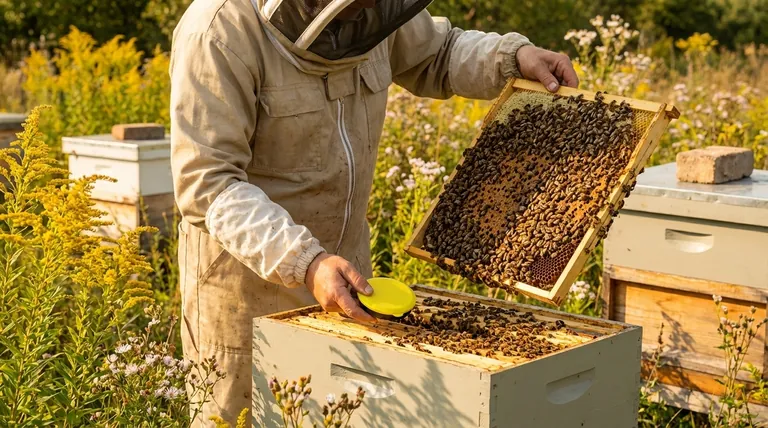
The Illusion of Strength
In late August, a beekeeper can look at a hive and see success. The air hums with thousands of foragers, honey stores are building, and the colony appears to be at the peak of its power.
This perception is one of the most dangerous cognitive traps in apiculture.
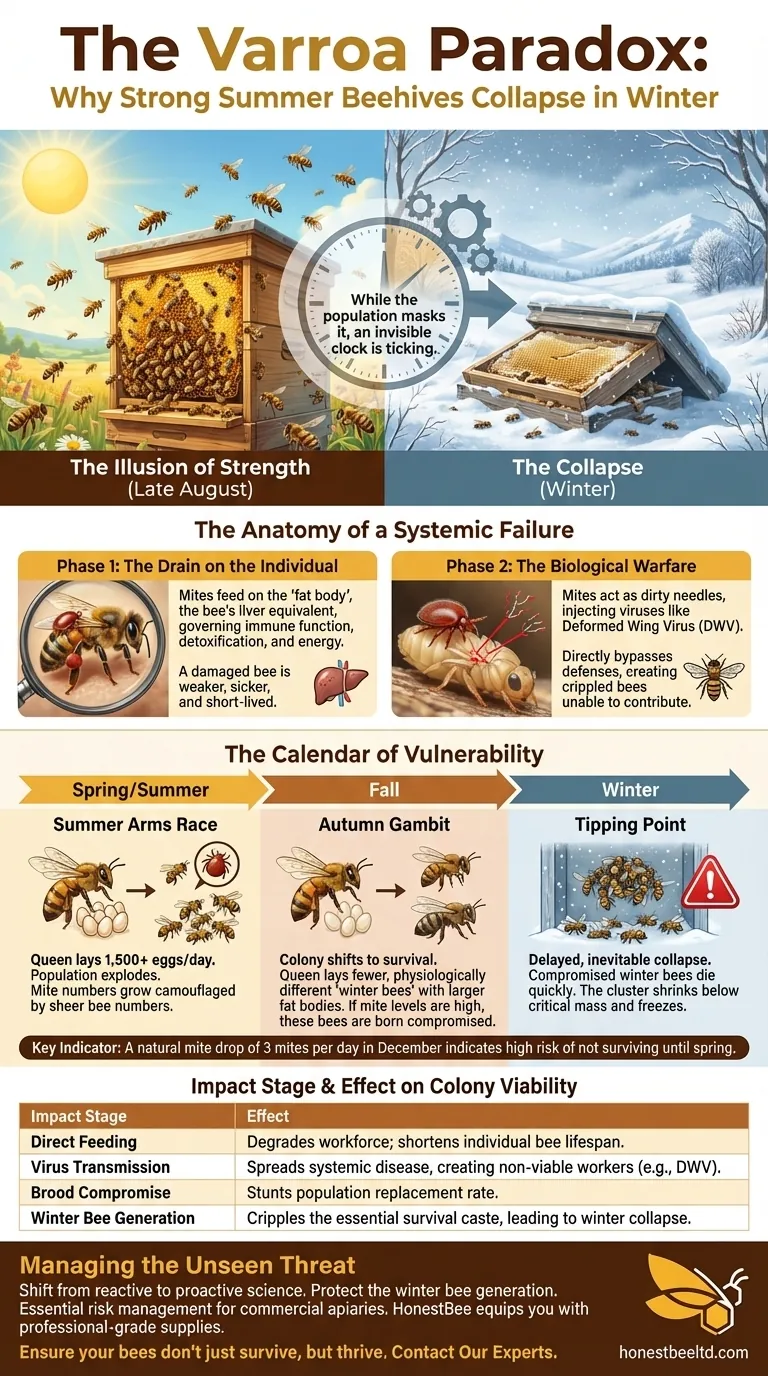
While the hive's population masks it, an invisible clock is ticking. A parasitic enemy, the Varroa mite, is not just growing in number; it is systematically dismantling the colony's ability to survive the coming winter. The battle for spring is often lost during the peak of summer abundance.
The Anatomy of a Systemic Failure
To understand a colony's sudden collapse, we must see the problem not as a simple pest infestation, but as a systemic attack on the hive's biological infrastructure. Varroa mites wage a war on two fronts: weakening the current generation and sabotaging the next.
Phase 1: The Drain on the Individual
Mites are not benign passengers. They attach to adult bees and developing pupae, feeding on a vital organ called the "fat body."
This tissue is the bee's equivalent of a human liver. It governs immune function, pesticide detoxification, and energy storage. A bee with a damaged fat body is weaker, sicker, and lives a shorter life. The colony's workforce is being quietly degraded from within.
Phase 2: The Biological Warfare
As they feed, mites act as dirty needles, injecting viruses directly into the bee's open circulatory system. The most notorious of these is the Deformed Wing Virus (DWV).
This direct transmission is brutally efficient, bypassing the bee's natural defenses and ensuring widespread infection. A bee that emerges from its cell may already be crippled, unable to fly, and a drain on resources rather than a contributor. The colony's ability to replace its aging population is systematically crippled.
The Calendar of Vulnerability
The mite's true genius lies in exploiting the colony's natural seasonal rhythm. The danger isn't static; it escalates dramatically at a specific, critical point in the year.
The Summer Arms Race
In spring and summer, the queen is a marvel, laying over 1,500 eggs per day. The colony's population explodes. The mite population grows right alongside it, but the sheer number of bees makes the infestation seem manageable. This is the period of camouflage.
The Autumn Gambit: Engineering the Winter Bee
As fall approaches, the colony's strategy shifts from growth to survival. The queen lays fewer eggs, and the bees that emerge are physiologically different. These are "winter bees."
They are built for endurance, with larger fat bodies and a longer lifespan, designed to sustain the cluster for months without foraging. They are the living bridge that carries the colony's genetic future from one year to the next.
This is the moment the Varroa mite's work becomes catastrophic.
If mite levels are high in the fall, these crucial winter bees are born compromised. They are weak, diseased, and lack the reserves to survive. The colony is producing a generation of winter survivors that is fundamentally unfit for the task.
The Tipping Point
The result is a delayed, but inevitable, collapse. The colony enters winter with what appears to be a sufficient population, but it's a house of cards. The weakened bees die off too quickly, the cluster shrinks below a critical mass, and it freezes.
The data is unforgiving. Research shows a direct correlation between fall mite levels and winter death. A seemingly small metric can signal doom:
- Key Indicator: A natural mite drop of just 3 mites per day in December indicates a colony is at high risk of not surviving until spring.
The colony doesn't get a second chance. The generation responsible for its survival was compromised months earlier.
| Impact Stage | Effect on Colony Viability |
|---|---|
| Direct Feeding | Degrades workforce; shortens individual bee lifespan. |
| Virus Transmission | Spreads systemic disease, creating non-viable workers (e.g., DWV). |
| Brood Compromise | Stunts population replacement rate. |
| Winter Bee Generation | Cripples the essential survival caste, leading to winter collapse. |
Managing the Unseen Threat
This understanding shifts beekeeping management from a reactive to a proactive science. The goal is not just to kill mites, but to protect the integrity of the winter bee generation. For commercial apiaries, where every colony represents a productive asset, this isn't just best practice—it's essential risk management.
Protecting your operation's future requires robust, timely, and effective mite control strategies. The right equipment and a deep understanding of this biological timeline are the cornerstones of sustainable beekeeping. At HONESTBEE, we equip commercial apiaries and distributors with the professional-grade supplies needed to manage this invisible threat at scale.
Ensure your bees don't just survive, but thrive. Contact Our Experts
Visual Guide
Related Products
- Varroa Easy Check Mite Tester Kit Counter Alcohol Wash Jar
- Oxalic Acid Vaporizer 12V for Bee Varroa Mite Treatment
- Durable 12V Oxalic Acid Vaporizer for Varroa Mite Treatment Beehive Beekeeping Tool
- Heavy Duty 12V Oxalic Acid Evaporator Vaporizer for Bee Varroa Mite Treatment Beekeeping Fumigator Atomizer
- 12V Bee Mite Removal Evaporator Oxalic Acid Vaporizer for Bee Fumigation Treatment 180W Atomization
Related Articles
- How Beekeepers Can Control Late-Summer Varroa Mites Without Compromising Honey Quality
- The Deceptive Calm: Why a Strong Summer Hive Masks a Looming Winter Collapse
- The Tyranny of Small Numbers: Mastering Varroa Mite Math Before It Masters Your Hives
- The Signal and the Noise: Why Thriving Hives Collapse and How Data Prevents It
- The Silent Collapse: Why Strong Beehives Die Over Winter





