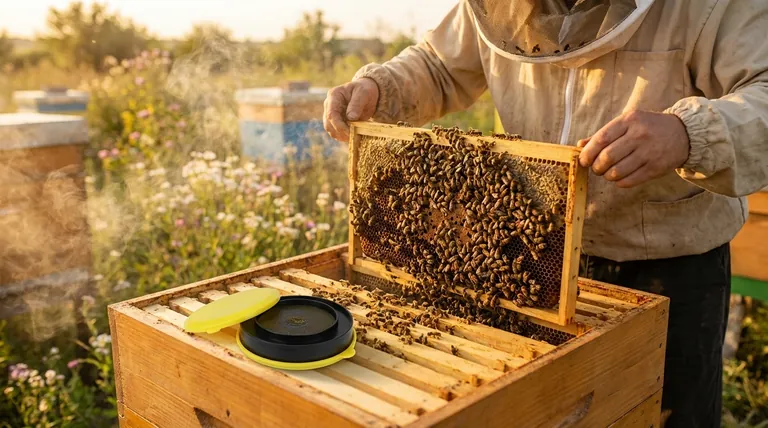
The Illusion of a Perfect August
It is one of the most rewarding sights for a beekeeper: a hive in late August, humming with activity. The honey supers are heavy, the entrance is a flurry of foragers, and the colony appears to be at the peak of its strength.
This perception is a dangerous cognitive trap.
Beneath this veneer of success, a mathematical crisis is unfolding. The visible strength of the hive is a lagging indicator of a summer that has passed. The most critical data point—the one that will determine winter survival—is invisible to the naked eye. It’s a battle of two opposing curves.
The Two Curves That Define a Colony's Fate
The survival of a honey bee colony is not a straight line. It is a story told by the intersection of two populations moving in opposite directions during the most critical weeks of the year.
The Mite's Exponential Ascent
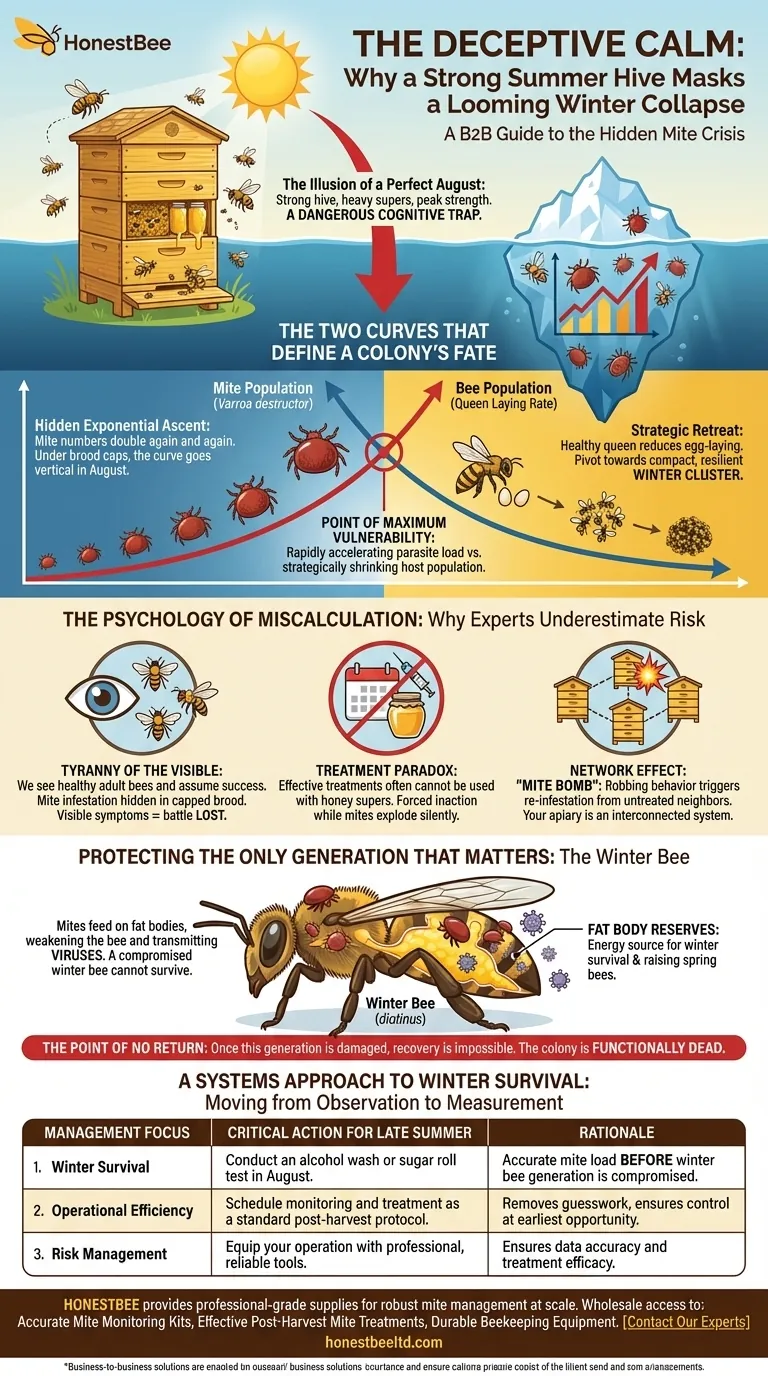
Throughout the spring and summer, the Varroa destructor mite population follows a relentless, exponential growth curve. Hidden from view, reproducing under the protective caps of brood cells, their numbers double again and again. In August, this curve goes vertical.
The Colony's Strategic Retreat
Simultaneously, the bee population begins a planned decline. After the summer solstice, a healthy queen naturally reduces her egg-laying rate. The colony stops investing in expendable summer foragers and begins the slow, deliberate pivot towards a compact, resilient winter cluster.
This divergence—a rapidly accelerating parasite load and a strategically shrinking host population—creates a point of maximum vulnerability. It’s a systemic risk engineered by nature.
The Psychology of Miscalculation
The late-summer period exposes several biases in how we assess risk, leading even experienced operators to underestimate the threat.
The Tyranny of the Visible
We are biased toward what we can see. We see thousands of healthy adult bees and assume the colony is thriving. But the majority of the mite infestation is hidden within the capped brood. By the time symptoms like Deformed Wing Virus (DWV) become visible, the battle has already been lost. It’s like judging a company’s financial health by its busy lobby while ignoring its balance sheet.
The Treatment Paradox
Effective mite treatments often cannot be used when honey supers are on the hive. This practical constraint creates a forced period of inaction during the very months when the mite population explodes. The infestation compounds silently while we wait for the harvest.
The Network Effect: The "Mite Bomb"
An apiary is not an isolated system. In late summer, nectar dearth can trigger robbing behavior. A nearby, untreated colony that collapses becomes a "mite bomb," unleashing a massive wave of parasites that re-infests every healthy hive in the vicinity. Your success is inextricably linked to the biosecurity of your entire operational area.
Protecting the Only Generation That Matters
The true cost of a late-summer mite infestation is not the loss of a few summer bees. It is the systematic destruction of the one generation the colony cannot afford to lose.
The Anatomy of a Winter Bee
Bees raised in the late summer and early fall are physiologically distinct. These "winter bees," or diutinus bees, are built with higher fat body reserves. These fat bodies are their energy source, allowing them to live for months instead of weeks, sustain the queen, and raise the first generation of spring bees. They are the biological bridge to the future.
The Point of No Return
Varroa mites feed directly on these vital fat bodies. This act does two things: it directly weakens the bee, and more critically, it transmits a payload of viruses. A winter bee compromised by viruses and depleted of its fat reserves cannot fulfill its biological role.
Once this generation is damaged, there is no recovery. Even if you eradicate every mite in October, the viruses are already rampant within the bees that must survive the winter. The colony is functionally dead; it just doesn't know it yet.
A Systems Approach to Winter Survival
Overcoming this challenge requires moving from observation to measurement. It demands a disciplined, systems-based approach, especially for commercial operations where colony losses have significant financial consequences.
The foundation of this system is accurate, timely data. Relying on visual inspection is not a strategy; it's a gamble.
| Management Focus | Critical Action for Late Summer | Rationale |
|---|---|---|
| Winter Survival | Conduct an alcohol wash or sugar roll test in August. | Provides an accurate mite load before the winter bee generation is compromised. |
| Operational Efficiency | Schedule monitoring and treatment as a standard post-harvest protocol. | Removes guesswork and ensures mite loads are controlled at the earliest opportunity. |
| Risk Management | Equip your operation with professional, reliable tools. | Ensures data accuracy and treatment efficacy, the cornerstones of asset protection. |
For commercial apiaries and beekeeping equipment distributors, managing this systemic risk is paramount. HONESTBEE provides the professional-grade supplies necessary to implement a robust mite management program at scale. Our wholesale-focused operation ensures you have access to:
- Accurate Mite Monitoring Kits for reliable data collection.
- Effective, Post-Harvest Mite Treatments to protect your colonies and your honey.
- Durable Beekeeping Equipment built for the demands of commercial use.
Your spring success is determined by the discipline you apply in the fall. Don't let the deceptive calm of a strong summer hive mask the true risk to your operation.
Visual Guide
Related Products
- Varroa Easy Check Mite Tester Kit Counter Alcohol Wash Jar
- Oxalic Acid Vaporizer 12V for Bee Varroa Mite Treatment
- Durable 12V Oxalic Acid Vaporizer for Varroa Mite Treatment Beehive Beekeeping Tool
- Heavy Duty 12V Oxalic Acid Evaporator Vaporizer for Bee Varroa Mite Treatment Beekeeping Fumigator Atomizer
- 12V Bee Mite Removal Evaporator Oxalic Acid Vaporizer for Bee Fumigation Treatment 180W Atomization
Related Articles
- How Beekeepers Can Control Late-Summer Varroa Mites Without Compromising Honey Quality
- The Tyranny of Small Numbers: Mastering Varroa Mite Math Before It Masters Your Hives
- The Varroa Paradox: Why Strong Summer Beehives Collapse in Winter
- The Signal and the Noise: Why Thriving Hives Collapse and How Data Prevents It
- The Silent Collapse: Why Strong Beehives Die Over Winter





