Late summer brings a critical challenge for beekeepers: surging Varroa mite populations threaten hive health just as honey supers reach peak production. Balancing effective mite suppression with honey quality preservation requires strategic monitoring, proactive interventions, and community-wide cooperation. This guide delivers actionable solutions tailored for commercial apiaries seeking non-disruptive management approaches.
Late Summer Mite Surge Challenges
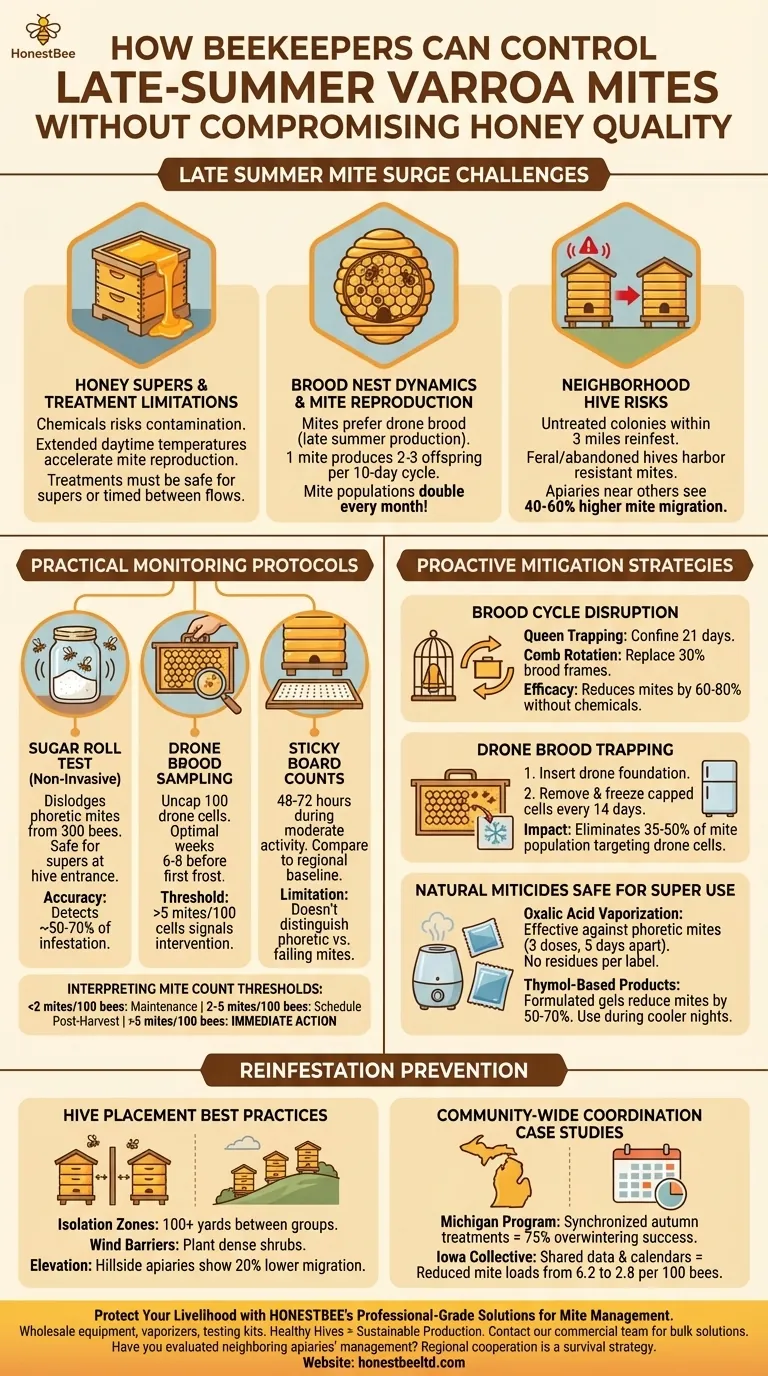
Varroa destructor populations spike in late summer due to three compounding factors:
Honey Supers and Treatment Limitations
- Most chemical miticides can't be applied during honey flow due to contamination risks
- Extended daytime temperatures accelerate mite reproduction cycles
- Key Consideration: Treatments must be safe for supers or timed between nectar flows
Brood Nest Dynamics and Mite Reproduction
- Mites preferentially infest drone brood, which colonies still produce in late summer
- A single mite can produce 2-3 offspring per 10-day worker brood cycle
- Critical Window: Mite populations double every month during peak season
Neighborhood Hive Risks
- Untreated colonies within 3 miles act as reinfestation sources
- Feral hives and abandoned equipment often harbor resistant mites
- Regional Data: Apiaries near commercial operations see 40-60% higher mite migration rates
Practical Monitoring Protocols
Non-Invasive Sampling Methods During Honey Flow
-
Sugar Roll Test
- Uses powdered sugar to dislodge phoretic mites from 300 bees
- Safe for supers when performed at the hive entrance
- Accuracy Note: Detects ~50-70% of actual infestation levels
-
Drone Brood Sampling
- Uncapping 100 drone cells reveals mite reproduction success
- Optimal during weeks 6-8 before expected first frost
- Threshold: >5 mites per 100 cells signals required intervention
-
Sticky Board Counts
- Place boards for 48-72 hours during moderate activity periods
- Compare drops to regional baseline data
- Limitation: Doesn't differentiate between phoretic and falling mites
Interpreting Mite Count Thresholds
- <2 mites/100 bees: Maintenance monitoring only
- 2-5 mites/100 bees: Schedule treatment post-harvest
- >5 mites/100 bees: Requires immediate brood-targeted action
Proactive Mitigation Strategies
Brood Cycle Disruption Techniques
- Queen Trapping: Confine queen to 1-2 frames for 21 days to create broodless period
- Comb Rotation: Replace 30% of brood frames to break mite reproduction cycles
- Efficacy Data: Disruption methods reduce mite loads by 60-80% without chemicals
Drone Brood Trapping Efficacy
- Insert drone foundation in perimeter frames
- Remove and freeze capped cells every 14 days
- Impact: Eliminates 35-50% of mite population targeting drone cells
Natural Miticides Safe for Super Use
- Oxalic Acid Vaporization
- Effective against phoretic mites when applied in 3 doses, 5 days apart
- Leaves no residues in honey when used per label instructions
- Thymol-Based Products
- Formulated gels reduce mites by 50-70% without comb contamination
- Application Tip: Use during cooler nights to minimize bee irritation
Reinfestation Prevention
Hive Placement Best Practices
- Isolation Zones: Maintain 100+ yards between treatment groups
- Wind Barriers: Plant dense shrubs to reduce drifting bees
- Elevation: Hillside apiaries show 20% lower mite migration rates
Community-Wide Coordination Case Studies
- Michigan Beekeepers Association Program
- Synchronized autumn treatments across 8 counties
- Resulted in 75% overwintering success vs. 45% in non-participating areas
- Iowa Commercial Apiary Collective
- Shared monitoring data and treatment calendars
- Reduced average mite loads from 6.2 to 2.8 per 100 bees in 3 seasons
Protect Your Livelihood with HONESTBEE's Professional-Grade Solutions
Commercial beekeepers trust HONESTBEE's wholesale-focused equipment for mite management that scales. From vaporizers to testing kits, our systems help distributors equip apiaries with research-backed tools—because healthy hives mean sustainable honey production. Contact our commercial team for bulk solutions tailored to your operation size.
Have you evaluated how neighboring apiaries' management calendars impact your mite pressure? Regional cooperation isn't just neighborly—it's a survival strategy in modern beekeeping.
Visual Guide
Related Products
- Durable 12V Oxalic Acid Vaporizer for Varroa Mite Treatment Beehive Beekeeping Tool
- Varroa Easy Check Mite Tester Kit Counter Alcohol Wash Jar
- Compact Circular Bee Mite Treatment Dispenser
- Oxalic Acid Vaporizer 12V for Bee Varroa Mite Treatment
- Adjustable Formic and Acetic Acid Dispenser for Bee Mite Treatment
Related Articles
- How Broodless Timing Unlocks Oxalic Acid's Full Potential Against Varroa Mites
- How to Master Oxalic Acid Vaporization for Safe and Effective Varroa Mite Control
- Optimizing Varroa Control: A Science-Backed Rotation Guide for Beekeepers
- How Oxalic Acid Vaporization Safely Controls Mites While Protecting Bees
- How Beekeepers Can Control Varroa Mites Without Harming Their Colonies