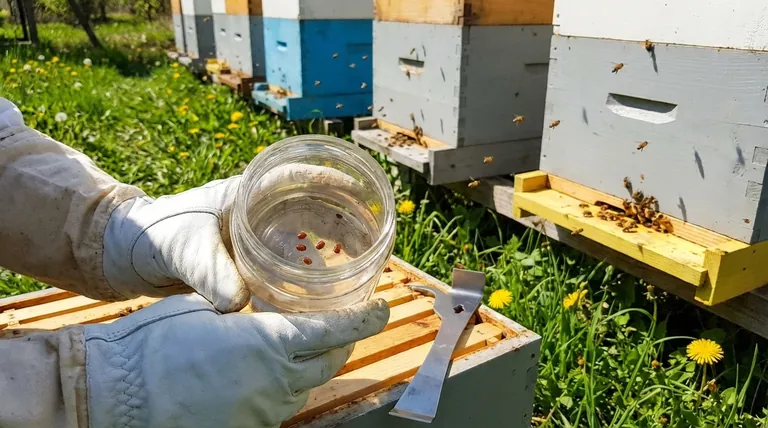
The Illusion of a Healthy Hive
Picture a commercial apiary in early April. The air hums. Bees, vibrant and busy, stream in and out of the hives, their legs heavy with bright yellow pollen. To the eye, it’s a perfect picture of health and productivity.
This picture is a dangerous illusion.
Our minds are wired to react to visible threats. We see a weak hive, we intervene. We see sick bees, we treat. But the most catastrophic threat in beekeeping, the Varroa destructor mite, operates on a mathematical principle that is invisible until it's too late. The fate of that bustling April hive is not determined by its apparent strength, but by a handful of mites hidden beneath the brood caps.
Spring Varroa management isn't a routine task; it's a strategic intervention against a predictable, exponential catastrophe.
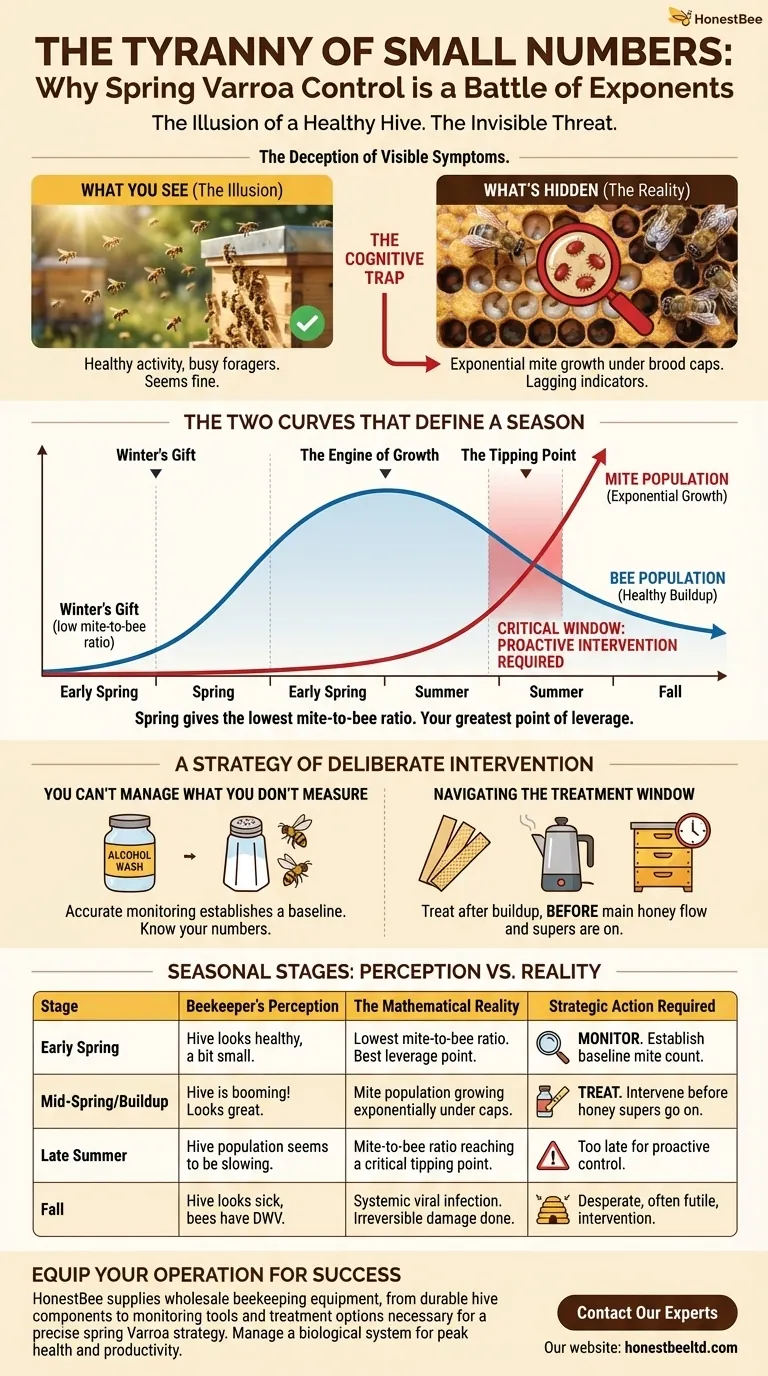
The Two Curves That Define a Season
The success or failure of a bee colony hinges on the interplay between two population growth curves: the bees and the mites. In spring, you are in a race to ensure the bee curve dramatically outpaces the mite curve.
The Starting Line: Winter's Gift
A colony emerging from winter is at its weakest, with its smallest population of the year. But this weakness is also a profound strategic advantage. The queen's reduced winter laying rate has starved the Varroa mite population of its only incubator: capped brood.
This gives you the lowest mite-to-bee ratio you will see all year. It is a gift—a reset point that you cannot afford to waste. This is your single greatest point of leverage.
The Engine of Growth (and Destruction)
As the nectar flows, the queen becomes an engine of growth, laying thousands of eggs per day. This explosion of bee brood is what builds a powerful honey-producing workforce.
Unfortunately, this same engine powers the mite population.
For every new cell of capped brood, a female Varroa mite can slip in, lay multiple offspring, and multiply her numbers. The very biological process that ensures the colony’s survival is also the mechanism for its potential destruction. The growth is exponential and it happens completely out of sight.
The Cognitive Trap of Procrastination
Because the mite population grows invisibly, beekeepers are often lured into a false sense of security. This delay is the most common and devastating mistake in apiary management.
The Deception of Visible Symptoms
By the time you see the classic signs of Varroa infestation—bees with deformed wings (DWV), a spotty brood pattern, a dwindling population—you are not witnessing a problem. You are witnessing the end result of a battle you lost months ago.
Visible symptoms are lagging indicators of a systemic failure. Treating the hive at this stage is like trying to patch a dam that has already burst.
The Anatomy of a "Mite Bomb"
An untreated hive's mite population skyrockets by late summer. As the bee population naturally begins to shrink post-solstice, the mites-per-bee ratio spikes to lethal levels. The colony collapses under the weight of the parasitic load and the viruses they transmit.
This dying colony becomes a "mite bomb." As it fails, its bees drift or rob neighboring hives, carrying a massive payload of mites with them. A single beekeeper's inaction can trigger a chain reaction, jeopardizing an entire region's apiaries.
A Strategy of Deliberate Intervention
Shifting from a reactive to a proactive mindset is what separates consistently profitable apiaries from those plagued by constant losses. This requires a strategy built on data and precise timing.
You Can't Manage What You Don't Measure
Hope is not a strategy. You must know your numbers. An alcohol wash or powdered sugar roll in early spring is non-negotiable. It provides a clear, data-driven baseline of your infestation level.
Professional apiaries rely on precise data, not guesswork. Accurate monitoring, using reliable equipment, is the foundation of any effective Varroa strategy. It tells you if you need to act and when to deploy your resources for maximum impact.
| Stage | Beekeeper's Perception | The Mathematical Reality | Strategic Action Required |
|---|---|---|---|
| Early Spring | Hive looks healthy, a bit small. | Lowest mite-to-bee ratio. Best leverage point. | Monitor. Establish baseline mite count. |
| Mid-Spring/Buildup | Hive is booming! Looks great. | Mite population is growing exponentially under the caps. | Treat. Intervene before honey supers go on. |
| Late Summer | Hive population seems to be slowing. | Mite-to-bee ratio is reaching a critical tipping point. | Too late for proactive control. |
| Fall | Hive looks sick, bees have DWV. | Systemic viral infection. Irreversible damage done. | Desperate, often futile, intervention. |
Navigating the Treatment Window
The most critical window for action is after the initial spring buildup but before the main honey flow requires you to add honey supers. Many effective treatments cannot be used with supers on the hive.
Having access to a range of effective, professional-grade tools is non-negotiable for commercial operations. HONESTBEE supplies wholesale beekeeping equipment, from durable hive components to the monitoring tools and treatment options necessary to execute a precise spring Varroa strategy. We equip professional beekeepers to win the race against the numbers.
This isn't just about keeping bees alive; it's about managing a biological system for peak health and productivity. By understanding the tyranny of small numbers and acting decisively in the spring, you turn a potential catastrophe into a predictable success.
To equip your operation with the professional-grade tools needed for effective spring Varroa management, Contact Our Experts.
Visual Guide
Related Products
- Oxalic Acid Vaporizer 12V for Bee Varroa Mite Treatment
- Heavy Duty 12V Oxalic Acid Evaporator Vaporizer for Bee Varroa Mite Treatment Beekeeping Fumigator Atomizer
- Durable 12V Oxalic Acid Vaporizer for Varroa Mite Treatment Beehive Beekeeping Tool
- Compact Circular Bee Mite Treatment Dispenser
- Adjustable Formic and Acetic Acid Dispenser for Bee Mite Treatment
Related Articles
- How Broodless Timing Unlocks Oxalic Acid's Full Potential Against Varroa Mites
- How to Master Oxalic Acid Vaporization for Safe and Effective Varroa Mite Control
- Optimizing Varroa Control: A Science-Backed Rotation Guide for Beekeepers
- How to Detect and Defeat Varroa Mite Syndrome in Your Beehives
- How Beekeepers Can Control Varroa Mites Without Harming Their Colonies






