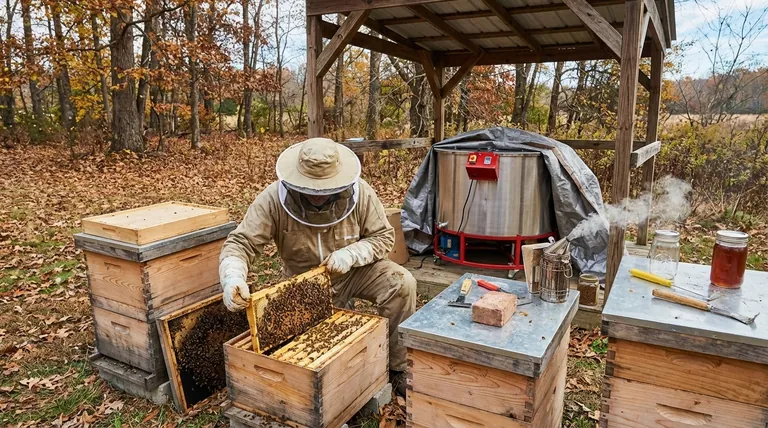
The October Deception
Picture a beehive in early October. The air is crisp. The bees are still flying, the entrance is busy, and the colony feels heavy with honey. To the beekeeper, everything looks perfect—a strong, populous hive ready for winter.
Yet, this hive might already be doomed.
Inside, a silent and invisible process is underway. A threat that doesn't announce itself with noise or obvious weakness is systematically dismantling the colony's future. This is the fundamental challenge of the Varroa destructor mite, and it's a problem rooted as much in beekeeper psychology as it is in bee biology.
We are wired to react to what we can see. But with Varroa, what you see is often a lagging indicator of a crisis that has already passed the point of no return.
A Two-Front War Inside the Hive
The genius of the Varroa mite is its efficiency. It doesn't just execute a single attack; it wages a devastating two-front war on the honey bee colony.
The First Attack: A Direct Drain on Life
A mite attaches itself to a bee and feeds on its fat body—an organ that functions much like the human liver. This isn't just a simple bite. It's a fundamental assault on the bee's core systems.
The fat body is responsible for:
- Immune function: It's the center of the bee's defense against disease.
- Energy storage: It holds the reserves needed to survive long periods, especially winter.
- Detoxification: It cleanses the bee's system.
By consuming this organ, the mite leaves the bee malnourished, immunocompromised, and with a drastically shortened lifespan. It cripples the individual before it can contribute.
The Second Attack: A Trojan Horse for Viruses
More destructive than the feeding itself is the mite’s role as a biological dirty needle. As it moves from bee to bee, it injects a cocktail of viruses directly into their open wounds.
The most infamous of these is the Deformed Wing Virus (DWV).
In a colony with few mites, DWV might exist as a low-level, asymptomatic infection. But when Varroa transmits it, the virus becomes hyper-virulent. Bees emerge from their cells with shrunken, useless wings, unable to fly, forage, or function. They are a total loss to the hive, dying within days. Seeing bees with deformed wings is not an early warning; it's the final symptom of a colony on the verge of collapse.
The Tipping Point: From Problem to Catastrophe
The damage escalates from the individual to the collective, following a predictable and tragic timeline.
Eroding the Summer Workforce
Throughout the spring and summer, a moderate mite infestation acts like a tax on the colony's productivity. Bees are slightly weaker and live shorter lives. The hive builds up more slowly and produces less honey. The damage is real but often subtle enough to be overlooked.
The Doomed Generation of Winter Bees
The true catastrophe happens in the late summer and fall. This is when the hive rears its "winter bees"—a biologically distinct generation of bees designed to live for months, not weeks. Their robust fat bodies allow them to survive the long, cold winter and restart the colony in the spring.
This is the generation that Varroa mites target with lethal precision.
When mites infest the brood cells of these crucial winter bees, they emerge as shadows of what they should be. Their fat bodies are diminished, their immune systems are compromised, and their lifespans are cut short. The colony may look strong in October, but its winter bees are not equipped to survive until March.
This is why beekeepers are so often shocked by winter losses. The colony didn't freeze or starve; it died in November from the cascade of failures set in motion by mites back in August.
Escaping the Cognitive Trap: You Cannot Manage What You Cannot See
Failure to control Varroa is rarely due to a lack of effort. It's due to a cognitive bias—we wait for a clear signal of danger before acting.
Waiting to see mites on bees or, worse, symptoms like DWV, is like waiting for your house to be engulfed in flames before calling the fire department. It’s too late. The internal damage is already done.
The only way to break this cycle is to shift from reactive observation to proactive data collection.
The Engineering of Certainty
The alcohol wash is the gold standard for Varroa monitoring for a reason. It is an act of engineering certainty in a biological system full of variables.
By sampling a set number of bees (typically 300) and washing them in alcohol, the mites are dislodged and can be accurately counted. The result—a clear "mites per 100 bees" number—removes all guesswork. It tells you the precise level of the threat, not what you hope it is.
While it requires sacrificing a small sample of bees, that calculated loss is insignificant compared to losing the entire colony to an unmanaged infestation. It is the logical, responsible choice.
A Blueprint for Resilient Apiaries
Effective Varroa management is the cornerstone of modern beekeeping. It is a system of defense built on understanding the enemy and using the right tools to measure its presence.
| Consequence | Systemic Impact on the Colony |
|---|---|
| Direct Parasitism | Weakens individual bees, shortening lifespan and immunity. |
| Virus Transmission | Amplifies deadly viruses like DWV, causing deformities. |
| Reduced Productivity | Leads to smaller honey crops and slower population growth. |
| High Winter Losses | Compromises winter bees, leading to inevitable collapse. |
Your strategy should be guided by data, not by sight. Protecting your bees and your business requires reliable equipment for testing and treating Varroa infestations. HONESTBEE provides commercial apiaries and distributors with the professional-grade supplies needed to implement a data-driven mite management program.
To safeguard your investment and ensure your hives thrive, you need the right tools for the job. Contact Our Experts
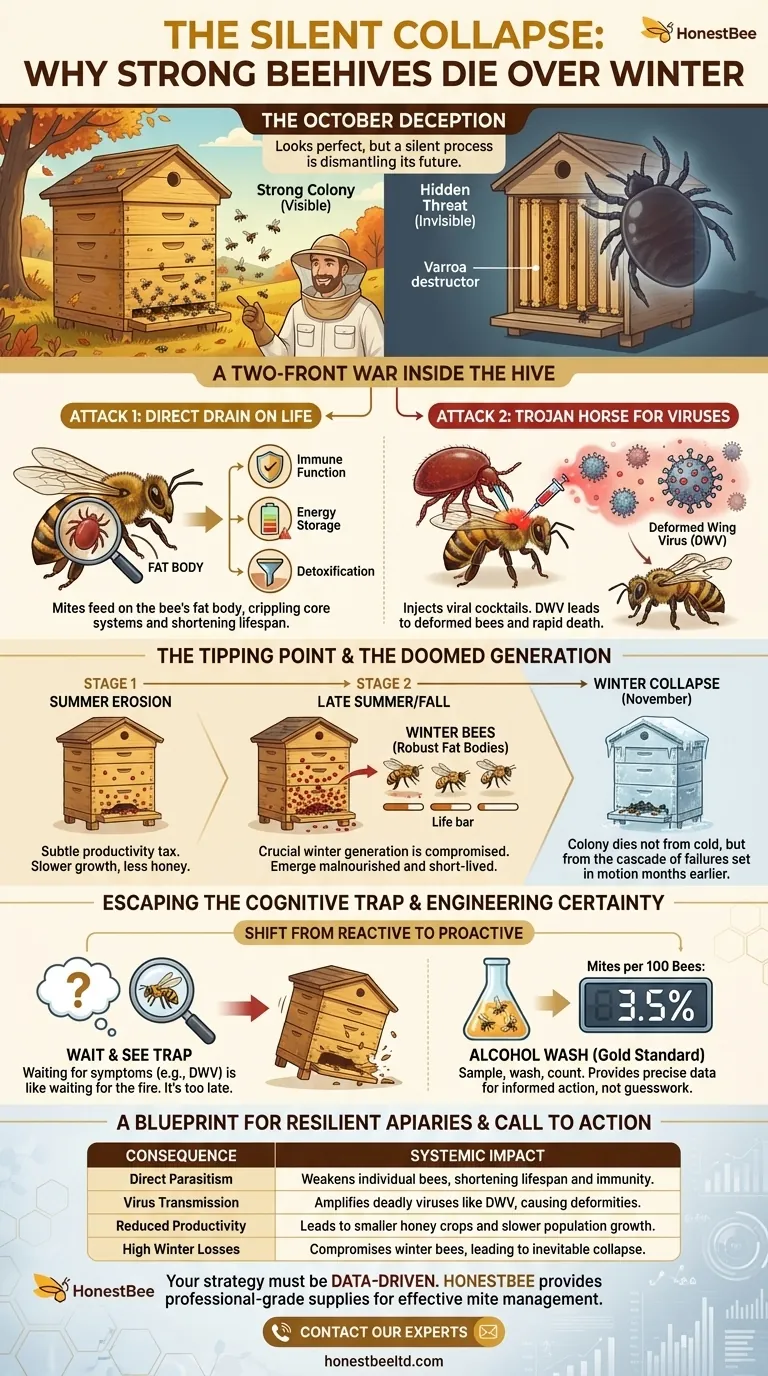
Visual Guide
Related Products
- Varroa Easy Check Mite Tester Kit Counter Alcohol Wash Jar
- Langstroth Screen Bottom Board for Beekeeping Wholesale
- Compact Circular Bee Mite Treatment Dispenser
- Heavy Duty 12V Oxalic Acid Evaporator Vaporizer for Bee Varroa Mite Treatment Beekeeping Fumigator Atomizer
- Durable 12V Oxalic Acid Vaporizer for Varroa Mite Treatment Beehive Beekeeping Tool
Related Articles
- How Beekeepers Can Control Late-Summer Varroa Mites Without Compromising Honey Quality
- The Deceptive Calm: Why a Strong Summer Hive Masks a Looming Winter Collapse
- The Tyranny of Small Numbers: Mastering Varroa Mite Math Before It Masters Your Hives
- The Varroa Paradox: Why Strong Summer Beehives Collapse in Winter
- The Signal and the Noise: Why Thriving Hives Collapse and How Data Prevents It






