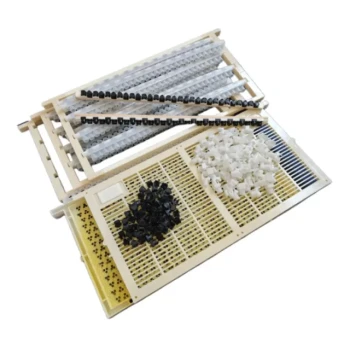
Strategic colony management often hinges on the quality of the queen. Beekeepers intentionally raise new queens to replace aging individuals whose egg-laying is declining, to facilitate splitting large colonies into multiple hives to prevent swarming, and to introduce superior genetic traits—such as gentleness or disease resistance—into their apiary.
Proactive queen rearing is not merely about maintenance; it is a calculated leverage point used to maximize honey production, expand apiary size, and selectively breed for resilience and temperament.
Maximizing Colony Productivity
Maintaining Peak Brood Production
As queens age, their biological capacity to lay eggs diminishes.
A beekeeper raises a replacement queen to swap out an older matriarch before she fails. This ensures the colony maintains a high population density, which is critical for hive survival and resource gathering.
Timing for Nectar Flows
The goal of most beekeeping is to have the maximum number of worker bees available exactly when local plants are blooming.
By timing the introduction of a vigorous new queen, a beekeeper ensures the brood cycle aligns with these peak nectar flows. This coordination results in a significantly higher honey yield compared to a colony with a failing queen.
Expansion and Swarm Control
Facilitating Colony Splits
To grow an apiary, beekeepers often split one large colony into two or more smaller ones.
Since every hive requires a queen, raising new queens allows the beekeeper to immediately provide leadership to these new divisions. This creates sustainable growth without the need to purchase external stock.
Managing the Swarm Impulse
When a colony becomes too populous, its natural instinct is to swarm—splitting itself and leaving with the old queen.
By intentionally raising queens and splitting the hive manually, the beekeeper preempts this natural event. This keeps the workforce under the beekeeper's control rather than losing half the bees to the wild.
Enhancing Colony Genetics
Improving Temperament
Not all bee colonies behave the same way; some are aggressive while others are docile.
A beekeeper can raise a new queen from their most gentle colony and introduce her to an aggressive hive. As her offspring replace the older workers, the entire colony's temperament will shift toward the calmer lineage.
Boosting Resistance and Yield
Genetics dictate a colony's ability to resist disease and their drive to produce honey.
Raising queens allows for selective breeding. A beekeeper can propagate traits from their strongest, healthiest hives, gradually improving the overall disease resistance and productivity of the entire apiary.
Understanding the Trade-offs
The Requirement of Expertise
While raising queens offers control, it is not a beginner's task.
It requires a sophisticated understanding of bee behavior, precise handling techniques, and accurate timing. Mistakes during the rearing process can leave a colony queenless or result in inferior stock.
Resource vs. Convenience
Rearing queens demands time, equipment, and biological resources from the hive.
Purchasing a mated queen from a breeder is often faster and easier for hobbyists. However, raising your own provides localized adaptation and self-sufficiency that purchased queens cannot match.
Making the Strategic Decision
Before deciding to raise your own queens, assess your primary objective for the season.
- If your primary focus is increasing honey yield: Prioritize raising queens to replace aging stock before the main nectar flow begins.
- If your primary focus is apiary growth: Focus on raising queens specifically to support splitting large, overwintered colonies.
- If your primary focus is manageability: Raise queens solely from your gentlest, most disease-resistant hives to improve your apiary's genetics.
Mastering queen rearing transitions a beekeeper from a passive observer of nature to an active steward of their colony's future.
Summary Table:
| Reason for Raising Queens | Primary Benefit | Strategic Impact |
|---|---|---|
| Colony Productivity | Maintains peak brood cycles | Maximizes honey yield during nectar flows |
| Swarm Control | Preempts natural hive splitting | Retains workforce and prevents bee loss |
| Genetic Improvement | Selective breeding for gentleness | Enhances temperament and disease resistance |
| Apiary Expansion | Facilitates manual colony splits | Enables sustainable growth without external costs |
Elevate Your Apiary with HONESTBEE Solutions
At HONESTBEE, we understand that high-quality queen rearing is the backbone of a productive apiary. Whether you are a commercial beekeeper looking to scale operations or a distributor seeking reliable equipment, we provide the professional-grade tools you need to succeed.
Why Partner with HONESTBEE?
- Comprehensive Inventory: From specialized hive-making and honey-filling machines to essential beekeeping consumables.
- Wholesale Expertise: Tailored solutions designed to meet the high-volume demands of industrial-scale beekeeping.
- Industry Leadership: We support your journey from genetic selection to final honey processing with premium hardware.
Ready to enhance your colony's genetics and maximize your production? Contact us today to explore our full spectrum of beekeeping tools and machinery.
Related Products
- Jenter Queen Rearing Kit Complete Set for Bee Breeding
- No Grafting Queen Rearing Kit: System for Royal Jelly Production and Queen Rearing
- Premium Nicot Style Queen Rearing Kit with Hair Roller Bee Cages
- Retractable Chinese Queen Rearing Grafting Tools Equipment
- Nicot Queen Rearing Kit for Beekeeping and Grafting in Nicot System
People Also Ask
- What is the primary function of a queen rearing kit? Eliminate Manual Grafting for Superior Bee Breeding
- What are some alternative methods to grafting for queen cell production? Discover Graft-Free Queen Rearing Systems
- How do specialized queen rearing kits and queen management tools improve the success rate of bee colony expansion?
- How do you prepare the frame for the Queen Rearing kit? Boost Queen Acceptance & Larval Quality
- How is 'active' queen rearing defined in beekeeping? Master Intentional Colony Management & Genetic Control