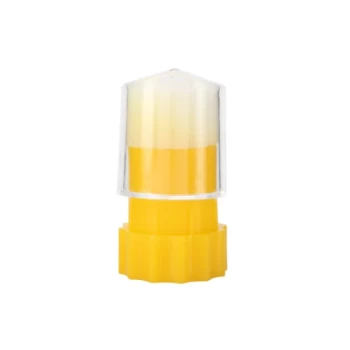
Paint markers provide a low-tech, high-efficiency solution for tracking honeybee populations during research and sampling. By applying distinct colors to the thorax of individual bees, researchers can visually classify specific groups without the need for advanced technology. This simple technique is critical for identifying the source colony and treatment history of bees during laboratory analysis, particularly when monitoring for spore proliferation.
By replacing complex optical identification systems with visual color-coding, this method enables the rapid classification of honeybees. It streamlines the workflow for auxiliary sampling and biochemical analysis, ensuring samples can be instantly traced back to their specific treatment group.
The Mechanics of Colony Marking
Thoracic Application
The core of this method involves applying paint directly to the honeybee's thorax. This specific placement ensures the marker is highly visible to the researcher while remaining safe for the bee.
Rapid Group Classification
Researchers utilize a variety of colors to represent different variables. By assigning a specific color to a group, they can instantly differentiate between distinct colonies or experimental subsets.
Application in Spore Detection and Sampling
Facilitating Auxiliary Sampling
The primary reference highlights the use of paint markers specifically for auxiliary sampling. This technique is employed to detect and monitor the proliferation of spores within a colony.
Streamlining Biochemical Analysis
When bees are removed for laboratory testing, maintaining their identity is crucial. The paint markers allow researchers to verify the source colony and treatment group during biochemical analysis, ensuring data integrity.
Advantages Over Complex Systems
Removing Technological Barriers
A significant advantage of this approach is that it does not rely on complex optical identification systems. Researchers can identify samples with the naked eye rather than depending on expensive digital tracking hardware.
Increasing Workflow Speed
The reference emphasizes the ability to achieve rapid classification. In time-sensitive sampling scenarios, visual markers allow for faster sorting and processing than digital alternatives.
Optimizing Your Sampling Strategy
To leverage this method effectively, align your color-coding system with your specific analytical goals.
- If your primary focus is spore detection: Use distinct colors to clearly separate treatment groups from control groups to ensure accurate attribution during biochemical analysis.
- If your primary focus is workflow efficiency: Adopt paint markers to bypass the setup time required for optical tracking equipment, allowing for immediate sample processing.
By simplifying identification with visual markers, you ensure the integrity of your data while significantly reducing technical complexity.
Summary Table:
| Feature | Paint Marker Method | Complex Optical Systems |
|---|---|---|
| Equipment Cost | Low (Basic markers) | High (Cameras & Software) |
| Identification Speed | Instant Visual Recognition | Requires Data Processing |
| Setup Complexity | Minimal/Manual | High/Technical |
| Key Use Case | Spore Sampling & Group Sorting | Precise Behavioral Tracking |
| Data Integrity | High (Physical Marking) | Variable (Lighting/Tech Dependency) |
Elevate Your Apiary Management with HONESTBEE
At HONESTBEE, we specialize in empowering commercial apiaries and distributors with professional-grade beekeeping tools and advanced machinery. Whether you are conducting scientific colony research or scaling your honey production, our comprehensive wholesale portfolio has you covered—from precision marking tools to hive-making and honey-filling machines.
Partner with us to streamline your workflow and ensure data integrity. Our team is dedicated to providing high-quality industry consumables and honey-themed merchandise tailored to your business needs.
Contact HONESTBEE Today for Exclusive Wholesale Pricing
References
- Célia Bordier, Cédric Alaux. Should I stay or should I go: honeybee drifting behaviour as a function of parasitism. DOI: 10.1007/s13592-016-0475-1
This article is also based on technical information from HonestBee Knowledge Base .
Related Products
- Queen Bee Catcher Plastic Bee Marker Bottle with Piston Marking Tube
- Queen Bee Marking Pen UNI Medium Point for Queen and Bee Marking
- Queen Bee Marking Pen POSCA Queen Marking Pens for Beekeeping Bee Markers
- Queen Bee Marking Tube Cage Bottle Catcher Holder with Clear Plastic Plunger Marker
- One Hand Yellow Queen Marking Catcher Tube Cage Beekeeper Tool Accessory for Queen Bee
People Also Ask
- What are the dual functions of queen bee catchers? Protect Your Queen with Isolation & Precision Management
- What are the primary objectives for marking a queen bee? Master Hive Management and Data Tracking
- Why is the physical marking of a queen bee important? Ensure Precise Colony Replacement Cycle Tracking
- Where on the queen bee's body should the mark be applied? Master the Art of Safe Queen Identification
- What is the purpose of a queen catcher in beekeeping? Safely Handle Your Queen Bee