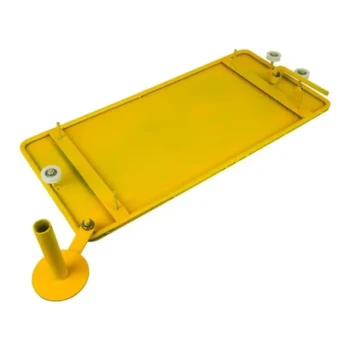
Standard grid frames act as high-precision translation tools. They function by overlaying a matrix of square-inch units onto the honeycomb, allowing beekeepers to convert irregular biological patterns of brood and honey into standardized data points.
The Core Insight Visual inspections of beehives are inherently subjective due to the irregular nature of comb construction. By applying a standardized grid, you transform organic "chaos" into objective metrics, enabling the precise evaluation of colony efficiency, biomass production, and overall health.
The Mechanics of Grid Quantification
Converting Area to Numbers
The primary function of a standard grid frame is to impose a geometric constant on a biological variable. The frame is divided into specific square-inch units.
When placed against a honeycomb, this grid allows the observer to count the exact surface area covered by colony activities. This converts visual estimates into hard data that can be tracked over time.
Targets of Measurement
Using this method, beekeepers can isolate and measure distinct aspects of colony productivity. The primary reference highlights three critical metrics: capped larvae, pollen stores, and capped honey.
By quantifying these specific areas, you gain a direct insight into the colony's current reproductive status (brood) and its resource stability (honey and pollen).
Establishing a Consistent Baseline
For these measurements to be valid, the hardware itself must not introduce variables. Standardized hives equalize the growth space across all colonies.
This ensures that changes in brood or storage area are due to biological factors—such as the impact of natural products or additives—rather than differences in available space or hive structure.
Quantifying Honey Storage: Beyond Area
While grid frames measure surface area, accurate honey quantification often requires determining net weight. This involves a specific protocol to account for the physical state of the equipment.
The Weight Deduction Standard
To calculate the actual honey contribution, you cannot simply weigh the frame. You must subtract the weight of the structure itself, known as the tare weight.
Supplementary data establishes specific standards for this: 400 grams for light-colored new frames and 600 grams for brown older frames.
Calculating Net Yield
By weighing a honey-laden frame on a precision scale and subtracting the appropriate standard weight based on frame color, you isolate the net weight of the honey.
This provides a secondary layer of data that complements the surface area measurements derived from the grid, offering a complete picture of storage efficiency.
Understanding the Trade-offs
Precision vs. Estimation
There is a balance to be struck between granular data and rapid assessment. While square-inch grids offer high precision, some protocols use broader estimates, such as 1/4 frame increments.
The 1/4 frame method is faster for general management but lacks the detailed resolution required for rigorous scientific studies or precise biomass evaluation.
The Variable of Frame Age
A common pitfall in quantifying honey storage is ignoring the age of the comb. As indicated by the weight standards, an older frame is significantly heavier than a new one (600g vs 400g).
Failing to categorize frames by age and color before weighing will introduce significant measurement errors, skewing your data on the colony's actual production performance.
Making the Right Choice for Your Goal
To select the right quantification method for your specific needs, consider the following:
- If your primary focus is scientific accuracy: Use square-inch grid frames to measure specific areas of eggs, larvae, and pupae, ensuring you capture subtle changes in colony reproduction.
- If your primary focus is honey production: Combine surface area measurement with precision weighing, strictly adhering to the 400g/600g deduction standard to account for frame age.
- If your primary focus is rapid management: Utilize the 1/4 frame increment method to get a quick, "big picture" view of colony health without the time investment of counting square inches.
Objective data is the only bridge between observing a hive and truly understanding its performance.
Summary Table:
| Measurement Goal | Recommended Method | Key Metric Used | Precision Level |
|---|---|---|---|
| Scientific Research | Square-inch Grid Frame | Exact surface area (sq. in) | High |
| Honey Yield Analysis | Precision Weighing | Net weight (minus 400g/600g tare) | High |
| Colony Biomass | Area Quantification | Capped larvae & pollen area | Medium-High |
| Routine Management | 1/4 Frame Increments | Visual volume estimation | Low-Medium |
Scaling Your Apiary Operations with HONESTBEE
Transitioning from subjective observations to precision data is the hallmark of a successful commercial operation. At HONESTBEE, we understand the technical demands of large-scale beekeeping and distribution.
We provide a comprehensive wholesale catalog including professional-grade hive-making machinery, honey-filling equipment, and high-performance beekeeping tools designed for durability and accuracy. Whether you are equipping a commercial apiary or stocking a distribution network, our solutions—from specialized hardware to honey-themed cultural merchandise—ensure your success in the competitive honey industry.
Ready to upgrade your equipment? Contact HONESTBEE today to discuss your wholesale needs!
References
- Dina Fathy. Compression Between Modified and Common Honey Bee Hive on Honey Bee Activity. DOI: 10.21608/jppp.2023.213999.1155
This article is also based on technical information from HonestBee Knowledge Base .
Related Products
- Wooden Bee Hive Frames for Beekeeping and Wholesale
- Assembled Wooden Bee Frames with Beeswax Foundation Ready to Use by HONESTBEE
- HONESTBEE Durable Frame Wiring Board with Integrated Tensioner
- Assembled Wooden Bee Frames with Plastic Foundation for Durability and Convenience by HONESTBEE
- Heavy Duty Castellated Iron Frame Spacer for Honey Supers
People Also Ask
- How do wooden and plastic hive frames compare in terms of durability? Wood vs. Plastic Longevity & Repairability
- How does balancing the number of frames impact hive productivity? Optimize Your Apiary's Biological Output
- What are the main considerations when choosing between wooden and plastic bee hive frames? Optimize Your Apiary's Efficiency
- How should beehive frames be maintained to prolong their lifespan? 5 Pro Tips for Durable Beekeeping Equipment
- What is the primary function of frames within a beehive system? Structural Foundation and Hive Management