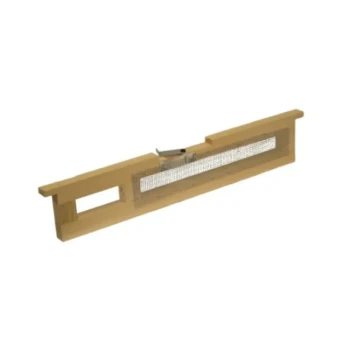
Artificial queen cell bars and grafting frames act as the foundational infrastructure for industrial-scale royal jelly harvesting. By organizing standardized artificial cups into high-density formations, these tools simulate the natural queen-rearing environment to trigger worker bees into mass-producing royal jelly. This system effectively converts a biological instinct into a systematic, scalable production line.
Core Insight: The efficiency of royal jelly production is not defined by the bees alone, but by the standardization of their environment. Grafting frames and cell bars allow apiarists to induce the nursing instinct across hundreds of larvae simultaneously, ensuring high biological output per colony through synchronized rearing.
Systematizing the Nursing Instinct
Simulating the Natural Nest
To produce royal jelly at scale, you must deceive the colony into believing it is rearing new queens. Artificial queen cells are the primary mechanism for this simulation.
These cups, often manufactured from or coated in beeswax, mimic the natural nest environment. By holding grafted larvae, they induce the nursing instinct of worker bees, prompting them to secrete and fill the cups with royal jelly.
Centralized Support Structures
The grafting frame serves as the chassis for this operation. It acts as a centralized carrier that holds multiple rows of cell cups in a standardized layout.
Instead of managing individual cells scattered throughout a hive, the frame consolidates dozens of potential queen cells into a single unit. This density is essential for converting a hive from a honey-producing unit into a royal jelly production unit.
Achieving Scale Through Modularity
The Role of Removable Bars
Specialized grafting frames feature a modular design equipped with removable cell bars. This allows technicians to detach the specific rows holding the cups without moving the entire heavy frame.
This modularity enables precise larval grafting to take place in a controlled laboratory environment rather than in the field. This protects delicate larvae during transfer and streamlines the workflow for mass harvesting.
Synchronous Mass Rearing
By using standardized frames, beekeepers can introduce hundreds of larvae to the colony simultaneously. This ensures that the colony's nursing effort is synchronized.
Because the larvae are all at the same developmental stage and introduced at the same time, the extraction of royal jelly can be scheduled and performed in bulk, rather than piecemeal.
Optimizing the Hive Microclimate
Ensuring Uniform Conditions
The physical structure of the grafting frame ensures that all cell cups are maintained at uniform nursing positions. This consistency is vital for maintaining stable temperature and humidity levels across all cells.
Uniform conditions lead to higher statistical accuracy in queen cell acceptance rates. When the environment is predictable, the bees are less likely to reject the artificial cups.
Strategic Positioning for Yield
The design of the frame allows for strategic placement of the cell bars. Evidence suggests that the position of the bar—front, middle, or rear—directly impacts yield.
Placing cell bars in the center of the frame typically results in heavier royal jelly yields. This area experiences the highest density of nurse bees and is best buffered against external temperature fluctuations.
Understanding the Operational Trade-offs
The Dependency on Precision
While frames provide the structure, the system fails without high-precision human intervention. The use of these tools requires the accurate transfer of larvae of a specific age.
If the grafting is imprecise or the larvae are damaged during the transfer to the removable bars, the bees will clean out the cells rather than fill them with jelly.
Microclimate Sensitivity
Despite the frame's design, the internal microclimate can vary. Cells placed on the periphery of the frame often yield less jelly than those in the center.
Beekeepers must accept that even with standardized frames, there will be variations in yield per cup based on the uneven distribution of nurse bees within the hive.
Making the Right Choice for Your Goal
- If your primary focus is maximizing yield weight: Prioritize placing your cell bars in the middle or center of the rearing frame to leverage the highest density of nurse bees.
- If your primary focus is operational efficiency: Utilize frames with easily removable bars to separate the delicate grafting process from the physical management of the hive.
- If your primary focus is acceptance rates: Ensure your artificial cups feature a high-quality beeswax coating to more closely simulate the natural nest environment.
Standardization is the key to transforming variable biological behavior into predictable industrial output.
Summary Table:
| Component | Role in Production | Key Benefit |
|---|---|---|
| Artificial Queen Cells | Simulates natural queen-rearing environment | Triggers worker bees to secrete royal jelly |
| Grafting Frame | Acts as a centralized carrier for cell bars | Enables high-density larval rearing in one unit |
| Removable Cell Bars | Modular rows for larvae placement | Allows for laboratory-controlled grafting and easy harvest |
| Strategic Positioning | Placement in the center of the frame | Maximizes yield by leveraging nurse bee density |
Scale Your Royal Jelly Production with HONESTBEE
Transitioning from honey production to industrial-scale royal jelly harvesting requires precision-engineered tools that synchronize biological instincts with operational efficiency. HONESTBEE specializes in catering to commercial apiaries and distributors by providing a comprehensive wholesale range of beekeeping equipment.
From high-density grafting frames and cell bars to advanced honey-filling and hive-making machinery, we supply the full spectrum of hardware and consumables needed to optimize your yield. Partner with us to access the specialized tools and honey-themed cultural merchandise your business needs to grow.
Contact HONESTBEE Today for Your Wholesale Solution
References
- Ahmet Emir Şahin, Süleyman Alparslan. An Online Survey to Determine Breeding Activities and Main Issues in Turkey s Beekeeping Enterprises. DOI: 10.51458/bstd.2021.20
This article is also based on technical information from HonestBee Knowledge Base .
Related Products
- JZBZ Langstroth Queen Rearing Frame for Beekeeping
- Clear Black Plain Polystyrene Queen Bee Grafting Cell Cups No Lug for Bee Queen Cup
- Premium Nicot Style Cell Bar Holder and Queen Cell Cup Holder System
- Retractable Chinese Queen Rearing Grafting Tools Equipment
- Professional Wooden Requeening Frame for Beekeeping
People Also Ask
- Why use finishing colonies for queen cell capping? Secrets to Superior Queen Quality and Performance
- How do queen rearing frames and grafting needles function together? Master the Doolittle Method for High-Quality Queens
- What is the purpose of queen rearing frames? Master Controlled Queen Production for Your Apiary
- What are the functions of queen rearing frames and artificial queen cells? Master Bee Genetic Improvement
- What roles do professional queen rearing frames and artificial queen cells play? Scaling Your Queen Bee Production