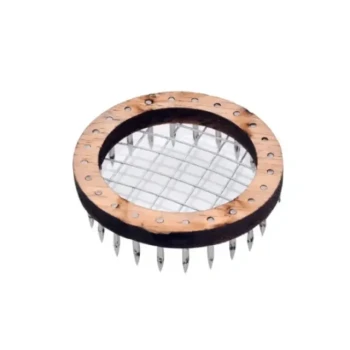
The grafting needle and queen rearing frame function as the precision input and the structural chassis of the Doolittle method.
The grafting needle is a surgical instrument used to manually transfer young larvae from a donor comb into artificial queen cups, while the queen rearing frame holds these cups in a standardized array. This combination allows beekeepers to transform a biological impulse—the colony's drive to raise queens—into a controlled, scalable production line.
Core Takeaway The success of the Doolittle method relies on the interplay between manual precision and biological manipulation. The grafting needle isolates specific genetic stock without damaging it, while the rearing frame positions that stock in the exact center of the hive's warmth and nurse bee population to guarantee maximum royal jelly production.
The Precision of the Grafting Needle
The grafting needle is the primary tool for genetic selection and larval transfer. Its function is strictly operational: moving a fragile life form without harming it.
Selective Transfer
The needle allows the beekeeper to select larvae from a specific "breeder queen" with desirable genetics. By manually choosing larvae, you bypass the colony's natural selection and impose your own criteria for quality.
Mechanical Protection
The specialized tip of the needle is designed to lift the larva along with a small bed of its native royal jelly. This "priming" fluid protects the larva from drying out and provides a cushion during movement.
Minimizing Physical Damage
Survival rates hinge on the needle's design and the operator's skill. A precise needle ensures the larva is deposited at the bottom of the artificial cup without rolling or crushing it, which is critical for acceptance by nurse bees.
The Architecture of the Queen Rearing Frame
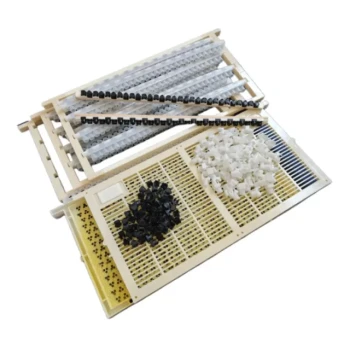
Once the larvae are grafted, the queen rearing frame serves as the incubation hardware. It turns a standard hive frame into a modular nursery.
Centralized Positioning
The frame is designed to hold bars of artificial cups (often 15 to 45 per frame) in the center of the brood nest. This positioning ensures the developing queens remain in the warmest part of the hive, surrounded by the highest density of nurse bees.
Standardized Workflow
Unlike natural queen cells, which are built sporadically across a comb, the frame arranges cells in neat rows. This allows for rapid inspection, easy capping verification, and efficient harvesting of mature queen cells.
Inducing Resource Concentration
By placing this frame into a "cell builder" (a colony prepared with an abundance of nurse bees and food), the frame focuses the colony's feeding energy. The artificial cups simulate the physical structure of natural queen cells, triggering the bees to secrete massive amounts of royal jelly.
Critical Trade-offs and Risks
While this hardware combination enables mass production, it introduces specific risks that must be managed to ensure quality.
Larval Age Sensitivity
The references mention using larvae aged 24 hours to two days. However, younger is universally better for quality. Grafting a two-day-old larva is mechanically easier with the needle, but it results in a queen of lower physiological quality. The highest quality queens come from the youngest possible larvae (typically 12-24 hours old) that have not yet been fed a worker diet.
Mechanical Injury
The needle is the point of failure. Even microscopic damage to the larva during the lift-and-place motion will cause the nurse bees to reject the cell immediately. This requires high manual dexterity.
Nutritional Dependencies
The frame concentrates larvae, but it does not feed them. As noted in the supplementary data, external feeders are often required. If the colony's nutrition drops, the high density of larvae on the frame will result in underfed, inferior queens.
Making the Right Choice for Your Goal
To maximize the effectiveness of these tools, align your technique with your breeding objectives.
- If your primary focus is Maximum Queen Quality: Use the finest grafting needle available to transfer the youngest possible larvae (12-24 hours), even though they are harder to see and handle.
- If your primary focus is High Survival Rates: Ensure your grafting needle transfers a generous amount of primordial royal jelly with the larva to prevent desiccation during the move to the frame.
- If your primary focus is Scale: Utilize the modularity of the queen rearing frame to run strictly timed batches, ensuring the cell builder colony is always populated with capping-stage cells or new grafts.
The Doolittle method works because the needle provides the selection, and the frame provides the environment.
Summary Table:
| Component | Primary Function | Key Benefit |
|---|---|---|
| Grafting Needle | Manual larval transfer & genetic selection | Minimal physical damage; precise placement of 12-24hr larvae. |
| Rearing Frame | Structural incubation & modular cell holding | Centralizes warmth and nurse bee resources for maximum royal jelly. |
| Artificial Cups | Simulates natural queen cell architecture | Triggers biological feeding impulse in the cell builder colony. |
| Cell Builder | Nutritional & environmental support | Ensures high acceptance rates and superior queen physiology. |
Elevate Your Queen Breeding with HONESTBEE
To produce superior queens, you need tools that match your precision. HONESTBEE specializes in supporting commercial apiaries and distributors with a comprehensive range of professional beekeeping equipment. From high-precision grafting needles and modular queen rearing frames to industrial-grade honey-filling machines, we provide the hardware you need to scale your operations.
Whether you are expanding a commercial breeding program or stocking essential consumables, our wholesale solutions are designed for durability and efficiency.
Ready to optimize your apiary’s production?
Contact HONESTBEE today to discuss our wholesale offerings
References
- Ahmet Güler, Abdurrahman Aydın. The effects of instrumental insemination on selected and unselected breeding characteristics in honeybee (Apis mellifera L.). DOI: 10.1007/s13592-022-00947-0
This article is also based on technical information from HonestBee Knowledge Base .
Related Products
- JZBZ Langstroth Queen Rearing Frame for Beekeeping
- Portable Bee Mating Hive Boxes Mini Mating Nucs 8 Frames for Queen Rearing
- Professional Wooden Requeening Frame for Beekeeping
- Automatic Heat Preservation 6 Frame Pro Nuc Box for Honey Bee Queen Mating
- Jenter Queen Rearing Kit Complete Set for Bee Breeding
People Also Ask
- Why use finishing colonies for queen cell capping? Secrets to Superior Queen Quality and Performance
- What is the purpose of queen rearing frames? Master Controlled Queen Production for Your Apiary
- What are the functions of queen rearing frames and artificial queen cells? Master Bee Genetic Improvement
- What roles do professional queen rearing frames and artificial queen cells play? Scaling Your Queen Bee Production
- What role do professional queen rearing frames play? Master Genetic Selection & Colony Replenishment