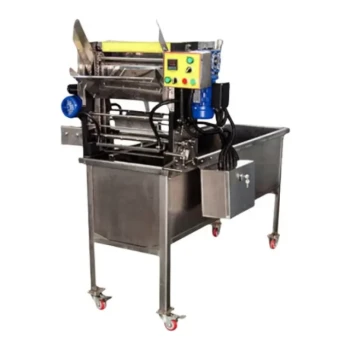
Automated honey filling and packaging production lines act as the critical infrastructure for complying with international trade standards. They fundamentally ensure consistent packaging quality and maintain the rigorous hygiene levels required to enter markets with high regulatory barriers, such as the EU and the US. By automating the process, producers can meet strict demands for measurement precision, labeling accuracy, and seal integrity that manual methods often fail to achieve.
The Core Takeaway: To compete globally, you cannot rely on product quality alone; you need process certainty. Automated lines bridge the gap between local production and global export by creating a closed, standardized environment that guarantees compliance with international safety and weight regulations.
Achieving Absolute Hygiene Control
Eliminating Secondary Contamination
International standards, such as the Food Codex, require honey to remain free from external substances and pathogens. Automated lines provide a closed, sterile environment during the filling process.
By removing direct human contact, these systems prevent "secondary contamination"—pollutants introduced during the packaging phase. This ensures the natural structure of the honey is maintained without adding external impurities.
Preserving Sensory and Biological Properties
High-end markets demand that honey retains its specific nutritional and medicinal properties.
Automated equipment often integrates filtration and moisture control to inhibit microbial growth. This preserves the active biological ingredients and sensory characteristics, which are prerequisites for commanding higher premiums in international trade.
Standardization and Precision Metrics
Exact Metering and Weight Control
A major barrier in international trade is meeting "Net Weight" regulations. Automated machines utilize high-precision metering systems to ensure every bottle meets the stated weight.
This consistency allows producers to comply with strict non-tariff trade measures (NTMs). It eliminates the variance found in manual filling, ensuring that consumers receive exactly what is on the label.
Maintaining Chemical Stability
Global standards often dictate specific physical and chemical indicators, such as maximum moisture content and specific sucrose levels.
Industrial filling machinery minimizes environmental exposure, preventing oxidative degradation. This tight control over the filling atmosphere ensures the product remains stable and falls within the specific chemical parameters required by standards like NMX-F-036-NORMEX-2006.
Navigating Global Regulatory Frameworks
Traceability and Labeling Accuracy
Regulatory bodies in the European Union and the United States require robust traceability. Automated lines facilitate equipment registration and batch tracking.
They also ensure labeling accuracy regarding origin and composition. This mechanical standardization proves to inspectors that the honey was processed under controlled conditions, smoothing the path through customs.
Seal Integrity and Safety
For a product to be exportable, it must be tamper-evident and leak-proof. Automated lines apply advanced sealing technologies that guarantee seal integrity.
This protects the product during long-haul shipping. A secure seal is not just a safety feature; it is a visual indicator of professional processing that builds trust with international buyers.
Understanding the Trade-offs
Operational Complexity vs. Consistency
While automation ensures compliance, it introduces operational rigidity. These systems require strict maintenance protocols to keep the "sterile environment" truly sterile.
Calibration Requirements
To maintain the high precision required for export, the equipment demands regular professional calibration. Failing to calibrate sensors can lead to batch-wide non-compliance, which is costlier than manual errors.
Making the Right Choice for Your Export Strategy
Whether you are upgrading an existing facility or building a new one, your equipment choice dictates your market access.
- If your primary focus is entering the EU or US markets: Prioritize systems with closed-loop sterile filling and advanced filtration to meet the highest purity and hygiene strictures.
- If your primary focus is volume and efficiency: Focus on machines with high-speed precision metering to ensure weight compliance across large batches without product giveaway.
- If your primary focus is premium/medicinal honey: Select equipment with specialized moisture control and low-temperature handling to preserve biological activity and justify higher price points.
Automation is not just about speed; it is the tool that turns a raw agricultural product into a compliant, tradable commodity.
Summary Table:
| Compliance Factor | Benefit of Automation | Impact on International Trade |
|---|---|---|
| Hygiene Control | Closed, sterile filling environment | Eliminates contamination; meets Food Codex standards. |
| Weight Precision | High-precision metering systems | Ensures net weight accuracy; avoids non-tariff barriers. |
| Product Stability | Minimal environmental exposure | Prevents oxidation; preserves biological/medicinal properties. |
| Traceability | Integrated batch tracking & labeling | Facilitates customs clearance and regulatory inspections. |
| Seal Integrity | Advanced tamper-evident sealing | Guarantees safety during long-haul shipping & logistics. |
Elevate Your Beekeeping Business to Global Standards
Transitioning from local production to international export requires more than just high-quality honey—it requires professional-grade process certainty. HONESTBEE empowers commercial apiaries and distributors with the specialized infrastructure needed to dominate the global market.
Our comprehensive wholesale portfolio includes:
- High-Precision Machinery: From automated honey-filling lines to advanced hive-making machines.
- Commercial Equipment: A full spectrum of beekeeping tools and essential industry consumables.
- Cultural Merchandise: Unique honey-themed retail products to diversify your brand.
Whether you are scaling your operation or sourcing for a distribution network, HONESTBEE provides the tools to ensure your products meet the world's most rigorous standards.
Contact HONESTBEE Today to discuss your wholesale equipment needs and secure your export future!
References
- Nancy Diana Panța. Honey Market Dynamics. The Case of Romania. DOI: 10.2478/msd-2019-0002
This article is also based on technical information from HonestBee Knowledge Base .
Related Products
- Fully Automatic Honey Filling Packaging Machine for Processing Line
- Precision Automated Packaging Turntable Honey Spoon Filling Sealing Packing Machine
- Automatic Single-Dose Snap & Squeeze Honey Sachets Packing Machine
- Automatic Honey Filling and Filtering Machine for Beekeeping Bottle Filling
- Economy Small Honey Filling Machine Honey Bottle Filler Packaging Machine
People Also Ask
- Why are fully automatic honey filling and packaging lines essential? Boost Your Honey's Market Value and Quality
- What is a fully-automatic honey filler? Streamline Your Production with High-Precision Automation
- How do automated honey filling and packaging machines affect profitability? Boost Margins with HONESTBEE Technology
- How do automated honey filling and packaging machines contribute to the market value of honey products? Maximize Your ROI
- How do industrial-grade automated honey filling and packaging machines mitigate the risk of physical contamination?