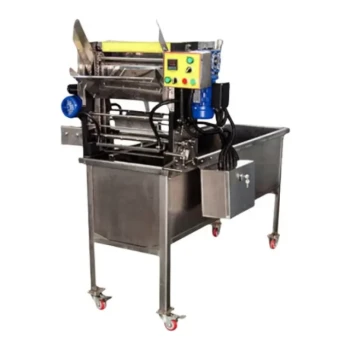
Automated honey-filling machines contribute to conservation primarily by shifting resources from labor to stewardship. By streamlining the downstream packaging process, these machines drastically reduce the time and manpower required for bottling. This efficiency allows commercial beekeepers to reallocate critical financial and human resources toward colony health management and ecological preservation, ensuring the survival of beneficial insect populations.
The conservation impact is economic and operational: automation improves the financial sustainability of apiaries, enabling beekeepers to afford the "non-productive" costs associated with protecting and managing vital pollinator populations.
The Mechanics of Indirect Conservation
Reallocating Human Resources
In traditional beekeeping operations, the packaging phase is labor-intensive. Manual filling, sealing, and labeling consume hours that could otherwise be spent in the field.
Automated filling lines utilize precise metering and high-speed processing to handle this workload.
This liberation of labor allows staff to focus on upstream activities. Personnel can be redeployed to monitor hive health, manage diseases, and maintain the delicate ecosystems where bees forage.
Economic Stability Supports Biology
Conservation efforts require capital. A commercial apiary that struggles with high overhead costs often lacks the margin to invest in sustainable practices.
By utilizing industrial filling lines, apiaries reduce labor costs and ensure consistent, high-quality product output.
This efficiency secures the economic viability of the business. A profitable apiary is better positioned to fulfill its role as a guardian of beneficial insects, investing in better feed, medical treatments, and hive infrastructure.
Scaling Hygienic Operations
To have a significant impact on insect populations, apiaries must often operate at scale. However, scaling increases the risk of contamination and disease if not managed correctly.
Automated machines maintain high standards of hygiene and filling precision that are difficult to achieve manually at scale.
This allows operations to grow without compromising quality. As the apiary scales efficiently, it brings a larger population of bees under professional management and protection.
Understanding the Operational Trade-offs
The Capital vs. Conservation Balance
While automation frees up resources eventually, it requires a significant upfront capital investment.
For smaller operations, the cost of industrial filling lines may arguably divert funds away from immediate colony care in the short term. It is a long-term play for efficiency, not an immediate fix for ecological issues.
Technical Complexity and dependency
Reliance on automation introduces a new layer of technical dependency.
Beekeepers must maintain not just their hives, but also complex machinery. A breakdown in the "delivery node" can cause bottlenecks that disrupt the entire operation.
Successful implementation requires a balance between biological expertise (for the bees) and technical support (for the hardware).
Making the Right Choice for Your Goal
To leverage automation for ecological benefit, you must intentionally direct the savings toward conservation.
- If your primary focus is business growth: Implement automation to resolve downstream bottlenecks and meet the hygiene standards required by large commercial distribution channels.
- If your primary focus is ecological stewardship: Explicitly reinvest the labor hours and wages saved by automation into expanded colony health monitoring and habitat preservation.
True sustainability in apiculture is achieved when operational efficiency provides the financial safety net required for dedicated environmental stewardship.
Summary Table:
| Impact Category | Benefit of Automation | Contribution to Conservation |
|---|---|---|
| Human Resources | Reduces manual bottling labor | Redirects staff to hive monitoring and disease management. |
| Economic Stability | Lowers overhead and increases output | Provides the financial margin needed for sustainable practices. |
| Operational Scale | High hygiene and precision at scale | Protects larger bee populations under professional management. |
| Resource Allocation | Streamlines downstream processing | Allows reinvestment into habitat preservation and colony care. |
Elevate Your Stewardship with HONESTBEE
At HONESTBEE, we empower commercial apiaries and distributors to bridge the gap between industrial efficiency and ecological responsibility. By integrating our advanced honey-filling machines and specialized beekeeping hardware into your operation, you can drastically reduce labor costs and focus your resources where they matter most: the health of your colonies.
From state-of-the-art hive-making machinery to comprehensive consumables, our wholesale solutions are designed to scale your business while protecting the environment. Partner with us to achieve a more profitable and sustainable future for the beekeeping industry.
Contact us today to optimize your apiary’s efficiency
References
- Mace Vaughan, Scott Black. Conservation of Insects: Instant Symposium Summary. DOI: 10.1093/ae/54.2.96
This article is also based on technical information from HonestBee Knowledge Base .
Related Products
- Fully Automatic Honey Filling Packaging Machine for Processing Line
- Automatic Honey Filling and Filtering Machine for Beekeeping Bottle Filling
- Precision Durable Efficient HONESTBEE Rotary Honey Filling Machine
- Precision Automated Packaging Turntable Honey Spoon Filling Sealing Packing Machine
- Semi Automatic Small Honey Bottle Filling Machine Honey Filler
People Also Ask
- Why are fully automatic honey filling and packaging lines essential? Boost Your Honey's Market Value and Quality
- What is a fully-automatic honey filler? Streamline Your Production with High-Precision Automation
- How do automated honey filling and packaging machines affect profitability? Boost Margins with HONESTBEE Technology
- How do automated honey filling and packaging machines contribute to the market value of honey products? Maximize Your ROI
- How do industrial-grade automated honey filling and packaging machines mitigate the risk of physical contamination?