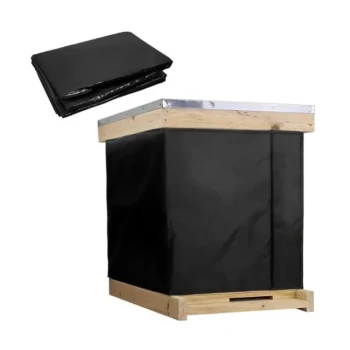
Foam insulation boards serve as a critical thermal defense for honey bee colonies living in observation hives. Because these hives typically feature thin glass walls and a narrow structure, the boards are applied to the sides to act as an external barrier, retaining heat and preventing colony collapse during sharp temperature drops.
Observation hives often lack the three-dimensional depth required for bees to cluster naturally and self-regulate their temperature. Foam insulation provides the necessary thermal stability to compensate for these structural limitations.
The Unique Vulnerability of Observation Hives
The Problem of Structure
In a natural setting or a standard hive, bees survive cold weather by forming a tight, three-dimensional cluster.
This ball shape minimizes surface area and conserves heat. Observation hives, however, have a limited three-dimensional structure, often forcing the colony into a narrow, two-dimensional arrangement.
Inability to Thermoregulate
Because the bees are spread out in a thin layer, they cannot rotate effectively from the cool outer edge of a cluster to the warm center.
This hinders the colony's natural ability to thermoregulate. Without intervention, this exposure leads to rapid heat loss and potential death.
How Insulation Boards Mitigate Risk
Artificial Thermal Stability
Foam insulation boards address the deficit created by the hive's design.
By covering the thin viewing walls, these boards drastically reduce the rate at which heat escapes the hive. They simulate the insulation protection of a thick tree trunk or a wooden box hive.
Integration with Control Systems
These boards are rarely the sole solution for extreme climates.
They are often used in conjunction with environmental temperature control systems. The foam ensures that the heat provided by these systems—or generated by the bees—is not immediately lost to the surrounding air.
Operational Trade-offs
Visibility vs. Protection
The primary function of an observation hive is visibility, yet the primary function of insulation is coverage.
When foam boards are applied to the sides of the hive to ensure survival, the colony cannot be viewed. Beekeepers must balance the desire to observe against the colony's biological need for warmth.
Dependence on Intervention
The necessity of foam boards highlights the artificial nature of the observation environment.
Unlike standard colonies which are largely self-sufficient, observation hives require constant human monitoring. If the boards are not applied promptly during temperature drops, the thin walls offer zero buffer against the cold.
Maximizing Survival in Observation Settings
To effectively manage an observation hive, you must alternate between viewing and protecting based on ambient conditions.
- If your primary focus is Colony Survival: Keep foam boards securely attached whenever the hive is not being actively viewed, especially during evening hours or cold snaps.
- If your primary focus is Educational Display: Ensure the environment around the hive is climate-controlled so that temporary removal of the boards for viewing does not shock the bees.
By treating foam boards as an essential structural component rather than an accessory, you ensure the longevity of the colony within its glass enclosure.
Summary Table:
| Feature | Observation Hive Limitation | Role of Foam Insulation Board |
|---|---|---|
| Thermal Regulation | Narrow structure prevents 3D clustering | Provides artificial thermal stability |
| Wall Material | Thin glass/plastic offers zero insulation | Acts as an external thermal barrier |
| Heat Retention | Rapid heat loss due to high surface area | Minimizes heat escape to the environment |
| Survival Strategy | Highly dependent on human intervention | Simulates protection of thick wooden hives |
Maximize Your Colony’s Potential with HONESTBEE
Protecting sensitive observation colonies is just the beginning. At HONESTBEE, we understand the specialized needs of commercial apiaries and distributors. We provide a comprehensive wholesale range of professional-grade beekeeping tools, from honey-filling and hive-making machinery to essential consumables and honey-themed cultural merchandise.
Whether you are scaling your operation or supplying the next generation of beekeepers, our hardware and expertise ensure your success. Contact us today to explore our full spectrum of beekeeping equipment and see how our tailored wholesale solutions can grow your business!
References
- Michael L. Smith, David T. Peck. Dynamics of honey bee colony death and its implications for Varroa destructor mite transmission using observation hives. DOI: 10.1007/s13592-023-00991-4
This article is also based on technical information from HonestBee Knowledge Base .
Related Products
- Professional Insulated Winter Hive Wrap for Beekeeping
- Langstroth Solid Bottom Board for Beekeeping
- Australian Pine Wood Langstroth Screen Bottom Board for Wholesale
- Solid Bottom Board Australian Pine Wood Langstroth Bottom Board for Wholesale
- Professional Insulated Plastic Bee Hives
People Also Ask
- What are the steps to properly wrap a beehive for winter? Ensure Your Colony Survives the Cold
- When is the best time to wrap a beehive for winter? A Guide to Perfect Winterization Timing
- How do professional insulation wraps provide protection for bee colonies? Optimize Winter Survival & Energy Efficiency
- What are the technical benefits of using winter wraps for beehive insulation? Boost Colony Survival & Hive Health
- What are the benefits of using insulated covers for hives? Ensure Colony Survival and Health