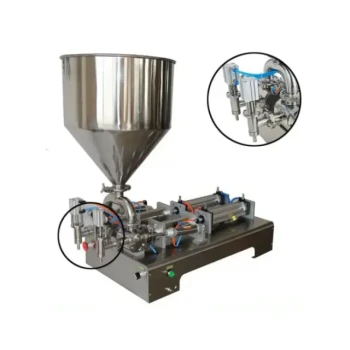
High-precision honey filling machines ensure public health safety primarily through automated, closed-loop sanitation protocols. These industrial-grade systems utilize sanitary piping equipped with Cleaning-in-Place (CIP) and Sterilization-in-Place (SIP) functions, which vigorously clean internal components without disassembly, drastically reducing the risk of external cross-contamination during packaging.
The critical safety mechanism of high-precision filling is the elimination of environmental exposure. By combining automated sterilization with a closed operating environment, these machines isolate the honey from airborne microbes and moisture, preserving its biological stability from the tank to the sealed container.
Automated Sterilization and Hygiene Control
Eliminating Human Contact
Manual cleaning is a primary vector for contamination in food processing. High-precision machines utilize automated CIP and SIP systems to flush and sterilize internal pathways.
Deep Cleaning of Sanitary Piping
The piping systems in these machines are designed to be "sanitary," meaning they lack crevices where bacteria typically harbor. The automated cleaning cycles circulate sterilizing agents through every inch of the flow path, ensuring total hygiene between batches.
Consistent Protocol Execution
Unlike manual washing, automated systems follow a rigid, repeatable program. This guarantees that the temperature, chemical concentration, and duration of the cleaning cycle meet safety standards every single time.
Preventing Secondary Contamination
The Value of Closed-System Packaging
Honey is vulnerable to contaminants present in the ambient factory air. High-precision machines operate within an enclosed filling environment, acting as a physical barrier against dust, airborne microbes, and particulate matter.
Controlling Moisture Absorption
Honey is hygroscopic, meaning it naturally absorbs moisture from the air. Excess moisture can lead to fermentation and spoilage, which poses a health risk.
By reducing the time honey is exposed to the atmosphere, these machines prevent moisture uptake. This preserves the honey’s natural enzyme activity and prevents the growth of yeast or bacteria associated with spoilage.
Operational Precision as a Sanitation Factor
Mitigating Spillage and Drips
High-precision metering pumps and anti-drip mechanisms ensure the honey goes into the bottle, not onto the conveyor or the bottle's exterior.
Reducing Pest Attraction
Honey residue on the outside of machinery or bottles is a magnet for pests and bacteria. By strictly controlling the volume and preventing overflow, these machines maintain a sterile production floor.
Integration with Safety Monitoring
While the machine itself packages the product, it functions best when integrated with upstream safety protocols. Specifically, these systems support workflows that include routine antibiotic residue monitoring, ensuring only compliant batches are processed for the consumer market.
Understanding the Trade-offs
Complexity of Maintenance
High-precision machines with CIP/SIP systems are mechanically complex. If sensors fail or valves clog, the automated cleaning process may be compromised without the operator realizing it immediately.
Reliance on Chemical Management
The effectiveness of CIP systems depends entirely on the correct supply of cleaning agents. If the chemical inputs are incorrect or depleted, the machine may run a "cleaning cycle" that fails to actually sterilize the equipment.
The "Black Box" Risk
Because the piping is enclosed, operators cannot visually inspect the interior surfaces easily. Facilities must rely on rigorous validation and testing of the final product to confirm the machine is performing as expected.
Making the Right Choice for Your Goal
To maximize safety and efficiency, align your equipment choice with your specific production needs:
- If your primary focus is regulatory compliance: Prioritize machines with certified CIP/SIP capabilities and data logging to prove sterilization cycles were completed successfully.
- If your primary focus is shelf-life extension: Select equipment with a fully enclosed, vacuum-sealed filling environment to minimize moisture absorption and oxidation.
Ultimately, high-precision automation transforms honey packaging from a vulnerability into a stronghold of quality control, protecting the consumer by removing human variability from the sanitation process.
Summary Table:
| Feature | Safety & Health Benefit | Technical Implementation |
|---|---|---|
| CIP/SIP Systems | Eliminates bacterial growth & cross-contamination | Automated internal flushing and sterilization |
| Closed-Loop Piping | Prevents exposure to airborne microbes | Sanitary, crevice-free internal pathways |
| Moisture Control | Inhibits fermentation and spoilage | Enclosed environment reduces atmospheric exposure |
| Anti-Drip Tech | Maintains sterile floor & prevents pests | High-precision metering and drip-free nozzles |
| Batch Consistency | Ensures regulatory & antibiotic compliance | Repeatable, automated sterilization protocols |
Elevate Your Honey Production Standards with HONESTBEE
Ensure the highest level of public health safety and product quality with HONESTBEE. As a premier partner for commercial apiaries and distributors, we provide more than just equipment; we deliver a total solution for your honey business.
From high-precision honey-filling machines equipped with advanced CIP/SIP technology to specialized hive-making machinery and essential consumables, our comprehensive wholesale offering is designed to scale your operations efficiently. Whether you are a large-scale producer seeking to automate or a distributor looking for a reliable supply of honey-themed cultural merchandise and hardware, HONESTBEE is committed to your success.
Ready to secure your brand's reputation for purity? Contact us today to explore our full equipment spectrum!
References
- Clara Mariana Gonçalves Lima, V. M. Scussel. Antibiotic residues in honey: a public health issue. DOI: 10.33448/rsd-v9i11.9604
This article is also based on technical information from HonestBee Knowledge Base .
Related Products
- Precision Durable Efficient HONESTBEE Rotary Honey Filling Machine
- Commercial Rotary Honey Filling Machine for Production
- Precision Automated Packaging Turntable Honey Spoon Filling Sealing Packing Machine
- Fully Automatic Honey Filling Packaging Machine for Processing Line
- Automatic Honey Filling and Filtering Machine for Beekeeping Bottle Filling
People Also Ask
- How do high-precision honey filling machines ensure quality? Optimize Your Commercial Production with HONESTBEE
- What are the common types of bottling machines used for honey? Choosing the Right Solution for Your Apiary
- What quality control role does professional honey filling equipment perform? Ensure Consistency and Product Stability
- How do honey filling machines work? Achieve Precision & Speed for Your Apiary
- How do honey filling and processing machines aid native bee product conservation? Boost Value with HONESTBEE Technology