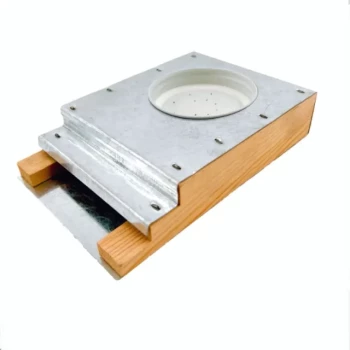
Industrial feeders act as essential environmental stabilizers in commercial apiaries, specifically targeting the biological triggers required for royal jelly production. By providing the colony with precise quantities of sucrose, glucose, or specialized syrups, these devices simulate a high-nectar flow environment, ensuring production continues regardless of external weather conditions.
Core Takeaway: Industrial feeders decouple royal jelly production from natural climate variability. By artificially simulating resource abundance, they trigger the hypopharyngeal glands of worker bees to secrete royal jelly, preventing production dips during droughts or seasonal scarcity.
The Biological Mechanism of Action
Simulating Nectar Flow
In a natural setting, bees restrict royal jelly production when resources are scarce. Industrial feeders override this instinct by providing a constant, regulated supply of carbohydrate-rich syrups. This signals to the colony that resources are abundant, maintaining the "flow" state necessary for production.
Triggering Glandular Secretion
The primary function of this artificial feeding is physiological stimulation. The intake of these specific sugars directly stimulates the hypopharyngeal glands of young worker bees. These glands are the biological manufacturing centers responsible for secreting royal jelly.
Sustaining the Workforce
Beyond just sugar, professional feeders can deliver pollen substitutes and clean water. This nutritional support ensures the colony maintains a high population of young nurse bees—the specific demographic required to produce the jelly.
Overcoming Environmental Constraints
Mitigating Climatic Risks
Royal jelly production is notoriously sensitive to drought and floral scarcity. Feeders act as a buffer against these unpredictable elements. By providing supplemental nutrition, apiaries ensure stable output even when natural nectar sources have dried up or failed.
Reducing Energy Waste
During resource shortages, worker bees typically expend vast amounts of energy flying long distances to find water or nectar. Feeders place these resources directly within the hive. This conservation of energy allows the colony to redirect metabolic effort toward brood rearing and royal jelly secretion.
Operational Considerations and Trade-offs
The Necessity of Precision
Effectiveness relies on more than just dumping syrup into a hive; the primary reference notes the need for precise amounts. Overfeeding or underfeeding can disrupt the colony balance, meaning the "industrial" aspect requires rigorous calibration of input volumes.
Dependency on Inputs
Using feeders shifts the operation from a foraging model to an input-dependent model. While this guarantees consistency, it increases the operational complexity regarding the sourcing of high-quality sucrose or glucose syrups. The quality of the artificial feed directly impacts the colony's health and the subsequent quality of the jelly.
Making the Right Choice for Your Goal
To maximize the potential of industrial feeders, align their usage with your specific production targets:
- If your primary focus is Production Stability: Implement feeders proactively during known seasonal lulls to prevent the colony's hypopharyngeal glands from entering a dormant state.
- If your primary focus is Colony Health: Utilize feeders to provide pollen substitutes and water, minimizing the energy stress on worker bees during drought conditions.
Successful royal jelly production relies not on controlling the weather, but on controlling the colony's perception of it through precise nutritional management.
Summary Table:
| Feature | Impact on Royal Jelly Production | Benefit to Apiary |
|---|---|---|
| Flow Simulation | Triggers hypopharyngeal glands via constant syrup supply | Decouples production from external weather |
| Glandular Stimulation | Sustains high-secreting state in nurse bees | Prevents production dips during droughts |
| Energy Conservation | Reduces long-distance foraging energy waste | Redirects metabolic effort to jelly secretion |
| Nutritional Support | Delivers pollen substitutes and clean water | Maintains a healthy, high-population workforce |
Maximize Your Honey and Royal Jelly Yield with HONESTBEE
At HONESTBEE, we understand that commercial success in beekeeping depends on precision and reliability. We provide a comprehensive wholesale offering designed specifically for commercial apiaries and distributors, ranging from specialized hive-making and honey-filling machines to essential industry consumables.
Our industrial feeders and equipment are engineered to help you maintain consistent production cycles and protect your colonies from environmental variability. Whether you are scaling your honey-themed cultural merchandise or upgrading your apiary's machinery, our team is ready to support your growth.
Ready to optimize your production? Contact us today to explore our full spectrum of beekeeping tools and equipment!
References
- Semiramis Karlıdağ, Selım Erdoğan. The effects of different industrial sugars on royal jelly production. DOI: 10.12681/jhvms.27794
This article is also based on technical information from HonestBee Knowledge Base .
Related Products
- Boardman Entrance Bee Feeder Durable Galvanized Steel and Wood Construction for Beekeeping
- 3.5L Plastic Beehive Frame Feeder Deep Frame Water Feeder for In Hive Use
- HONESTBEE Entrance Bee Feeder Efficient Hive Front Liquid Feeding Solution for Beekeeping
- Professional Hive Top Bee Feeder for Beekeeping
- Rapid Bee Feeder White Plastic 2L Round Top Feeder for 8 or 10-Frame Bee Hives
People Also Ask
- What types of bee feeders are available for beginners? Start with the Simple Entrance Feeder
- How does a bee entrance feeder work? A Simple Guide to Convenient Hive Feeding
- What is a bee entrance feeder and what are its drawbacks? Essential Guide to Hive Security and Feeding Efficiency
- What are the advantages and disadvantages of using an entrance feeder for bees? Balance Convenience and Hive Security.
- How to make an entrance feeder for bees? A DIY Guide for Safe & Effective Feeding