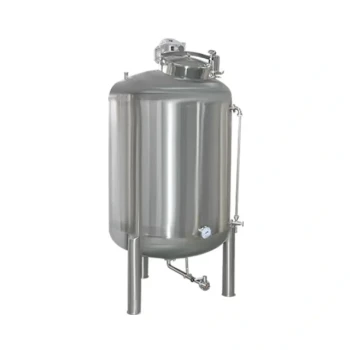
Professional large-capacity honey storage tanks prevent spoilage through a combination of optimized sealing structures and precise temperature control systems. These engineering features work in tandem to minimize moisture exchange between the honey and the surrounding environment. By maintaining a stable internal climate, these tanks inhibit the natural migration of moisture that leads to stratification and fermentation.
The primary threat to stored honey is the density-driven rise of moisture, which creates a diluted top layer prone to yeast activity. Professional storage systems solve this by establishing a sealed, temperature-regulated microenvironment that halts this separation process.
The Mechanics of Honey Preservation
Combatting Density-Driven Stratification
Honey is not a static fluid; it is subject to changes in density. During storage, density differences often cause moisture to migrate upward.
This results in the upper layers of the honey having a significantly higher water content than the bottom.
If left unchecked, this "wet" top layer becomes a breeding ground for yeast, leading to localized fermentation at the top of the tank.
Inhibiting Moisture Migration
Specialized storage equipment is designed specifically to disrupt this natural physical process.
By utilizing temperature control systems, the tanks maintain the honey's viscosity and density at stable levels.
This effectively locks the moisture in place, preventing the vertical migration that causes the dangerous separation of water and sugars.
Sealing and Material Integrity
Creating a Stable Microenvironment
The physical structure of the tank is just as critical as its temperature controls.
Optimized sealing structures are employed to create a hermetic barrier.
This isolation prevents the honey from absorbing humidity from the external air, which is a common cause of spoilage in non-professional setups.
Barrier Protection Against Contaminants
Honey is highly hygroscopic (water-absorbing) and susceptible to absorbing ambient odors.
References indicate that professional-grade plastic containers are often utilized for their superior sealing properties and stability.
These materials act as an effective barrier against external environmental pollutants, ensuring the honey’s flavor profile remains unaltered during long-term storage.
Understanding the Risks and Trade-offs
The Vulnerability of Large Volumes
While large-capacity tanks offer efficiency, they concentrate risk.
If the temperature control system fails or a seal is compromised, the stratification process can accelerate rapidly across a massive volume of product.
The Importance of Material Selection
Not all storage vessels provide the necessary "microenvironment."
Standard containers may lack the specialized sealing properties required to prevent odor absorption.
Using inferior equipment can lead to a phenomenon where the honey does not ferment, but its quality degrades due to the intake of environmental smells or pollutants.
Making the Right Choice for Your Goal
To ensure the longevity and quality of your honey inventory, prioritize the following based on your specific operational needs:
- If your primary focus is preventing spoilage: Prioritize tanks with active temperature control systems to physically inhibit density-driven moisture migration to the top layer.
- If your primary focus is flavor preservation: Select professional-grade containers with superior sealing properties to create a barrier against external odors and pollutants.
Effective honey storage is not just about containment; it is about actively managing the physics of moisture and density.
Summary Table:
| Feature | Function in Preservation | Impact on Honey Quality |
|---|---|---|
| Temperature Control | Maintains stable viscosity & density | Prevents vertical moisture migration and stratification |
| Hermetic Sealing | Creates an airtight microenvironment | Blocks humidity absorption and external contaminants |
| Material Integrity | Uses professional-grade food-safe barriers | Prevents odor absorption and ensures flavor purity |
| Stratification Control | Disrupts density-driven separation | Eliminates yeast-prone 'wet' layers at the top |
Maximize Your Honey Quality with HONESTBEE
For commercial apiaries and honey distributors, maintaining product integrity is non-negotiable. HONESTBEE provides the industry's most reliable large-capacity storage solutions and high-performance honey-filling machinery designed to eliminate the risks of fermentation and spoilage.
Beyond storage, we offer a comprehensive wholesale portfolio ranging from hive-making equipment to specialized honey cultural merchandise. Partner with us to scale your operations with professional-grade tools that protect your investment from hive to bottle.
Ready to upgrade your honey processing? Contact our expert team today for tailored wholesale solutions!
References
- Mohsin Bashir Aga, Shafat Ahmad Khan. Comprehensive review on functional and nutraceutical properties of honey. DOI: 10.1002/efd2.71
This article is also based on technical information from HonestBee Knowledge Base .
Related Products
- Stainless Steel Honey Storage Tank with Lid for Honey
- Professional Honey Storage Tank with Agitation System
- Stainless Steel Honey Storage and Settling Tank with Double Strainer
- Heavy Duty Stainless Steel Honey Processing Machine Decrystallizing Tank
- Stainless Steel Heated Honey Tank Warming Heating Tank
People Also Ask
- What economic role do honey storage tanks play? Boost Your Revenue Through Strategic Inventory Management
- What roles do industrial honey storage tanks and filtration meshes play in processing? Ensure Purity & Consistency
- What is the purpose of a honey storage tank? Streamline Your Honey Processing for Quality & Efficiency
- What are honey storage tanks used for? Essential Features for Quality Preservation and Profit
- How do large honey storage tanks and gravity fall filling systems improve honey packaging efficiency and safety?