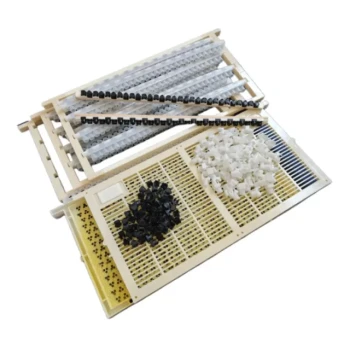
Professional queen rearing and colony splitting tools eliminate hive vacancy by fundamentally shifting operations from passive reliance on nature to proactive, controllable management. Rather than waiting to catch wild swarms—a method fraught with uncertainty—these tools allow beekeepers to artificially propagate queens and scientifically split existing colonies to fill empty equipment on demand. This methodology transforms hive occupancy from a variable dependent on luck into a predictable, scalable production metric.
The transition to specialized rearing and splitting tools transforms hive occupancy from a game of chance into a calculated engineering process. By enabling artificial propagation and standardized management, these tools provide the technical foundation required to achieve economies of scale and maximize yield per unit area.
Moving Beyond Passive Reliance
The Shift to Proactive Breeding
Traditional apiary expansion often relies on catching natural swarms. This is a passive strategy that leads to unpredictable vacancy rates and fluctuating production capacity.
Professional rearing tools empower you to breed queens artificially. This ensures you have the biological "keys" necessary to start new colonies whenever resources allow, rather than when nature dictates.
Scientific Colony Splitting
To fill vacant hives efficiently, commercial operations utilize scientific colony splitting. This involves dividing strong, established colonies into multiple smaller units.
Specialized tools are required to execute this without damaging the brood or the queen. By splitting colonies systematically, you can rapidly multiply your hive count and ensure that empty boxes are occupied immediately.
The Role of Standardization in Scaling
Supporting Rapid Expansion
Splitting colonies to reduce vacancy requires a steady supply of high-quality hardware. This includes boxes, frames, foundation, and inner covers.
Industrial-grade hive-making machinery ensures these components are produced with high precision and standardization. This universality allows you to establish newly split colonies quickly without worrying about equipment compatibility or structural failures.
Reducing Management Friction
When you are managing hundreds of colonies to combat vacancy rates, efficiency is paramount. Standardized equipment, produced by professional machinery, ensures interchangeability across different apiary sites.
This optimization reduces the labor cost per unit. It allows your team to focus on biological management rather than struggling with mismatched or poor-quality gear.
Mitigating Colony Loss
Creating a Controlled Environment
Vacancy often results from colony collapse or high annual losses. Specialized tools help prevent this by reducing physical disturbance during management.
By using precise equipment, you minimize stress on the bees. This preserves their biological activity and natural enzyme levels, helping them withstand ecological pressures like drought or climate fluctuations.
Hygiene and Disease Prevention
Keeping hives full requires keeping bees alive. Professional tools function alongside sanitary and disease prevention equipment to maintain a controlled breeding environment.
High-quality housing standards, achieved through precise manufacturing, support better hygiene management. This helps protect the colony from pests and diseases that would otherwise lead to empty hives.
Understanding the Trade-offs
Technical Complexity
Moving from swarm catching to queen rearing increases the technical skill required. You must understand the biological lifecycle of the queen and precise timing for splitting.
Failure to execute these techniques correctly can lead to weak splits that fail to thrive, effectively increasing your labor without solving the vacancy issue.
Capital Investment
While passive swarm catching is low-cost, professional rearing and splitting require upfront capital. This includes investment in specific tools, and potentially, hive-making machinery.
You must view this as a long-term investment in stability. The ROI comes from the consistency of production and the ability to scale, not from immediate cost savings.
Making the Strategic Choice for Your Apiary
Adopting these tools is about choosing control over chance. To effectively address hive vacancy, align your tool selection with your specific operational goals.
- If your primary focus is rapid scaling: Prioritize industrial-grade hive-making machinery to ensure your hardware supply never bottlenecks your biological expansion.
- If your primary focus is yield per unit area: Invest in precision queen rearing tools to ensure every hive is occupied by high-performance genetics that maximize nectar collection.
Mastery of these tools is the defining factor that separates hobbyist uncertainty from the reliable, scalable output of a commercial enterprise.
Summary Table:
| Feature | Traditional (Passive) Approach | Professional (Proactive) Approach |
|---|---|---|
| Colony Source | Catching wild swarms (unpredictable) | Artificial propagation & scientific splits |
| Equipment | Manual/Variable hardware | Standardized, industrial-grade components |
| Vacancy Rate | High & dependent on nature | Low & controlled by management |
| Scalability | Slow and limited | Rapid and industrially scalable |
| Management | Reactive to hive loss | Preventive through precision hygiene |
Eliminate Hive Vacancy and Scale Your Operation with HONESTBEE
Moving from reactive beekeeping to a scalable commercial enterprise requires more than just bees—it requires industrial-grade precision. HONESTBEE empowers commercial apiaries and distributors with a comprehensive suite of professional tools and machinery designed to maximize your yield and operational efficiency.
Our Value to Your Business:
- Precision Machinery: From hive-making to honey-filling machines, we provide the hardware needed for standardized, high-volume production.
- Total Supply Chain: Access a full spectrum of beekeeping tools, essential industry consumables, and honey-themed cultural merchandise.
- Scalable Solutions: We cater specifically to the needs of large-scale operations, ensuring your equipment never bottlenecks your growth.
Ready to transform your apiary's productivity? Contact HONESTBEE today to explore our wholesale offerings and professional-grade equipment.
References
- Nicholaus Bhikolimana Tutuba, Wim Vanhaverbeke. Beekeeping in Tanzania: why is beekeeping not commercially viable in Mvomero?. DOI: 10.21825/af.v31i1.9047
This article is also based on technical information from HonestBee Knowledge Base .
Related Products
- Retractable Chinese Queen Rearing Grafting Tools Equipment
- Plastic Chinese Queen Grafting Tool for Bee Queen Rearing
- Stainless Steel Queen Grafting Tool for Beekeeping and Bee Queen Grafting
- Stainless Steel Beekeeping Queen Grafting Tool for Honey Bee Rearing
- Plastic Beekeeping Honey Bee Larvae Grafting Tools for Queen Rearing and Chinese Grafting
People Also Ask
- Which specialized tools are necessary for implementing standardized queen rearing? Scale Your High-Yield Apiary
- Why are specialized queen rearing tools necessary to mitigate winter hive losses? Boost Apiary Survival and Recovery
- How do queen-rearing tools facilitate the sustainability and expansion of a commercial apiary? Drive Scalable Growth
- In what ways do modern queen rearing equipment and grafting tools improve competitiveness? Boost Breeding Success Rate
- What role do specialized queen rearing tools and consumables play in modern large-scale apiculture? Drive Production & Scale