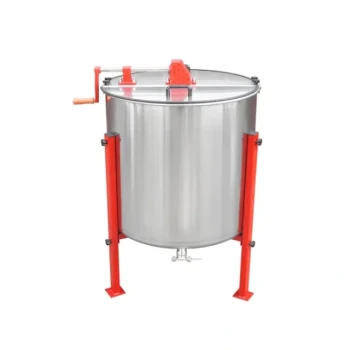
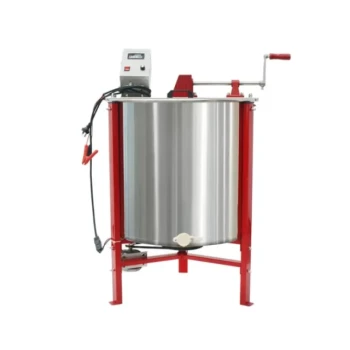
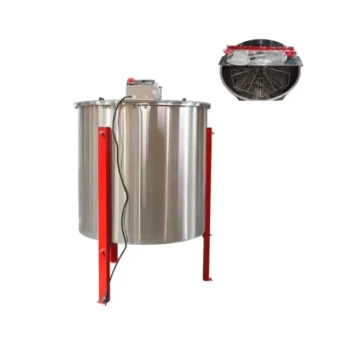
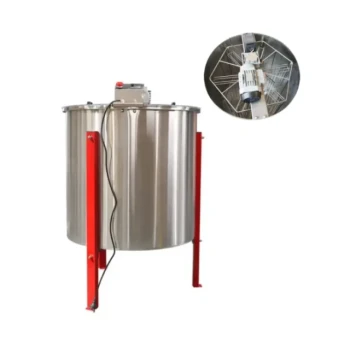
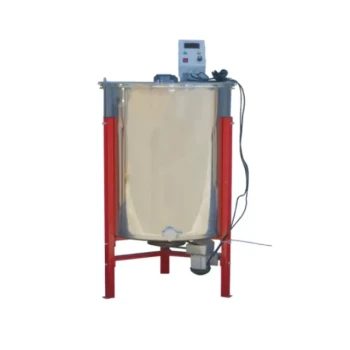
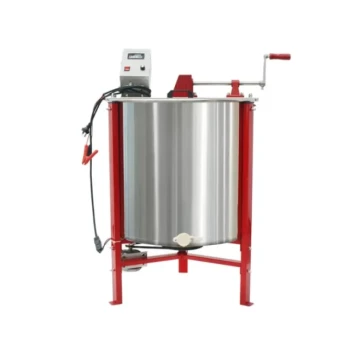
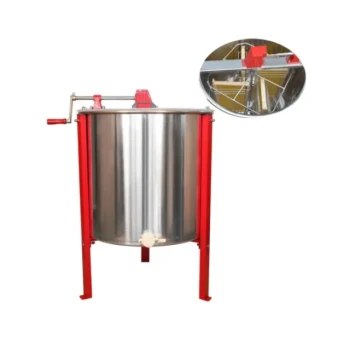
Radial honey extractors function by utilizing centrifugal force to pull honey from the comb while the frames are arranged in a "spoke-like" configuration. In this design, the top bars of the frames face the outer wall of the drum, allowing honey to be extracted from both sides of the comb simultaneously without the need to stop and flip the frames.
Core Takeaway The definitive advantage of a radial extractor is the elimination of mid-cycle frame handling. By positioning frames like the spokes of a wheel, the machine processes both sides of the honeycomb at once, significantly reducing labor and processing time for beekeepers managing larger apiaries.
The Mechanics of Radial Extraction
The "Spoke" Configuration
Unlike tangential extractors where the comb face runs parallel to the drum wall, radial extractors arrange frames vertically, radiating outward from a central axis. This setup mimics the spokes of a bicycle wheel.
Orientation of the Frames
Crucially, the frames are positioned so that the top bar faces the extractor's outer wall. This places the frame perpendicular to the wall rather than flat against it.
Simultaneous Extraction
As the basket spins, centrifugal force draws the honey out of the slightly upward-angled cells. Because the force acts longitudinally along the frame, honey flows out from both sides of the comb at the same time.
Primary Operational Advantages
Significant Time Savings
The most distinct benefit of the radial design is workflow efficiency. Operators do not need to stop the machine, pull the frames out, reverse them, and spin them again to empty the second side.
Increased Capacity and Throughput
Radial extractors are generally designed to handle higher volumes, with typical capacities ranging from 6 to 20 frames. This makes them the preferred choice for beekeepers processing a significant number of hives.
Preservation of Equipment
Like other centrifugal extractors, the radial method removes honey without damaging the structural integrity of the wax combs. This allows empty combs to be reused immediately, saving the bees the energy cost of rebuilding wax and shortening the turnaround for the next honey crop.
Understanding the Trade-offs
Mechanical Complexity vs. Speed
While radial extractors are faster overall due to the "single-spin" process, the physics involved require precise engineering. The frames must be oriented perfectly for the centrifugal force to effectively clear the angled cells of the honeycomb.
The Tangential Comparison
It is important to understand the alternative to appreciate the radial advantage. Tangential extractors (common for small-scale hobbyists) face the comb outward; this extracts one side very quickly but requires the user to manually flip every frame to harvest the other side.
Power and Automation Options
Manual Operation
Radial extractors are available with manual hand-cranks. These are suitable for mid-sized operations where the efficiency of not flipping frames is desired, but the budget does not allow for a motor.
Motorized Efficiency
Motorized models provide consistent spinning speeds and true automation. This frees the beekeeper to perform other critical tasks, such as uncapping the next batch of frames, while the machine runs its cycle.
Making the Right Choice for Your Goal
- If your primary focus is high-volume efficiency: Choose a motorized radial extractor to maximize throughput and utilize the time savings for uncapping and bottling.
- If your primary focus is budget but you hate flipping frames: A manual radial extractor offers the mechanical advantage of simultaneous extraction without the cost of an electric motor.
- If your primary focus is small-scale hobby harvesting: Recognize that while radial is more efficient, a smaller tangential extractor may be sufficient if you only process a few frames per year.
Radial extractors represent the logical upgrade for any beekeeper looking to move from hobbyist tinkering to efficient, volume-focused production.
Summary Table:
| Feature | Radial Honey Extractor | Tangential Honey Extractor |
|---|---|---|
| Frame Orientation | Vertical, radiating like spokes | Flat, parallel to the drum wall |
| Extraction Method | Both sides simultaneously | One side at a time |
| Manual Labor | Minimal; no need to flip frames | High; frames must be flipped |
| Typical Capacity | High (6 to 100+ frames) | Low (2 to 4 frames) |
| Ideal User | Commercial apiaries & distributors | Small-scale hobbyists |
Maximize Your Honey Production with HONESTBEE
Efficiency is the backbone of a profitable apiary. At HONESTBEE, we empower commercial beekeepers and global distributors with high-performance radial honey extractors and automated machinery designed to minimize labor and maximize yield.
Our comprehensive wholesale catalog includes:
- Advanced Machinery: From high-capacity radial extractors to honey-filling and hive-making machines.
- Essential Tools: A full spectrum of professional beekeeping equipment and hardware.
- Industry Consumables: Everything your operation needs to maintain health and productivity.
Ready to scale your operation with specialized hardware and expert support? Contact us today to discuss our wholesale offerings and how we can strengthen your beekeeping business.
Related Products
- 24 Frame Honey Extractor Commercial Radial Honey Frame Extraction Machine
- Stainless Steel Manual 8 Frame Radial Honey Extractor Machine for Beehives
- 6 Frame Manual Stainless Steel Honey Extractor Beekeeping Equipment
- HONESTBEE 8 Frame Electric and Manual Three Use Honey Extractor
- Electric 4 Frame Tangential Honey Extractor
People Also Ask
- How does a radial honey extractor leverage the natural structure of a honeycomb? Optimize Your Apiary's Efficiency
- How do modern honey extraction machines improve harvest efficiency? Boost Your Yield with Radial Technology
- Why must the head of the honey comb be placed near the center axis? Protect Your Comb During Radial Extraction
- Why is the width of iron rings varied for radial honey extractor tilt? Optimize Your Harvest with Precise Engineering
- What are the operational differences between radial and tangential honey extractors? Maximize Your Harvest Efficiency