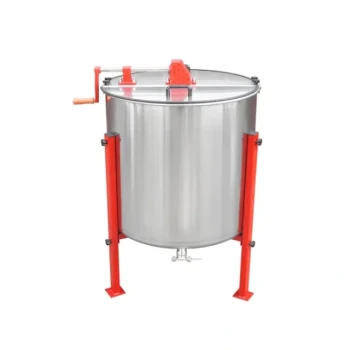
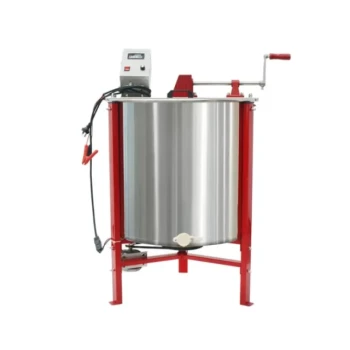
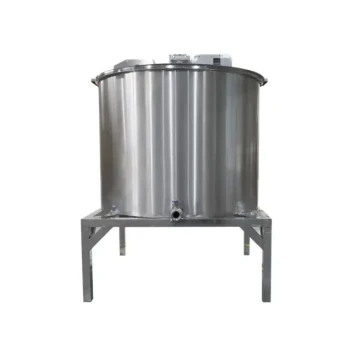
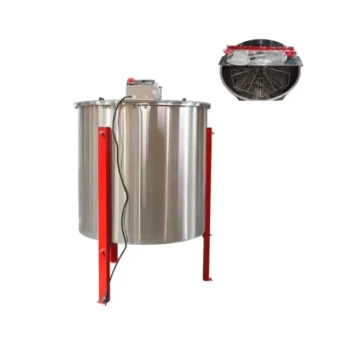
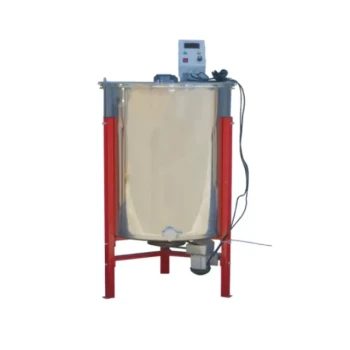
Radial honey extractors work by utilizing specific geometric alignment to empty honeycomb cells efficiently. By positioning the frames like the spokes of a wheel—with the top bars facing the outer wall—the machine uses centrifugal force to eject honey from both sides of the comb simultaneously. This design eliminates the manual labor of stopping the machine to flip the frames.
The Core Insight: The efficiency of a radial extractor lies in how it aligns with the natural architecture of the honeycomb. By positioning frames perpendicular to the drum's wall, the centrifugal force works in parallel with the natural upward slope of the comb cells, allowing honey to flow freely from both sides at once.
The Mechanics of Radial Extraction
The "Spoke" Configuration
In a radial extractor, the basket is engineered to hold frames vertically, radiating outward from the central axis.
Crucially, the top bar of the frame faces the outer wall of the drum. This places the frame perpendicular to the extractor's wall, rather than having the face of the comb looking directly at it.
Leveraging Natural Geometry
This orientation is not arbitrary; it is designed to exploit the natural engineering of the honeybee.
Bees construct honeycomb cells with a slight upward slope of 10 to 14 degrees from the center rib. This slope prevents nectar from spilling out of the hive naturally.
The Force Vector
When the extractor spins, centrifugal force pushes contents away from the center.
Because the frames are oriented radially, this force aligns perfectly with the angle of the cells. The honey moves up the natural slope of the cell and out the top, rather than being forced against the cell walls.
Operational Efficiency
Simultaneous Extraction
The primary operational advantage of this design is the ability to extract both sides of the frame at the same time.
Because the force pulls outwards from the center axis, it draws honey from the cells on both the left and right sides of the frame simultaneously.
Elimination of Manual Steps
This contrasts sharply with other methods that require the operator to stop the machine halfway through.
In a radial system, once the frames are loaded and the machine is activated, the cycle runs to completion without interruption. This reduces the total time and energy required for harvest.
Understanding the Trade-offs
Radial vs. Tangential Designs
To understand the value of a radial extractor, you must compare it to the tangential extractor, which is the most common type for small-scale hobbyists.
In a tangential design, the face of the honeycomb looks directly at the wall. While effective, this only extracts honey from the outward-facing side. To finish the job, the user must stop the machine, remove the frame, flip it, and spin it again.
Volume and Scale
Because they eliminate the "flip" step and utilize space efficiently, radial extractors are generally preferred for larger operations.
They are available in manual or electric models with capacities ranging significantly, often handling between 2 to 72 frames in a single batch. This makes them the standard choice for commercial beekeepers prioritizing speed and volume.
Making the Right Choice for Your Goal
If you are evaluating extractors based on your operational needs, consider these factors:
- If your primary focus is speed and efficiency: Choose a radial extractor, as the simultaneous extraction of both sides significantly reduces processing time.
- If your primary focus is high-volume processing: Opt for a large electric radial model, which leverages this geometry to handle dozens of frames without manual intervention.
- If your primary focus is understanding the physics: Remember that radial extraction depends on the 10-14 degree cell slope; if the comb structure is irregular, efficiency may vary.
The radial extractor is ultimately defined by its ability to work with the honeycomb's natural structure rather than fighting against it.
Summary Table:
| Feature | Radial Extractor | Tangential Extractor |
|---|---|---|
| Frame Orientation | Perpendicular to wall (Spoke-like) | Parallel to wall (Facing wall) |
| Extraction Method | Both sides simultaneously | One side at a time |
| Manual Labor | Low (No flipping required) | High (Requires frame flipping) |
| Best Suited For | Commercial & Large-scale | Small-scale & Hobbyists |
| Volume Capacity | High (Up to 72+ frames) | Low (Typically 2-4 frames) |
Maximize Your Honey Yield with HONESTBEE
Elevate your commercial apiary or distribution business with high-performance extraction technology. HONESTBEE specializes in professional-grade beekeeping tools and machinery designed for efficiency and scale.
From high-capacity electric radial extractors and honey-filling machines to specialized hive-making hardware and essential consumables, we provide everything needed to streamline your operations. Let us help you optimize your harvest with equipment built for the industry’s highest standards.
Ready to scale your production? Contact our wholesale experts today to discover how HONESTBEE can power your success.
Related Products
- 24 Frame Honey Extractor Commercial Radial Honey Frame Extraction Machine
- Stainless Steel Manual 8 Frame Radial Honey Extractor Machine for Beehives
- 6 Frame Manual Stainless Steel Honey Extractor Beekeeping Equipment
- HONESTBEE 8 Frame Electric and Manual Three Use Honey Extractor
- Electric 4 Frame Tangential Honey Extractor
People Also Ask
- How does a radial honey extractor leverage the natural structure of a honeycomb? Optimize Your Apiary's Efficiency
- How do modern honey extraction machines improve harvest efficiency? Boost Your Yield with Radial Technology
- Why must the head of the honey comb be placed near the center axis? Protect Your Comb During Radial Extraction
- Why is the width of iron rings varied for radial honey extractor tilt? Optimize Your Harvest with Precise Engineering
- What are the operational differences between radial and tangential honey extractors? Maximize Your Harvest Efficiency